Benchmarking v5 Droplets: what the numbers say across real workloads

By Debabrata Subudhiray
- Published:
- 4 min read
We ran v5 (5th Gen AMD EPYC “Turin”) compared to our existing Dedicated Premium Droplets across a range of workloads: a realistic microservices application, raw CPU, memory, and database transactions. We measured throughput and latency for each. Throughout, we compare v5 against Dedicated Premium on the same storage type (network-attached Block Storage Volumes on both), so the comparison focuses on performance improvements in the compute platform.
General-purpose microservices: v5 handles more, with room to spare
Most real applications aren’t a single tight loop; they’re a mesh of services calling each other, where one user request fans out across front-ends, business logic, caches, and databases. This is the workload that best predicts how v5 behaves for a typical web app, API backend, or agent platform, so it’s the one we care about most.
To test a realistic web application, we used DeathStarBench, an open-source microservices benchmark. We ran its Media Service application: a movie-review site built from 79 containers, including an nginx front end, a set of microservices, and MongoDB, memcached and Redis. Each request writes a new movie review, so it passes through several services (user lookup, movie lookup, text, rating and review storage) before a response comes back. We used to send a steady rate of requests and measured how quickly the app responded and how much CPU it used.
v5 sustained 1,500 requests per second reliably, against 1,000 for Dedicated Premium: up to 50% more load at the same size. At 1,000 requests per second, v5 also responded in half the time (2.24 ms vs. 4.48 ms median) and used less CPU (38% vs. 46% for Dedicated Premium).
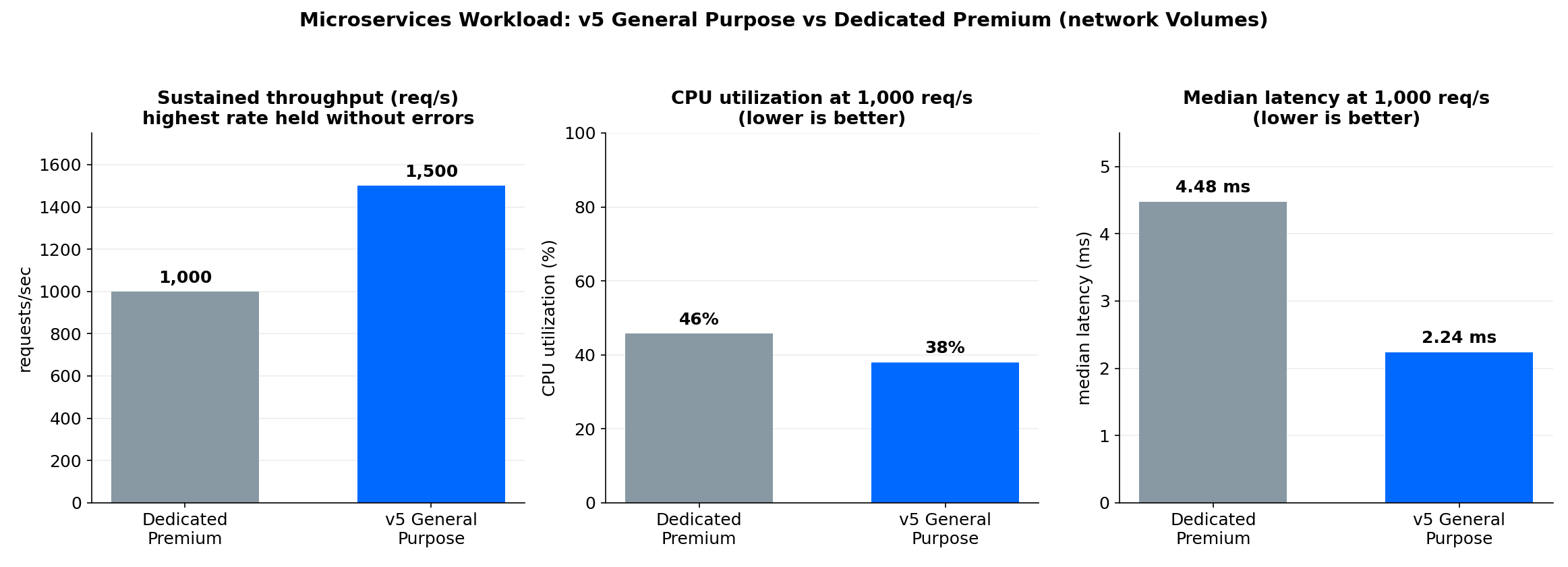
The takeaway: for web apps, APIs and agent platforms, each v5 Droplet handles more requests and responds faster, so you can serve the same load with fewer Droplets
CPU-bound work: v5 pulls clearly ahead
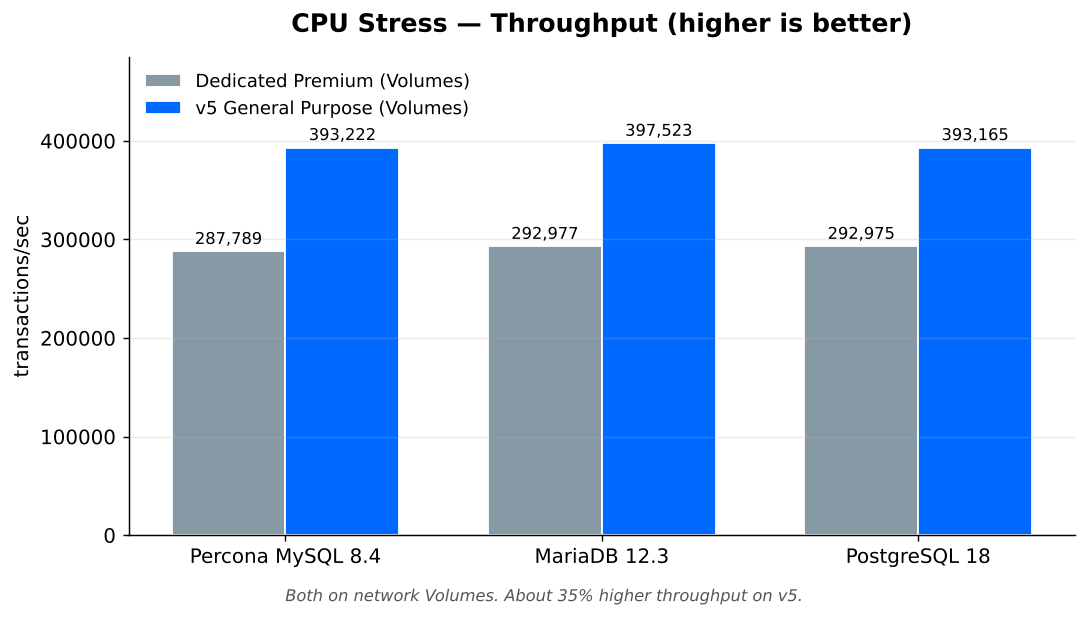
We tested three popular databases, PostgreSQL 18, Percona MySQL 8.4 and MariaDB 12.3, using sysbench. This CPU stress test sends a constant stream of small, simple queries against data already in memory, so the database never waits on disk and performance depends entirely on how fast the processor runs. v5 delivered about 393,000–398,000 transactions per second, against about 287,000–293,000 for Dedicated Premium, a consistent lead of about 35% on all three databases.
Memory-bound work: the largest gains
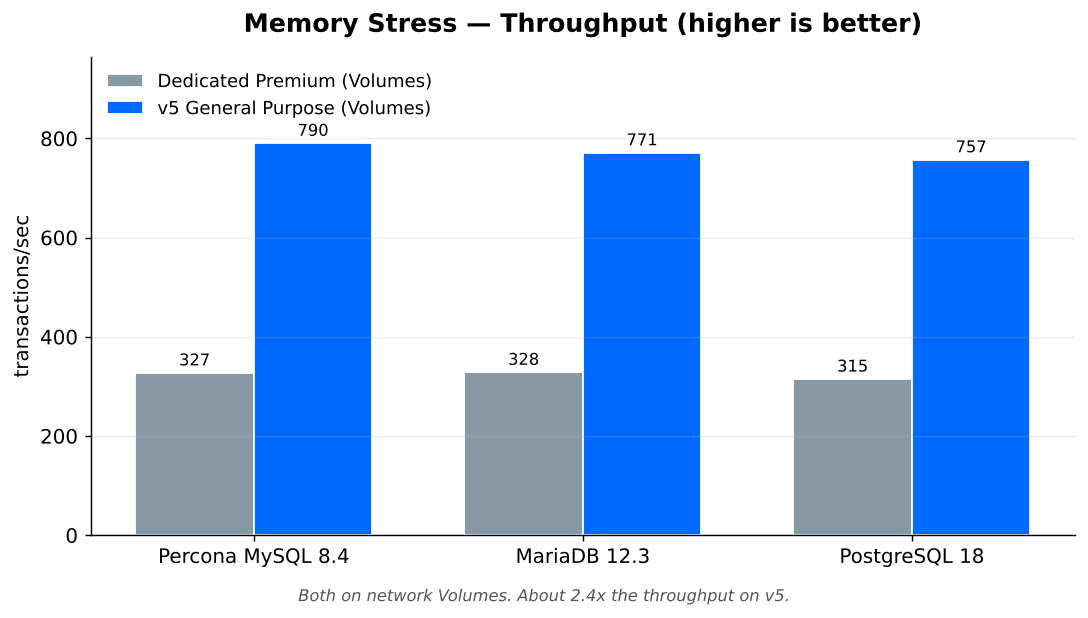
Memory stress showed the biggest jump. Across all three databases, v5 delivered roughly 757–790 transactions/sec versus ~315–329 for Dedicated Premium — more than 2x the throughput — while median latency more than halved. Memory-sensitive applications are likely to see the largest benefit.
General OLTP: v5 leads across all the three databases we tested
General OLTP is the most database-representative test — a balanced, read-skewed transactional workload like a typical production database.On the same network Volumes, v5 delivered more transactions per second than Dedicated Premium on all three databases we tested: PostgreSQL ~55% higher (6,911 vs 4,462), Percona MySQL ~24% higher (5,750 vs 4,650), and MariaDB ~17% higher (6,153 vs 5,258). Average latency was also lower on all three: 6.94 vs 10.76 ms on PostgreSQL, 8.35 vs 10.32 ms on Percona MySQL, and 7.80 vs 9.13 ms on MariaDB
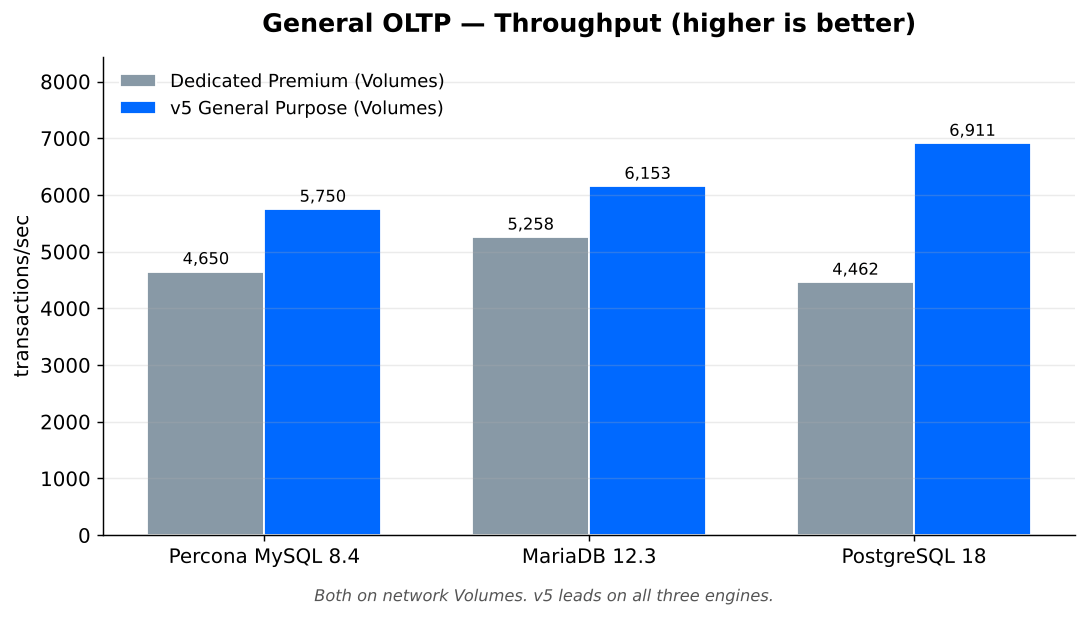
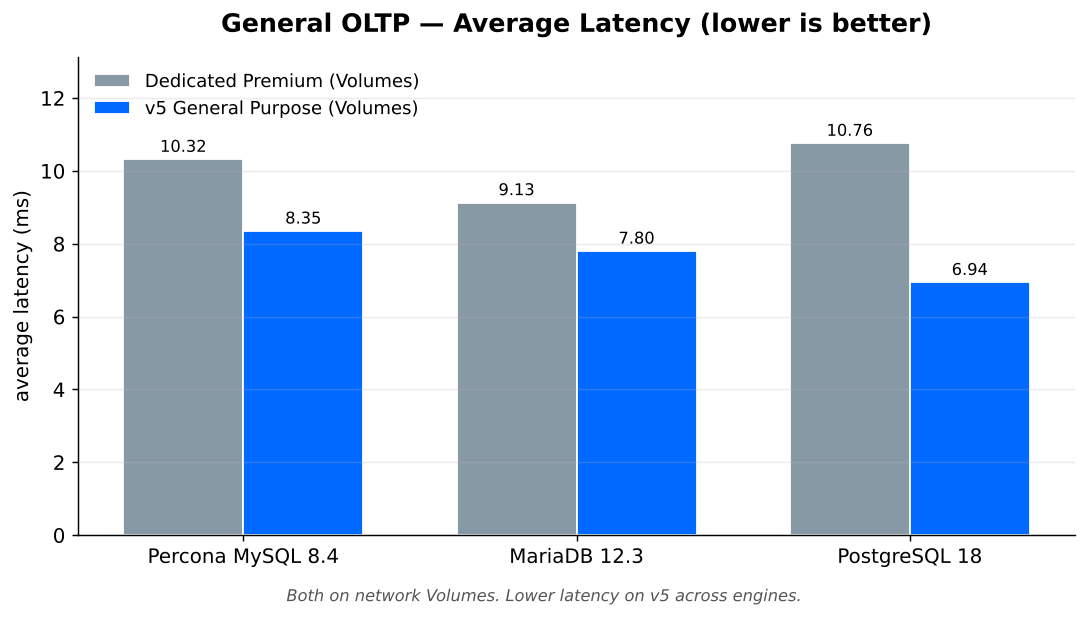
On all three databases we tested, v5 delivered more transactions per second and lower average latency than Dedicated Premium on the same storage.
What this means for you
-
General-purpose, request-driven apps (web apps, APIs, agent platforms, microservices):. v5 handles higher load while keeping response times low, so you can serve more requests per Droplet before you need to scale out.
-
Compute-bound and memory-bound workloads: a clear, substantial upgrade — ~35% more CPU throughput and more than 2x on memory-bound work.
-
Transactional databases (OLTP): v5 leads on every engine tested — Percona MySQL, MariaDB, and PostgreSQL — with higher throughput and lower latency.
The direction is clear: across general-purpose, compute, memory, and transactional-database workloads, v5 outperformed Dedicated Premium in every workload we tested. Create a v5 Droplet and see how your own workload behaves — the only benchmark that ultimately matters is yours.
Methodology: Throughput is measured in transactions/sec (requests/sec for the microservices workload) and latency in milliseconds, across Percona MySQL 8.4, MariaDB 12.3, and PostgreSQL 18. v5 and Dedicated Premium are compared on the same network-attached Block Storage Volumes. Figures are from DigitalOcean’s internal benchmarking and reflect the specific engine configurations; your results will vary with workload, configuration, and data set.
AMD, EPYC and Turin are trademarks of Advanced Micro Devices, Inc. MySQL and Percona, MariaDB and PostgreSQL are trademarks of their respective owners. Use of these names does not imply affiliation or endorsement.
About the author

Related Articles

Build an On-Call Team of AI Agents on DigitalOcean MicroVMs
Kushal Walia
- November 18, 2026
- 18 min read
Building a computer that can pause and resume in milliseconds: Inside the MicroVM architecture behind Managed Agents
Braden Bassingthwaite
- October 15, 2026
- 20 min read
