By Adrien Payong and Shaoni Mukherjee
Introduction
Customer support is one of the most powerful use cases for AI agents. It involves repetitive questions, time pressure, information lookup, and the need for accurate answers. Millions of businesses get the same types of questions and requests each day. Where’s my order? I want a refund. Can’t access my account. How does this feature work? Is this compatible with…? How much does this cost? I’m not happy with this product.
In theory, a properly trained AI customer support agent could instantly respond to a large subset of these requests, reducing operational expenses and delighting your customers. However, not every customer request has the same level of complexity. Some requests are simple and low-risk. Others are more sensitive, ambiguous, or business-critical.
This poses a major challenge for businesses developing AI-driven support agents. While a fast and cheap model may be good enough for answering simple queries, it may cause the agent to stumble when a customer’s intent is unclear, the issue is emotionally sensitive, legally risky, or requires highly technical knowledge. On the other hand, using a more powerful model to process every message can be costly and introduce latency, which can be problematic as the volume of conversations grows. A better solution is to design a customer support agent with fallback routing.
This article explains how to build such a system. It covers the architecture of a support agent, the role of the router, how confidence-based fallback works, and how to define priority and cost constraints in the router configuration.
Key Takeaways
- Fallback routing balances speed, cost, and answer quality by sending routine questions to fast models and complex cases to stronger models.
- Confidence scoring is essential because the system needs clear thresholds to decide when the primary model’s answer is safe and complete enough to send.
- Priority classes improve business decision-making by giving higher-quality handling to sensitive, high-value, or escalated customer issues.
- Cost controls prevent overuse of expensive models by setting limits per message, per conversation, per customer tier, and across the whole platform.
- The best AI support agent is not just a chatbot; it is an intelligent workflow that combines routing, retrieval, evaluation, escalation, and human handoff when necessary.
What Is Fallback Routing?
Fallback routing is an AI orchestration pattern where a request is initially routed to a primary model (typically chosen for speed and cost considerations). The answer quality is then assessed. If the answer reaches established confidence, safety, and policy thresholds, it is returned to the customer. Otherwise, the request is routed to a stronger model, a specialist model, a human agent, or another workflow.
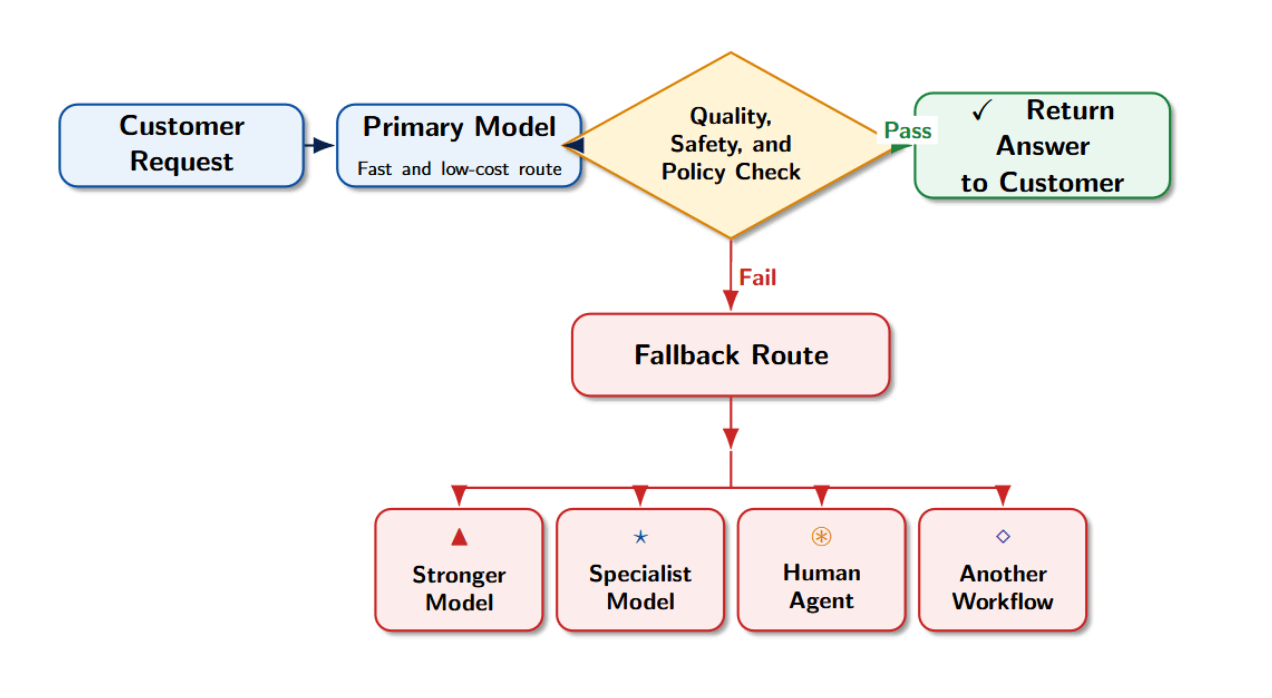
Fallback routing is useful for many customer support use cases because customer support workloads tend to be very imbalanced. A large percentage of tickets can be routed to a lightweight model because they’re completely repetitive. A smaller percentage of tickets need more advanced reasoning skills, better instruction-following, a more careful tone, or access to advanced tools. The fallback mechanism can be triggered by several signals:
- Low confidence score
- Missing or incomplete answer
- Customer frustration
- Sensitive topic
- High-value customer
- Complex technical issue
- Policy uncertainty
- Failed knowledge-base retrieval
- Contradictory information
- Repeated user dissatisfaction
The fallback router acts as the traffic controller of the AI support system. It decides which model should handle each request, when escalation is necessary, and how much cost the system is allowed to spend.
Core Architecture of a Real-Time Fallback Support Agent
A real-time customer support agent with fallback routing usually contains several components.
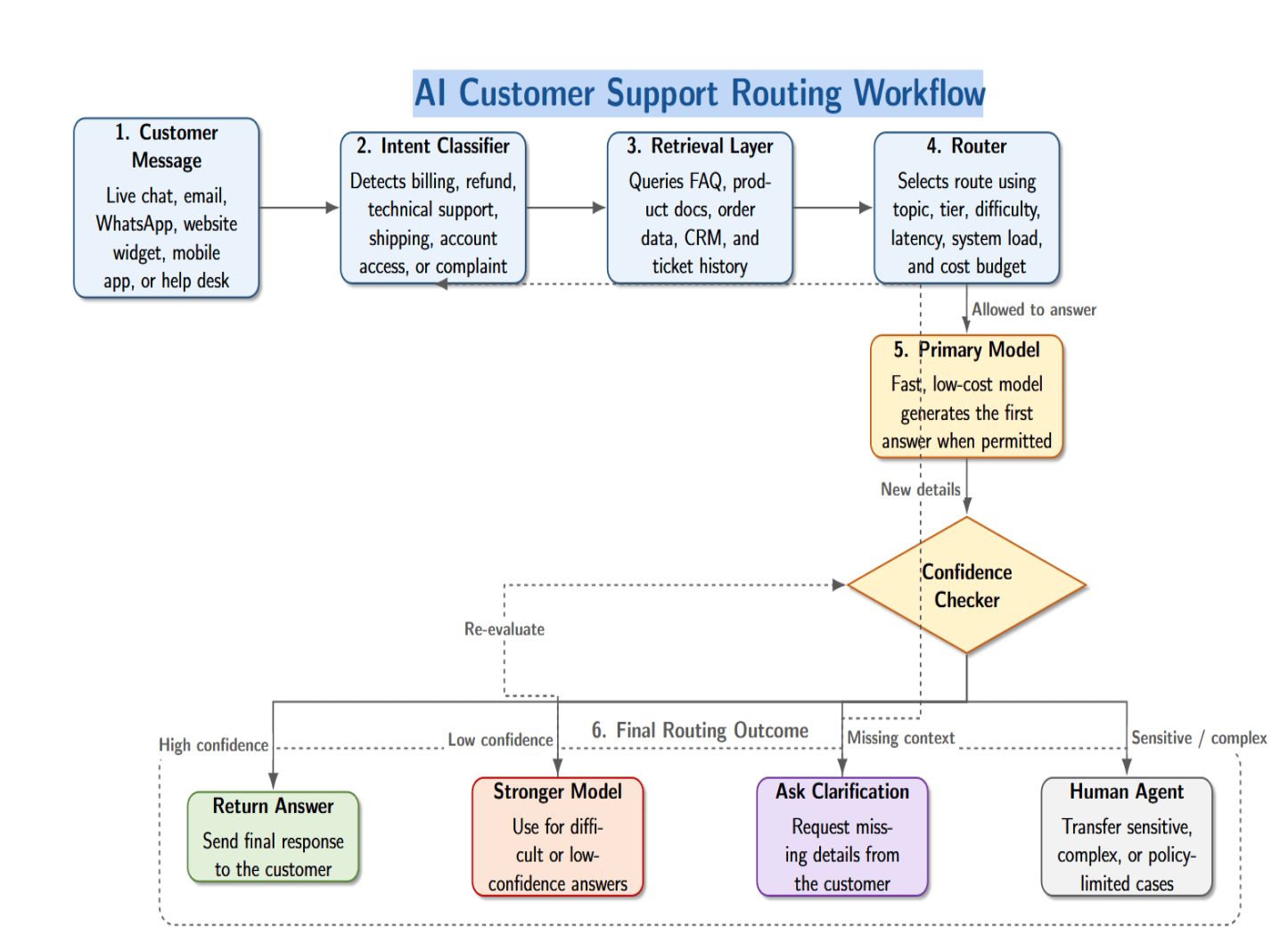
1. The customer inputs their message using some customer support channels, like live chat, email, WhatsApp, website chat widget, mobile app, help desk software, etc.
2. An intent classifier classifies what type of request this might be (i.e., billing, refund, technical support, shipping, account access, complaint, etc.)
3. A retrieval layer queries the appropriate company knowledge bases.
This could be an FAQ repository, product documentation, order database, CRM, or ticketing history. The model needs a reliable context before producing an answer.
4. The router inspects the request and decides which model should fulfill the request. Typically, the default or primary route points to the cheapest and fastest model. But the router might also inspect the customer tier, the requested topic (some topics might be sensitive and require a high-quality model), the expected difficulty of the answer, the current system load, the available latency budget, and the available cost budget.
5. If allowed to answer the request, the primary model generates its answer. This answer might then be evaluated by some confidence checker. Confidence could be assessed using confidence score thresholds, retrieval quality, policy compliance, detecting uncertainty language, answer completeness, customer sentiment, etc.
6. Finally, the system either returns the answer, escalates to a stronger model, asks the customer for clarification, or transfers the conversation to a human support agent.
Primary Route: Fast and Cheap Model
Primary model refers to the initial model the customer support agent uses. This model should be very fast, cheap to run, and of acceptable quality for answering routine queries. Use your primary model for tasks like:
- Answering FAQs.
- Summarizing simple policies
- Providing order tracking guidance
- Explaining basic account steps
- Gathering missing information
- Determining customer intent
- Drafting brief support reply
- Routing tickets appropriately
The primary model shouldn’t have to handle every situation. It should be able to confidently resolve most simple requests. Most customer support dialogues are straightforward tasks. They don’t need complex reasoning; they need correct retrieval, clear language, and quick responses.
If a customer asks, “How do I reset my password?” The primary model should be able to retrieve the password policy, generate a concise response, and close off the dialogue without escalation.
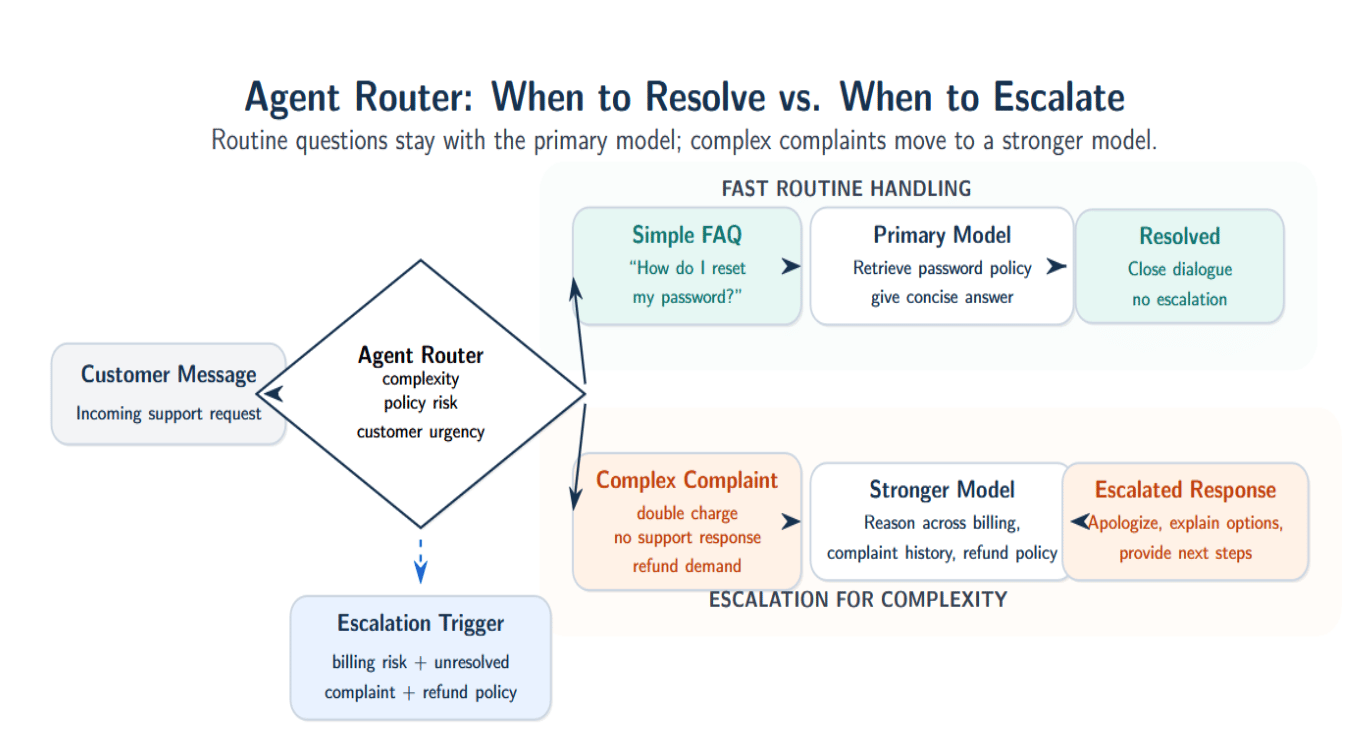
However, if a customer asks, “I was double-charged, customer support didn’t respond to me, and I want a refund now.” This inquiry touches on billing issues, complaint follow-ups, potential customer dissatisfaction, and the refund policy. An agent router can judge that the primary model is not equipped to handle this complexity and can escalate to a stronger model.
Fallback Route: Stronger Model for Low-Confidence Cases
The fallback model should be more capable, but often comes at the cost of being slower and/or more expensive. Enabling the fallback model allows for better reasoning, stronger instruction following capabilities, careful policy interpretation, and better handling of ambiguity. Fallback can be triggered after the primary model responds if that response does not pass the required confidence check. The fallback model can also be selected prior to generation if the router deems the case to be high priority or high risk.
Cases the fallback model can help with:
- Complex troubleshooting
- Cases requiring multi-step reasoning
- Customer refund disputes
- Contract or pricing interpretation
- Enterprise customer issues
- Angry/emotional customers
- Incomplete /Contradictory knowledge-base resultsé
- Cases involving compliance or legal sensitivity
- Situations where the primary model expresses uncertainty
The fallback process should not be noticeable by the customer. The user shouldn’t know that the system switched models. The conversation should flow as normal. There should be no indicator that a fallback system was used other than a better response.
A good fallback system can also work by passing the primary model’s draft answer to the stronger model. The stronger model can then edit, validate, or replace the draft answer. This allows less duplicated effort and helps the fallback model learn why its first response was inadequate.
Confidence Scoring in the Router
Confidence scoring is one of the most crucial components of fallback routing. The system needs to know when to trust the primary answer and when not to. Signals for scoring confidence can include:
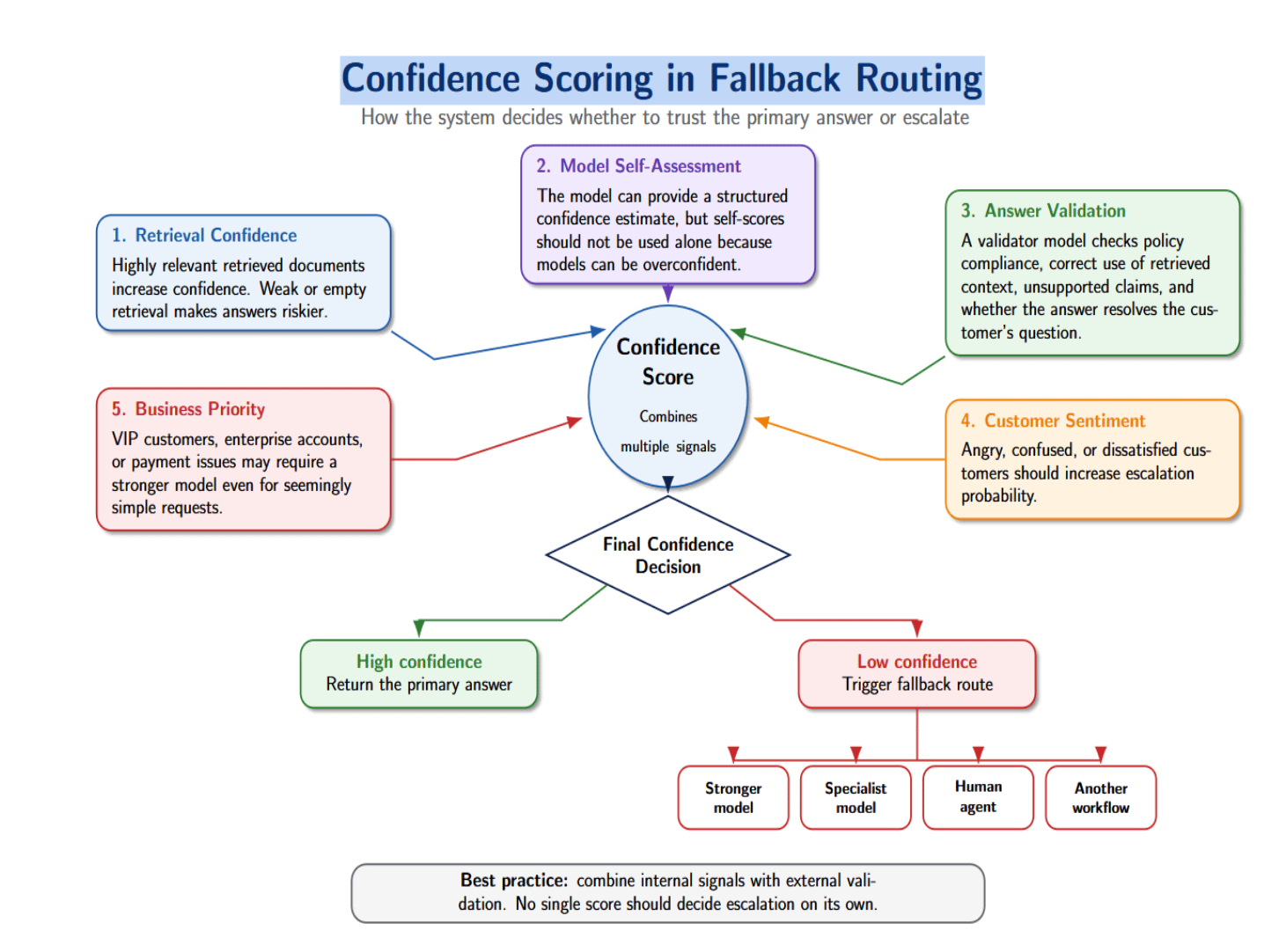
- Retrieval confidence. If our knowledge base search yielded highly relevant documents, the model is probably capable of answering correctly. If the retrieval step came up empty or returned weak documents, the answer will be less reliable.
- Model self-assessment. The model can be prompted to generate a structured confidence score along with the answer. Self-assessment scores shouldn’t be used on their own because language models are typically overconfident. They’re best used alongside external validation.
- Answer validation. Another model can act as a safety evaluator, scoring whether the answer follows company policy, uses retrieved context, makes no unsupported claims, and resolves the customer’s question.
- Customer sentiment. If the user sounds angry, confused, or dissatisfied, the system should raise the escalation probability.
- Business priority. Was this a VIP customer? Is this an enterprise account? Is this user having a payment issue? These factors can mean you need a “stronger” model than you would otherwise use for a seemingly simple request.
It’s possible to create a practical confidence score that considers each of these aspects before making a routing decision.
Let’s consider the following, for example:
confidence_policy:
 minimum_confidence: 0.78
 fallback_if:
   retrieval_score_below: 0.70
   answer_completeness_below: 0.75
   policy_risk_above: 0.40
   customer_sentiment: "angry"
   contains_sensitive_topic: true
In this configuration, the answer must pass several checks before being sent to the customer. If one or more checks fail, the system automatically uses the fallback route.
Defining Priority in the Router Config
Priority should define which requests get better models, faster responses, or human escalation. In a realistic support environment, not all tickets have equal business value. Taking a while to respond to a free user is probably okay, but sending a poor answer to an enterprise client can damage the business relationship. Router configuration should make priority classes obvious.
For example:
priority_classes:
 low:
   examples:
     - general_faq
     - product_information
     - password_reset
   primary_model: fast_support_model
   fallback_model: standard_reasoning_model
   max_latency_ms: 2500
   max_cost_per_request_usd: 0.01

 medium:
   examples:
     - billing_question
     - subscription_change
     - technical_issue
   primary_model: fast_support_model
   fallback_model: advanced_support_model
   max_latency_ms: 5000
   max_cost_per_request_usd: 0.05

 high:
   examples:
     - refund_dispute
     - escalated_customer
     - enterprise_account
     - legal_or_compliance_topic
   primary_model: advanced_support_model
   escalation_target: human_agent
   max_latency_ms: 8000
   max_cost_per_request_usd: 0.20
The configuration shows that low-priority questions are handled by a fast model with strict cost limits. Medium questions can escalate to a stronger fallback model. High-priority questions can afford to start with a stronger model and fall back to a human if necessary.
The goal is not simply to reduce AI cost. The goal is to spend intelligently. The router should invest more resources where the business risk is higher.
Handling Latency in Real Time
Real-time support requires low latency. Customers expect immediate responses, especially in live chat. Fallback routing can increase latency if not designed carefully because the system may call one model, evaluate the answer, and then call another model. To reduce delay, the router can use several strategies:
- Pre**-routing**: Instead of always trying the primary model first, the router can analyze the incoming requests and detect high-risk requests before generation. Then send only high-risk requests to the stronger model.
- Parallel evaluation: As the model generates its response, the router can already perform retrieval checks, policy checks, sentiment analysis, etc.
- Streaming: The support agent can begin with a short acknowledgment while the system completes deeper reasoning in the background of the same request flow. For example, the agent may say, “I’m checking your account details now,” before giving the final answer.
- Cache common responses: reuse approved responses for repeated FAQ-style questions.
- Clarification questions before escalating: If the customer’s question is ambiguous, instead of immediately sending it to an expensive model, the system can try asking ONE clarifying question.
Defining Cost Constraints
Cost Constraints allow you to keep your AI support system sustainable. Without cost constraints, fallback routing or escalation could trigger too often, eliminating your primary model savings. Cost Constraints should be applied at several levels:
- Per request to limit spending on an individual customer message.
- Per conversation to manage the overall expense of lengthy support threads.
- Per day/month to guard against unexpected usage spikes.
- Per customer tier, to allow higher spend for enterprise users than for free users.
A practical router configuration might look like this:
cost_controls:
 default:
   max_cost_per_message_usd: 0.02
   max_cost_per_conversation_usd: 0.15
   max_fallbacks_per_conversation: 2

 customer_tiers:
   free:
     max_cost_per_conversation_usd: 0.05
     allow_human_escalation: false
     fallback_mode: cheapest
   pro:
     max_cost_per_conversation_usd: 0.20
     allow_human_escalation: true
     fallback_mode: balanced
   enterprise:
     max_cost_per_conversation_usd: 1.00
     allow_human_escalation: true
     fallback_mode: quality_first
     prefer_advanced_model: true

 global_budget:
   daily_limit_usd: 500
   action_when_limit_reached: degrade_to_primary_model
   output_length_policy: shorten
   escalation_policy: restrict_to_high_priority
The cost_controls specify how the support platform spends AI credit per message and conversation, how it balances conversations, and the global daily budget. In this example, each message costs up to 2 cents, and each conversation costs up to $0.15. We allow two failed fallback attempts per conversation.
We’ve also configured tiered limits for free, pro, and enterprise users. Free users get the lowest conversation budget ($0.05), aren’t allowed to escalate to a human, and use the cheapest fallback mode. Pro users get a larger budget, can escalate to humans, and use balanced fallback mode. Enterprise users get the biggest budget and access to human escalation, quality-first routing, and preference for advanced models.
Finally, we put a daily budget on the entire platform. If we hit $500 in AI credit for the day, we stop using expensive features across the board. We’ll use only the primary model, shorten output, and disallow escalation except for high-priority cases.
Example End-to-End Scenario
Imagine a customer writes: “I paid for the Pro plan, but my account still shows Free. I’m really frustrated because I need this today.”
The intent classifier recognizes billing/account access as the primary topic. The sentiment detector recognizes the comment as negative, specifically, frustration. The customer tier is currently Free, but the message mentions a Pro payment. The retrieval system finds help articles about billing troubleshooting.
The router sees that this is not a simple FAQ. This is likely a billing issue with explicit annoyance and potentially a failed payment. Since the policy allows one attempt for a medium-priority billing issue, the request is routed to the primary fast model.
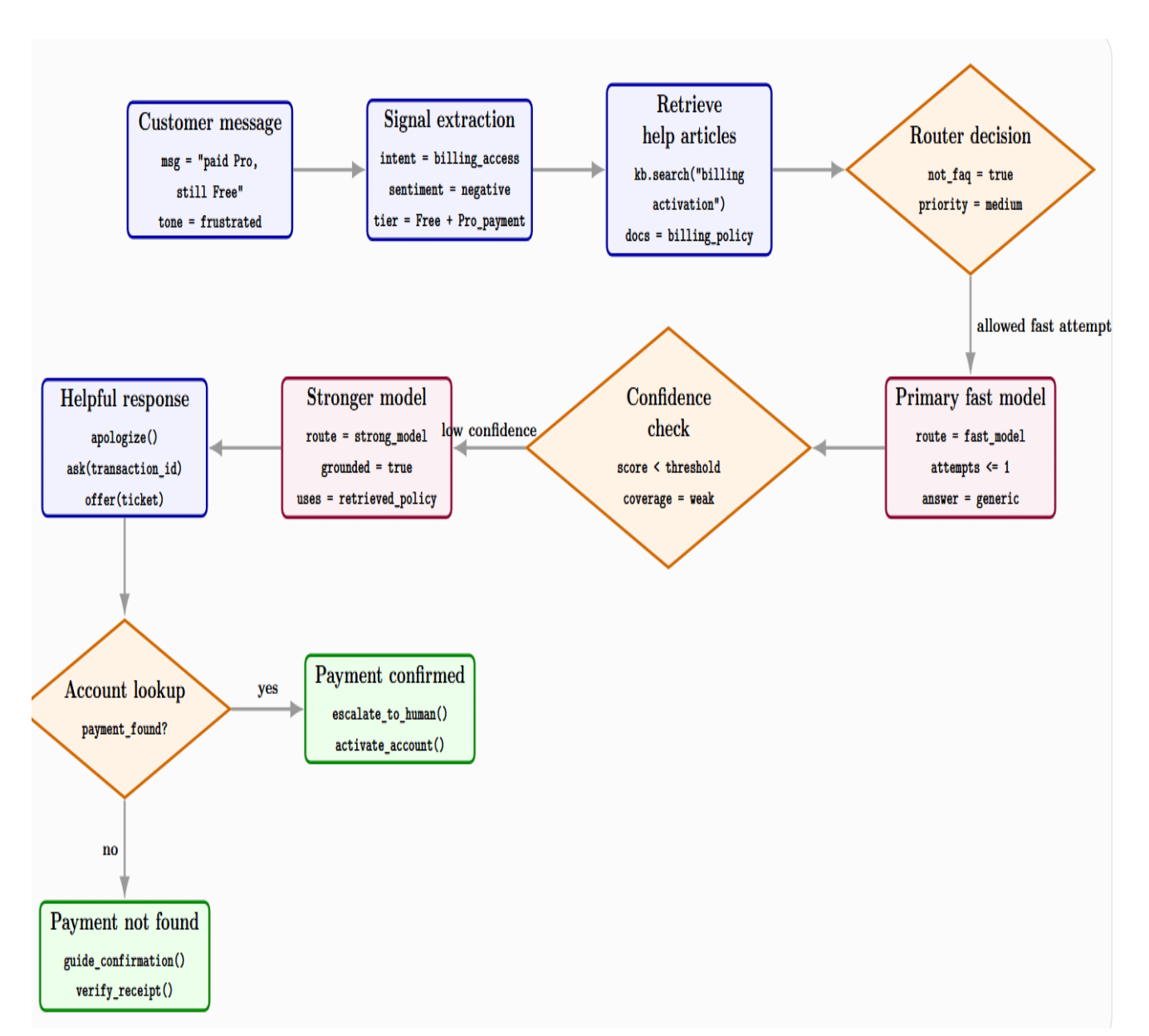
The primary model generates an answer, but the confidence checker shows that it is overly generic and doesn’t explain what the user can do when their payment goes through, but account activation doesn’t occur. The confidence score is below the threshold.
The router escalates to the stronger model. The stronger model takes the retrieved policy into account and produces a far more helpful answer. The model apologizes, explains likely causes, asks for the transaction ID if necessary, and offers to open a support ticket for manual verification.
If the account lookup tool confirms the payment, this can automatically be escalated to a human billing agent to process activation. If payment is not found, the agent can guide the customer through confirmation steps.
FAQ
- What is fallback routing in AI customer support?
Fallback routing is an AI orchestration method where a request first goes to a fast, low-cost model and is escalated to a stronger model or human agent when confidence, safety, or policy checks fail.
- Why not send every customer request to the strongest model?
Using the strongest model for every request improves quality but increases cost and latency. Fallback routing helps reserve expensive models for complex, sensitive, or high-risk cases.
- When should a support request fall back to a stronger model?
Fallback should occur when the primary model shows low confidence, gives an incomplete answer, detects customer frustration, faces policy uncertainty, or handles sensitive topics such as billing, refunds, legal issues, or enterprise accounts.
- How does the router decide which model to use?
The router evaluates factors such as customer intent, retrieval quality, confidence score, customer sentiment, business priority, latency budget, and cost constraints.
- Can fallback routing reduce customer support costs?
Yes. It allows simple requests to be handled by cheaper models while reserving stronger models or human agents for cases where quality and risk management matter most.
Conclusion
Fallback routing enables AI customer support to be practical, reliable, and cost-effective. Rather than routing all requests through the highest-cost model or relying only on the cheapest model, fallback routing routes intelligently based on confidence, risk thresholds, case complexity, customer priority, and other business rules. Simple requests can be routed immediately to a lightweight model for fast response times. High-risk, complex, low-confidence requests can be routed to a stronger model or human agent. This approach enables organizations to enhance response quality, lower operating costs, protect customer trust, and responsibly scale AI customer support.
References
- FrugalGPT: How to Use Large Language Models While Reducing Cost and Improving Performance
- Doing More with Less: Implementing Routing Strategies in Large Language Model-Based Systems
- Dynamic Model Routing and Cascading for Efficient LLM Serving
- Cluster, Route, Escalate: Cascaded Framework for Cost-Aware LLM Serving
- OpenAI API: Orchestration and Handoffs
Thanks for learning with the DigitalOcean Community. Check out our offerings for compute, storage, networking, and managed databases.
About the author(s)
I am a skilled AI consultant and technical writer with over four years of experience. I have a master’s degree in AI and have written innovative articles that provide developers and researchers with actionable insights. As a thought leader, I specialize in simplifying complex AI concepts through practical content, positioning myself as a trusted voice in the tech community.
With a strong background in data science and over six years of experience, I am passionate about creating in-depth content on technologies. Currently focused on AI, machine learning, and GPU computing, working on topics ranging from deep learning frameworks to optimizing GPU-based workloads.
Still looking for an answer?
This textbox defaults to using Markdown to format your answer.
You can type !ref in this text area to quickly search our full set of tutorials, documentation & marketplace offerings and insert the link!
 This work is licensed under a Creative Commons Attribution-NonCommercial- ShareAlike 4.0 International License.
Become a contributor for community
Get paid to write technical tutorials and select a tech-focused charity to receive a matching donation.

DigitalOcean Documentation
Full documentation for every DigitalOcean product.

Resources for startups and AI-native businesses
The Wave has everything you need to know about building a business, from raising funding to marketing your product.
The developer cloud
Scale up as you grow — whether you're running one virtual machine or ten thousand.

Start building today
From GPU-powered inference and Kubernetes to managed databases and storage, get everything you need to build, scale, and deploy intelligent applications.