

By Adrien Payong and Shaoni Mukherjee

Large language models don’t learn directly from plain text. They require a tokenizer, an algorithm that breaks text into manageable units. The choice of tokenizer influences everything else: Vocabulary size, training speed, memory usage, and ultimately model performance. Developers will often use off‑the‑shelf tokenizers without considering whether they are suitable for their domain or language, or they dive into training on their own without understanding the implications. This article bridges that gap. We’ll cover the basics of how tokenization works, explain popular methods like Byte‑Pair Encoding and SentencePiece, and point you in the right direction for either reusing a pretrained tokenizer or training your own from scratch.
Key TakeAways
- Tokenization is foundational to LLM performance. It also defines how raw text is segmented into tokens and converted into token IDs. This impacts memory consumption, training speed, effective context size, and cost of inference.
- BPE and SentencePiece are two major subword tokenization approaches, but they differ in flexibility. The benefit of BPE is its simplicity and speed, as it repeatedly merges frequent character pairs. SentencePiece operates directly on raw text, making it more suitable for multilingual or noisy corpora.
- Pretrained tokenizers are convenient, but custom tokenizers can be better for specialized domains. You may want to train a custom tokenizer if you have a lot of technical or scientific terms, code snippets, low-resource languages, or specialized vocabulary. This can increase the token efficiency of your data and result in a higher-quality token representation.
- Vocabulary size creates an important trade-off. Larger vocabularies shorten sequences but require bigger embedding tables, while smaller vocabularies reduce embedding size but produce longer sequences and more attention computation.
- A custom tokenizer can reduce token counts and computation, but changing tokenizers is not always worth it. It may lower costs and improve compression for domain data, yet it also introduces training overhead and compatibility risks, especially when fine-tuning existing pretrained models.
Why Tokenization Matters
Conceptually, a tokenizer performs two steps. First, it splits the input text into tokens. A token can be any kind of chunk of text: usually words, but also subwords, characters, or others. Second, it converts these tokens into numbers: each token is mapped to a unique integer ID:
- Vocabulary size: Tokenization into unique tokens affects memory requirements and computation. Large vocabularies allow shorter sequences at the expense of requiring larger embedding tables.
- Granularity: The choice of word‑level, subword‑level, or character‑level tokenization affects how rare words or morphological variants are represented. Subword tokenization can better capture the morphology of highly inflected languages.
- Compression and cost: Tokenizers determine how many tokens a given piece of text will be broken into. Since model context length and inference costs are measured in tokens, a tokenizer that emits fewer tokens can reduce computational demands.
- Transferability: Tokenizers trained on one corpus may not effectively tokenize foreign languages, jargon, or domain‑specific terminology. You may need to adapt an existing tokenizer or train a new one when switching domains.
How LLM Tokenizers Work: BPE, SentencePiece, Pretrained vs Custom
Conceptually, a tokenizer performs two steps. First, it splits the input text into tokens. A token can be any kind of chunk of text: usually words, but also subwords, characters, or others. Second, it converts these tokens into numbers: each token is mapped to a unique integer ID.
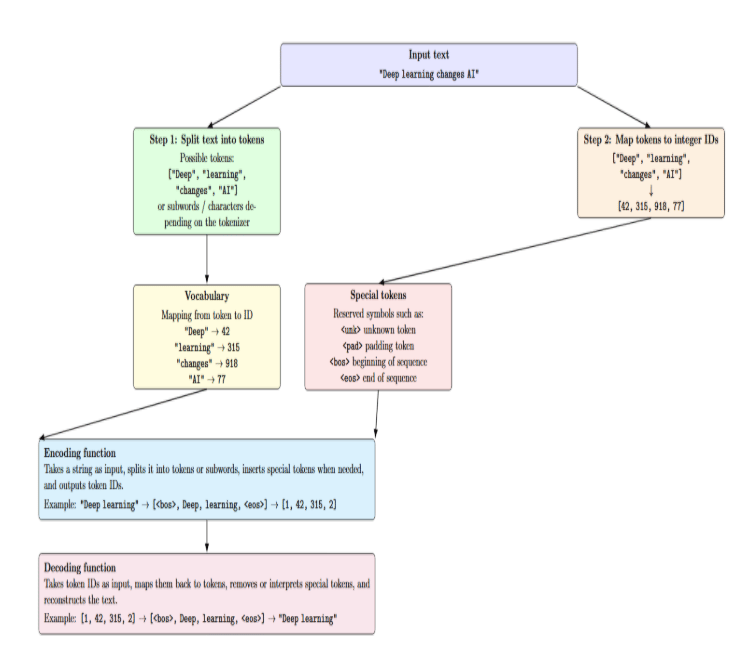
A typical tokenizer consists of:
- Vocabulary: A mapping from tokens to unique integer IDs.
- Special tokens: Reserved symbols (e.g., <unk>, <pad>, <bos>, <eos>) that represent unknown words, padding, or sequence boundaries.
- Encoding function: Converts a string into a sequence of token IDs, including splitting into subword tokens and inserting special tokens as required.
- Decoding function: Reconstructs text from token IDs, reversing the segmentation process.
Byte‑Pair Encoding
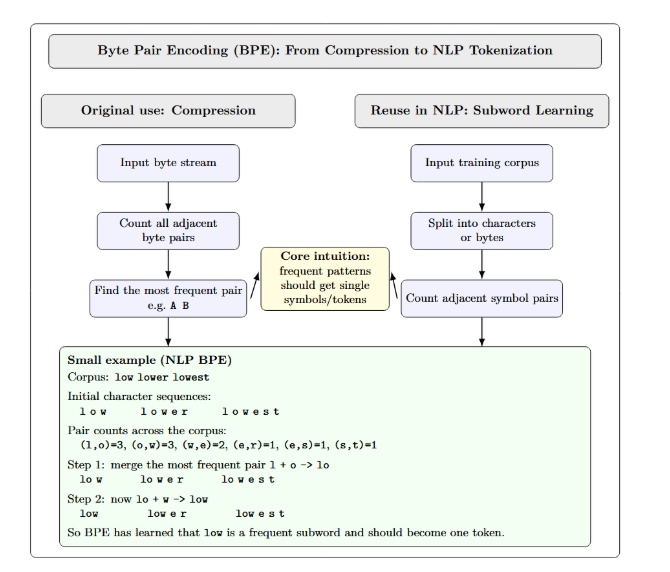
BPE was originally developed as a data compression algorithm: it repeatedly finds the most frequent pair of adjacent bytes, replaces them with a new symbol, and stores a substitution table to enable decompression. NLP BPE tokenization reuses the same merge rule, but applies it to learn subword units, typically starting from characters or bytes. The fundamental loop of counting adjacent pairs and merging the most frequent ones, then repeating, implements the intuition that “frequent patterns should get single tokens.” We have illustrated this in the following diagram:
SentencePiece
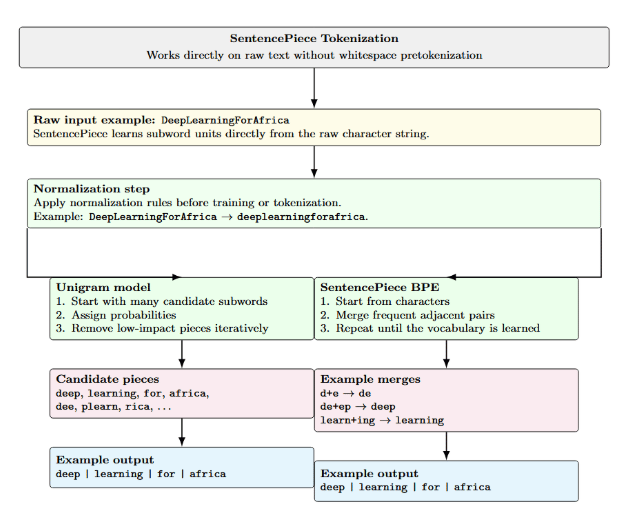
SentencePiece is a tokenizer framework that works directly on raw text. Input is fed as Unicode characters, including whitespace as a token. Unlike traditional tokenizers, it does not rely on whitespace-based pretokenization. SentencePiece supports both the Unigram and BPE algorithms. SentencePiece Unigram model probabilistically assigns scores to tokens and iteratively removes the token that provides the least contribution to the overall likelihood.
SentencePiece’s BPE uses the same merge-based algorithm as standard BPE but operates on raw text instead. Because of that, SentencePiece can work well on multilingual or noisy corpora. SentencePiece allows user-defined special tokens and normalisation rules. It also includes built-in support for subword regularization for data augmentation.
Pretrained vs Custom Tokenizers
Frameworks like Hugging Face’s AutoTokenizer provide pretrained tokenizers that come with many popular models. Pretrained tokenizers have been trained on massive general- purpose corpora and offer good out‑of‑the‑box performance. However, by using a pretrained tokenizer, you ensure compatibility with an existing model’s vocabulary. Additionally, using a pretrained tokenizer means you don’t need to retrain the embeddings.
Custom tokenizers are trained on a specific corpus. Usually, when building a custom tokenizer, you’re also tokenizing in a specific domain (e.g., medical texts, legal documents, code). With a custom tokenizer, you can add domain‑specific vocabulary and set your own vocabulary size. The downside to a custom tokenizer is that you’ll need to train or otherwise adapt a model from scratch, or use methods like vocabulary interpolation.
Tokens, IDs, and Vocabulary Size
A token is an indivisible unit of meaning that your LLM works with. Each token has an ID, which is simply an integer associated with that token in the vocabulary. The vocabulary size is the number of unique tokens (including special tokens) that the tokenizer can recognize. Adjusting vocabulary size affects model complexity:
- Larger vocabularies mean fewer tokens per sentence on average. This is better for context compression, but it will increase the size of the embedding table and memory footprint.
- A smaller vocabulary compresses the embedding table but lengthens sequences. Longer sequences mean more tokens to perform attention operations on, which increases computational cost.
Selecting an appropriate vocabulary size depends on the corpus language, domain variety, and computational budget.
Training Tokenizers from Scratch: BPE vs SentencePiece Explained
Training a tokenizer involves learning which subword units best represent your corpus. The process typically includes:
- Collecting a corpus. Gather text that is representative of the data that your LLM will be processing. Clean the text by normalizing whitespace, lowercasing if appropriate, and removing irrelevant characters.
- Selecting the algorithm and vocabulary size. Decide whether to use BPE or SentencePiece(Unigram or BPE variant) as well as what vocabulary size to train your corpus with.
- Training the tokenizer. Run the algorithm to build a vocabulary and store merge operations or token probabilities. Save the vocabulary and any associated model files.
- Evaluating the tokenizer. Review metrics such as tokens per sentence, coverage of domain‑specific vocabulary, and handling of rare tokens. and computational efficiency.
The following table compares BPE and SentencePiece across common criteria. Note how the phrases remain succinct rather than full sentences.
| Criterion | BPE Tokenization | SentencePiece Tokenization |
|---|---|---|
| Training input | Typically requires pretokenized text | Trains directly on raw text (no pretokenization) |
| Algorithm | Greedy pair merging (frequency-based) | Unigram LM or BPE (probabilistic or merge-based) |
| Unknown words | May use <unk> if tokens are unseen | Splits into subwords; <unk> is rare |
| Multilingual support | Less flexible (depends on preprocessing) | Strong multilingual support (language-independent) |
| Training cost | Fast and lightweight | Heavier and slower (especially Unigram LM) |
| Vocabulary behavior | Deterministic merge rules | Probabilistic tokens with likelihoods |
| Whitespace handling | Relies on pre-splitting | Treats whitespace as a token (▁) |
| Tooling | Hugging Face tokenizers, GPT-style BPE | SentencePiece library (.model, .vocab) |
A Small BPE Merge Example
BPE starts with a vocabulary of individual characters. Then, at each iteration, it merges the most frequent adjacent pair of characters. The table below demonstrates a simple merge sequence for the word habanero over four steps, including frequency counts. Each row lists the current vocabulary and the result of the merges at that step.
| Step | Frequent pair (freq) | New token | Vocabulary after merge |
|---|---|---|---|
| 1 | a b (3) |
ab |
a, b, h, n, e, r, o, ab |
| 2 | h ab (3) |
hab |
n, e, r, o, ab, hab |
| 3 | hab a (3) |
haba |
n, e, r, o, hab, haba |
| 4 | haba n (3) |
haban |
e, r, o, hab, haban |
BPE actually continues merging until it has reached a desired vocabulary size. SentencePiece implements a similar concept but may split tokens more aggressively. It does not depend on whitespace, so merges can occur across whitespace boundaries.
Minimal Python Example: Training a BPE Tokenizer with Hugging Face
With the tokenizers library, it’s easy to train a BPE tokenizer. The example below shows how to build a tokenizer trained on a small corpus of English sentences and then examine its tokenization logic. For more realistic usage, try a larger corpus and play with the vocab_size.
from tokenizers import Tokenizer, models, trainers, pre_tokenizers, processors
# Sample corpus
corpus = [
    "Machine learning is fun and powerful.",
    "Hugging Face provides excellent NLP tools.",
    "Tokenizers transform text into numerical IDs."
]
# Initialize a Byte-Pair Encoding (BPE) model
bpe_model = models.BPE(unk_token="<unk>")
tokenizer = Tokenizer(bpe_model)
# Use whitespace pre-tokenization
tokenizer.pre_tokenizer = pre_tokenizers.Whitespace()
# Trainer for BPE
trainer = trainers.BpeTrainer(
    vocab_size=2000,
    min_frequency=2,
    special_tokens=["<unk>", "<pad>", "<bos>", "<eos>"]
)
# Train the tokenizer on the corpus
tokenizer.train_from_iterator(corpus, trainer)
# Post-processing: add start and end tokens
tokenizer.post_processor = processors.TemplateProcessing(
    single="<bos> $A <eos>",
    pair="<bos> $A <eos> $B:1 <eos>:1",
    special_tokens=[("<bos>", tokenizer.token_to_id("<bos>")), ("<eos>", tokenizer.token_to_id("<eos>"))]
)
# Encode a sentence
encoding = tokenizer.encode("Hugging Face tokenizers are modular and efficient.")
print(encoding.tokens)
print(encoding.ids)
This script performs a simple whitespace pretokenization, trains a BPE model with a vocabulary size of 2000, and adds <bos> and <eos> tokens via the post processor. The final lines encode a new sentence and print the resulting tokens and their IDs. To replicate SentencePiece behavior, you can replace Whitespace with other pre-tokenizers or switch to the sentencepiece library.
When Should You Train a New Tokenizer?
Retraining a tokenizer is not always necessary. It takes extra effort and may cause compatibility issues with pretrained models. You might want to train your own tokenizer under the following conditions:
- Low‑resource languages: If you’re operating in a language with few pre-trained models/tokenizers, character‑/subword‑level tokenizers will be tailored to handle your use case’s linguistic nuances.
- Domain‑heavy jargon or code: Corpora involved with technical industries, legal matters, or software development often use words that are very uncommon or nonexistent in regular tokenizer training corpora. You can use a custom tokenizer to make sure these terms are included as individual tokens.
- Specialized multilingual corpora: When your dataset contains a mix of languages or rare scripts, a pretrained tokenizer may not cover all characters. SentencePiece Unigram can better handle this scenario.
- Compression‑sensitive workloads: If you’re severely limited by context length (chatbots, long‑doc summarization), you might reduce the token count by training a custom tokenizer on your dataset. This can decrease your generation costs.
- Significant distribution shift: Data wholly outside the scope of pre-trained models’ training data (biomedical data vs. web data) can suffer from poor performance downstream if not accounted for. Training a custom tokenizer on your dataset may reduce token count and cost.
Evaluating a New Tokenizer
If you decide to train a new tokenizer, evaluate it beyond simple token count. Good practices include:
- Token coverage: Ensure domain terms and rare words are represented without excessive splitting.
- Downstream impact: Compare model performance metrics (accuracy, perplexity, F1) using the new tokenizer versus the baseline.
- Memory and speed: Measure embedding table size, decoding speed, and training time. A larger vocabulary may increase memory usage.
- Cross‑language robustness: For multilingual tasks, verify that the tokenizer doesn’t disproportionately favor one language.
Practical Example: Token Count Comparison
Tokenization in NLP splits text into smaller units called tokens. Tokenizers like BPE or SentencePiece are types of subword tokenization. They reduce unknown words by splitting them into subwords learned during pretraining. If we suppose that a generic pretrained tokenizer has produced 23 tokens for a given sentence. If you fine-tune or train a tokenizer (BPE/SentencePiece) on your corpus, you may only get 19 tokens because the tokenizer has learned more frequent domain‑specific subwords. The difference per sentence is small, but over long documents or millions of sentences, these reductions compound and can save significant computation.
Here’s a minimal Python example comparing token counts using a pretrained BPE tokenizer from Hugging Face and a SentencePiece tokenizer trained on the same domain:
pip -q install transformers sentencepiece

from transformers import AutoTokenizer
import sentencepiece as spm

# 1. Small domain corpus
corpus = """
Tokenization in NLP splits text into smaller units called tokens.
Domain-specific tokenizers can learn frequent subwords.
This can reduce the number of tokens in technical text.
"""

with open("corpus.txt", "w", encoding="utf-8") as f:
    f.write(corpus)

# 2. Train a tiny SentencePiece tokenizer on the corpus
spm.SentencePieceTrainer.train(
    input="corpus.txt",
    model_prefix="my_tokenizer",
    vocab_size=50,
    model_type="bpe"
)

# 3. Load pretrained Hugging Face tokenizer
hf_tokenizer = AutoTokenizer.from_pretrained("gpt2")

# 4. Load trained SentencePiece tokenizer
sp = spm.SentencePieceProcessor(model_file="my_tokenizer.model")

# 5. Compare token counts on the same sentence
text = "Tokenization in NLP can reduce token count for domain-specific text."

hf_tokens = hf_tokenizer.tokenize(text)
sp_tokens = sp.encode(text, out_type=str)

print("Text:", text)
print("Hugging Face token count:", len(hf_tokens))
print("HF tokens:", hf_tokens)
print()
print("SentencePiece token count:", len(sp_tokens))
print("SentencePiece tokens:", sp_tokens)
The above code installs necessary libraries, builds a small corpus of text, and trains a miniature SentencePiece BPE tokenizer on that corpus of in-domain text. It then loads a pretrained GPT-2 tokenizer from Hugging Face and compares both tokenizers on the same sentence. The purpose is to demonstrate how a tokenizer trained on your own corpus might split text from your domain into fewer or more suitable subwords than a generic pre-trained tokenizer.
When to Change the Tokenizer During Fine‑Tuning
Changing the tokenizer while fine-tuning is risky. The model has learned embeddings associated with those token IDs. Switching tokenizers means the model will see tokens distributed differently. If you want to change the tokenizer (add tokens specific to your domain), you can use methods like interpolating between vocabularies or using the transformers.add_tokens method. These methods allow you to expand the vocabulary while keeping the original embeddings. Remember to re‑initialize the embedding matrix for new tokens and carefully monitor performance.
Domain Adaptation and Compression
Training a custom tokenizer on your domain typically reduces the number of tokens needed per document. This decreases compute costs and enables longer sequences within the same context window size. Consider splitting a legal document using a general tokenizer into 400 tokens, while a tokenizer pretrained on a legal corpus creates only 350 tokens. Saving 50 tokens per document can decrease attention operations and save memory. The benefits decrease if your domain is similar to the original data used to train the underlying pretrained tokenizer.
Tokenizer choices affect compression, memory usage, and downstream context. Customizing a tokenizer may benefit applications such as summarization or retrieval-augmented generation, where cost per token matters. Yet the benefits must be weighed against the effort and potential compatibility issues.
Frequently Asked Questions
What is a tokenizer in an LLM? Tokenizers split text into tokens (words/subwords/characters) and map them into numerical IDs, which can be fed into a language model.
How does BPE work? BPE starts with individual characters and iteratively merges the most frequent adjacent pairs to create longer subwords, forming a deterministic vocabulary.
How does SentencePiece differ from BPE? SentencePiece operates on raw text, supports a probabilistic Unigram model and a BPE variant, and better handles multilingual or noise‑rich corpora.
Does tokenization affect LLM cost and context length? Yes. Tokenization determines how many tokens an input produces. Since inference cost and maximum context length are measured in tokens, efficient tokenization can reduce costs and allow longer inputs.
Should I use a pretrained tokenizer or train my own? Use pretrained tokenizers when your domain is similar to the model’s training data or when compatibility matters. Train your own for specialized domains, low‑resource languages or when you need to reduce token count.
Conclusion
Remember that tokenization isn’t just preprocessing -- it fundamentally determines how the LLM “sees” and represents language. While BPE and SentencePiece remain popular, each has its own strengths. BPE is fast and simple, but it relies on pretokenization. SentencePiece is more flexible and allows better multilingual coverage, but it introduces some additional complexity. You can reuse pretrained tokenizers for convenience and compatibility. However, depending on your application (e.g., low-resource languages, domain-specific jargon, context length constraints), training your own tokenizer could yield tangible benefits.
Thanks for learning with the DigitalOcean Community. Check out our offerings for compute, storage, networking, and managed databases.
About the author(s)
I am a skilled AI consultant and technical writer with over four years of experience. I have a master’s degree in AI and have written innovative articles that provide developers and researchers with actionable insights. As a thought leader, I specialize in simplifying complex AI concepts through practical content, positioning myself as a trusted voice in the tech community.
With a strong background in data science and over six years of experience, I am passionate about creating in-depth content on technologies. Currently focused on AI, machine learning, and GPU computing, working on topics ranging from deep learning frameworks to optimizing GPU-based workloads.
Still looking for an answer?
This textbox defaults to using Markdown to format your answer.
You can type !ref in this text area to quickly search our full set of tutorials, documentation & marketplace offerings and insert the link!
 This work is licensed under a Creative Commons Attribution-NonCommercial- ShareAlike 4.0 International License.
Become a contributor for community
Get paid to write technical tutorials and select a tech-focused charity to receive a matching donation.

DigitalOcean Documentation
Full documentation for every DigitalOcean product.

Resources for startups and AI-native businesses
The Wave has everything you need to know about building a business, from raising funding to marketing your product.
The developer cloud
Scale up as you grow — whether you're running one virtual machine or ten thousand.

Start building today
From GPU-powered inference and Kubernetes to managed databases and storage, get everything you need to build, scale, and deploy intelligent applications.
