
The cloud service provider you bet on affects far more than your monthly bill. Whether you opt for a hyperscaler like AWS, Google Cloud, or Azure—or a specialized provider built with developers in mind—that choice shapes everything from how you deploy AI workloads to how you scale. It determines your security posture, your team’s velocity, and how much operational overhead you absorb as you grow. Get it right, and infrastructure becomes a lever—not a bottleneck.
Whether you’re migrating to the cloud for the first time, moving from one provider to another, or building out a multi-cloud strategy, the evaluation criteria stay the same: reliability, pricing transparency, performance at scale, and how well the platform fits the way your team actually works. The difference is context—an AI startup optimizing for speed to market has different priorities than an enterprise rearchitecting for resilience. That’s why a side-by-side comparison matters more than any single vendor’s pitch. We’ve gathered the top cloud service providers—including DigitalOcean—to help you make that call with confidence.
Key takeaways:
-
Cloud service providers deliver the core building blocks—virtual machines, storage, networking, managed databases, and platform-as-a-service—that power business infrastructure at scale, along with the AI and ML tooling increasingly central to modern workloads.
-
The best infrastructure platforms give you elastic scalability, high availability, fast provisioning, GPU access, and managed services, so your team spends less time on operations and more time building products.
-
When choosing the ideal cloud service, consider pricing models, GPU support, developer experience, compliance, and multi-region capabilities to ensure alignment with your workload demands and operational goals.
-
Top cloud service providers include DigitalOcean, Vultr, AWS, Microsoft Azure, Google Cloud Platform, IBM Cloud, Oracle Cloud Infrastructure, Alibaba Cloud, OVHcloud, and Scaleway.
What are cloud service providers?
Cloud service providers are companies that deliver on-demand computing resources—like servers, storage, databases, and networking—over the internet. This means customers can create and manage servers, storage, and networks through a web dashboard or API rather than setting up physical hardware themselves. Instead of managing physical servers, cloud service organizations provision virtual machines, storage volumes, and virtual networks on hardware abstracted by virtualization layers.
Most providers deliver Infrastructure as a Service (IaaS) that gives customers control over operating systems, networking configuration, and workload deployment while the provider manages the underlying hardware and facility operations. Because cloud infrastructure is distributed across global data centers, resources are organized into regions and availability zones. This structure improves reliability and geographic reach, but it can also influence pricing, along with data transfer costs and deployment strategies. While the core model is similar across providers, they differ in network design, performance characteristics, service integration depth, and the level of control they provide customers.
Benefits of cloud service providers
Moving to a cloud service provider gives you flexibility, speed, and scale that on-premises infrastructure simply can’t match:
-
Elastic scalability: Cloud infrastructure is designed to scale in response to workload demand. Teams can expand compute capacity for peak traffic, data processing, or AI workloads and reduce it when demand declines.
-
High availability and resilience: Multi-zone and multi-region architectures keep applications running even during infrastructure failures. Built-in redundancy reduces single points of failure and simplifies disaster recovery design across distributed and multi-cloud infrastructure environments.
-
Faster infrastructure provisioning: Compute, storage, and networking resources can be deployed through APIs and infrastructure-as-code tools. This shortens provisioning cycles and helps enable automated, repeatable environments across development and production.
-
Access to specialized compute: Cloud platforms provide high-performance CPUs, GPU instances, and optimized storage systems that support data-intensive workloads. Organizations evaluating cloud providers for AI and machine learning or GPU cloud providers can run analytics, AI training, inference, and distributed applications without investing in dedicated hardware.
-
Operational abstraction: Managed services for databases, app deployment (PaaS), orchestration, monitoring, and networking reduce the burden of infrastructure maintenance. Engineering teams can focus on application logic rather than patching, scaling, or maintaining underlying systems.
How to choose the right cloud service provider
The right cloud service provider isn’t necessarily the biggest—it’s the one that fits your workloads, your budget, and the way your team actually builds. Here’s some criteria to consider:
-
Pricing: Evaluate total cost, not just instance rates. This includes storage tiers, network egress, managed service premiums, and long-term commitments. Complex pricing models within large enterprise cloud infrastructure platforms can introduce forecasting risk, particularly for startups and high-growth teams, while simpler pricing structures can support more predictable budgeting.
-
Scalability: Assess how the platform supports horizontal scaling, autoscaling policies, and regional expansion. If traffic patterns fluctuate or global deployment is planned, the provider should support distributed and multi-cloud infrastructure architectures without requiring major redesign.
-
AI-ML/GPU support: For AI-driven workloads, confirm GPU availability, provisioning timelines, and regional capacity. High-throughput storage and low-latency networking are equally crucial because model training and inference involve moving large datasets between compute and storage, and performance bottlenecks can slow execution.
-
Developer experience: Consider API design, documentation clarity, CLI tooling, and ecosystem integrations. A streamlined developer workflow helps reduce onboarding friction and operational complexity.
-
Compliance: Verify alignment with security standards, such as SOC 2, ISO certifications, and regional data hosting requirements. Data residency controls, identity segmentation, and support for zero-trust cloud architecture principles are often critical for regulated industries.
Choosing AWS goes beyond comparing instance specs. Teams must account for AWS’s complicated pricing models, where compute, storage, networking, and data transfer fees stack across services.
When to avoid choosing a hyperscaler
Hyperscalers such as Amazon Web Services, Microsoft Azure, and Google Cloud are built to support highly complex enterprise environments. Their extensive service portfolios and global infrastructure make them attractive to organizations running large-scale, multi-service architectures. However, that scale can introduce layers of operational and financial complexity.
If your workloads are predictable and your architecture is relatively simple, the overhead associated with managing a hyperscale environment may outweigh its benefits. You may wish to avoid a hyperscaler if:
-
You need focused, not sprawling, infrastructure: Hyperscalers push hundreds of services, many of which you may never use—but you’ll still navigate their complexity. If your stack runs on VMs, containers, managed databases, and Kubernetes, a specialized provider delivers tighter integration without the bloat.
-
Pricing transparency is a priority: Hyperscaler pricing can be described as opaque—seemingly hidden fees, variable egress charges, tiered discounts that require long-term commitments, and bills that can spike without warning. If your team doesn’t have a dedicated FinOps practice to decode invoices and optimize spend, you can be overpaying.
-
Your team is lean: Hyperscale platforms can seem like they were built with the assumption you have cloud architects, security engineers, and platform teams to manage them. If you don’t, your developers can end up wrestling with IAM policies, networking layers, and service configurations instead of shipping products.
Top 10 cloud service providers
Cloud service providers differ across compute, storage, networking, compliance, and AI capabilities. Here are the top 10 platforms for business infrastructure in 2026.
Pricing and feature information in this article are based on publicly available documentation as of February 2026 and may vary by region and workload. For the most current pricing and availability, please refer to each provider’s official documentation.
*This “best for” information reflects an opinion based solely on publicly available third-party commentary and user experiences shared in public forums. It does not constitute verified facts, comprehensive data, or a definitive assessment of the service.
| Provider | Best for* (use cases) | Key features | Pricing |
|---|---|---|---|
| DigitalOcean | Scalable cloud infrastructure and GPU-powered AI | Simple, predictable VMs; Managed Kubernetes; Scalable storage; Automated managed databases | Droplets from $4/mo; App Platform free (3 apps w/static sites) or from $5/mo; GPU from $1.99/hr |
| Vultr | Compute-intensive and latency-sensitive workloads | Distributed VMs and bare metal; High-performance compute; Scalable storage and networking; Developer-friendly APIs | Compute from $5/mo; GPU from $2.99/hr |
| AWS | Global-scale infrastructure control | Multi-region compute and storage; Advanced networking; Broad managed services; Strong compliance | EC2 from $6.13/mo; App Runner from $0.007/vCPU-hr; GPU from $6.88/hr |
| Microsoft Azure | Hybrid and enterprise AI workloads | Hybrid governance; Integrated identity tools; Confidential computing; Wide VM and storage options | VMs from $6.13/mo; App Service free (F1) or from $9.49/mo; GPU from $8.82/hr |
| Google Cloud Platform | Data-intensive and ML-driven workloads | High-performance compute and storage; Global low-latency network; Managed analytics and AI tools | Compute from $6.11/mo; App Engine from $0.05/hr; GPU from $88.49/hr |
| IBM Cloud | Regulated and hybrid enterprise workloads | Hybrid deployment with OpenShift; Bare metal and VMs; Strong security and compliance; Centralized networking | VMs from $53.29/mo; GPU from $85/hr |
| Oracle Cloud Infrastructure | Enterprise databases and HPC workloads | High-performance compute and storage; Bare metal options; HPC-optimized workloads; Scalable enterprise infrastructure | Dense I/O E5 - $0.03 per OCPU/hour; Virtual Machine Standard - X7 - $0.0638 OCPU/hour; VM GPU (NVIDIA P100) - $1.275/GPU/hour; Dense I/O E5 - $0.0612 per TB NVMe/hour |
| Alibaba Cloud | Asia-Pacific enterprises and AI workloads | Regional compute and storage; Local compliance; High-performance networking; Private connectivity options | ECS from $4.55/mo; SAE from $6.85/yr; GPU from $2.26/hr |
| OVHcloud | European data sovereignty dedicated infrastructure | Bare metal and private cloud; European data centers; GDPR compliance; Flexible networking | Instances from $8.59/mo; GPU from $4.59/hr |
| Scaleway | European sovereign workloads | Multi-tier VMs (ARM and x86); Bare metal servers; Managed Kubernetes; Serverless platform; SLA-backed infrastructure | Instances from €0.10/mo; GPU from €2.52/hr |
Global AI-ready cloud platforms
This category of providers operates large-scale, multi-region cloud infrastructure capable of supporting both enterprise systems and AI workloads. They offer GPU-backed compute, managed services, and global networking environments that enable distributed training and production inference across modern enterprise cloud infrastructure environments.
1. DigitalOcean with scalable cloud infrastructure and GPU-powered AI
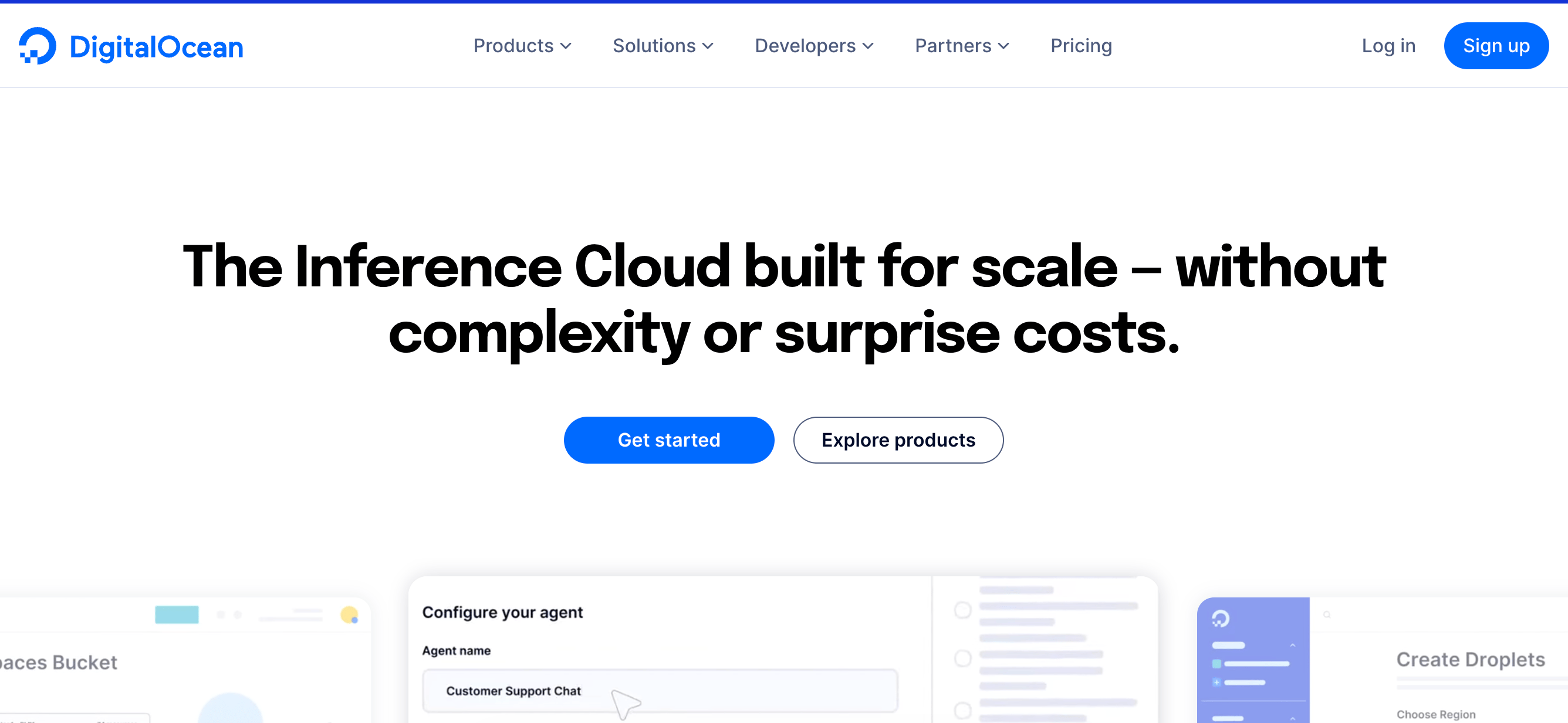
DigitalOcean Inference Cloud is built for teams developing and scaling modern applications, including AI-enabled products. It focuses on providing reliable, production-ready compute without the operational complexity often associated with large hyperscale environments. The platform offers GPU Droplets powered by NVIDIA H100 and H200 accelerators for model inference, fine-tuning workflows, and batch AI processing. Managed Kubernetes supports GPU-enabled node pools within the same cluster used for application services, enabling teams to run AI workloads alongside core product infrastructure. VPC networking is enabled by default to help isolate workloads, and managed PostgreSQL, MySQL, and Redis services integrate directly with application stacks. Teams typically choose DigitalOcean when they need straightforward infrastructure that supports AI workloads with predictable performance and clear cost visibility.
DigitalOcean key features:
-
GPU Droplets are provisioned with preconfigured CUDA toolkits and optimized driver stacks to help reduce environment configuration overhead.
-
Kubernetes control plane supports dedicated GPU node pools without requiring separate cluster orchestration layers.
-
Gradient**™** AI Platform provides managed model hosting, serverless inference endpoints, and integrated tooling for deploying and scaling AI applications without managing underlying infrastructure.
-
Droplets - $4/month starting for basic VMs with 512 MiB memory, 1 vCPU, 10 GiB SSD, and 500 GiB transfer
-
App Platform - $0 for 3 apps with w/static sites; $5/month starting for basic web apps with automatic scaling and built-in CI/CD
-
GPU Droplets - $3.39/GPU/hour on-demand for NVIDIA H100 GPU instances, or $1.99/GPU/hour with a 12-month commitment
2. Vultr with support for compute-intensive and latency-sensitive workloads
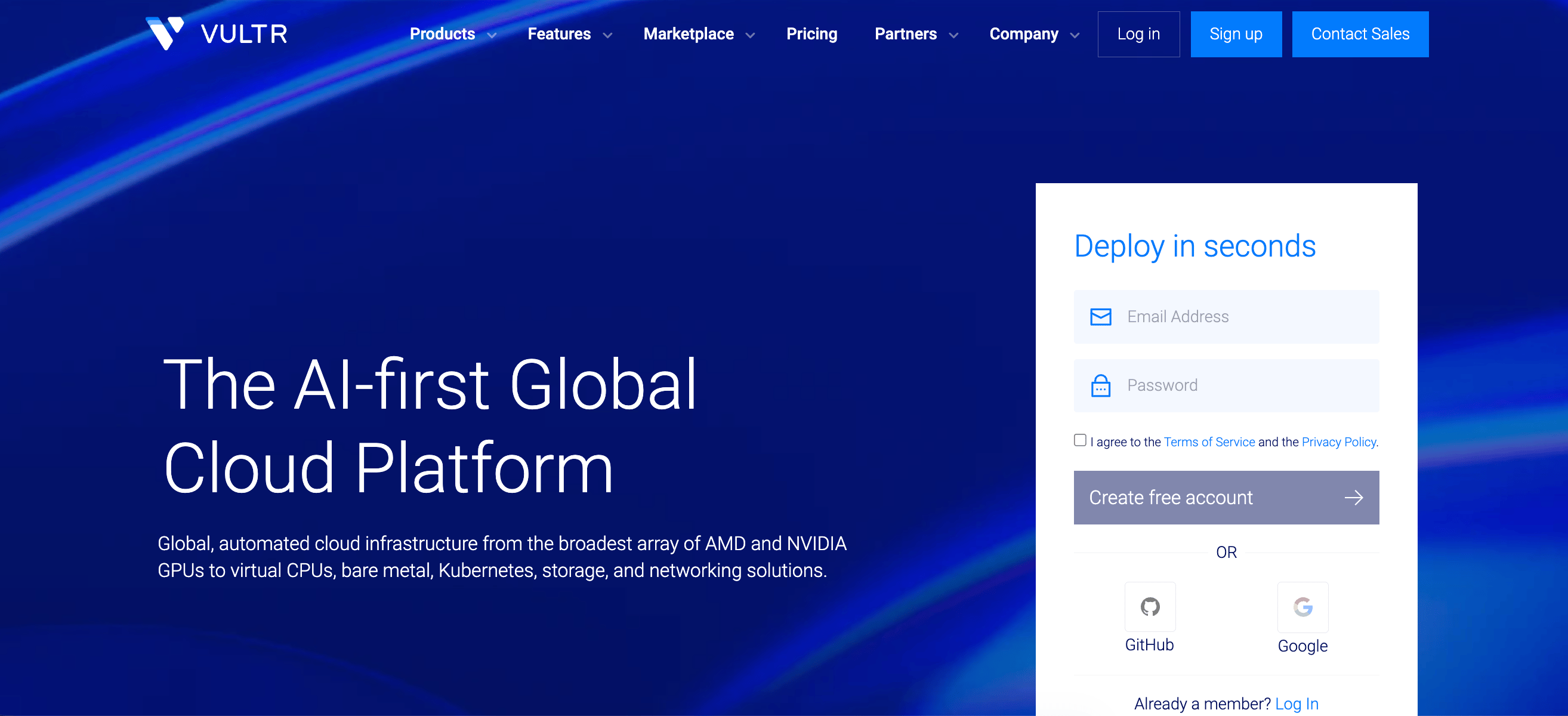
Vultr is a developer-oriented cloud platform offering general-purpose infrastructure alongside GPU-enabled compute. It supports scalable web applications, databases, containerized workloads, and performance-sensitive systems across a globally distributed footprint. The platform provides virtual machines, bare metal servers, storage, and networking services, with GPU instances available for AI training and inference. Vultr is commonly selected by startups and digital-native teams that need flexible cloud infrastructure with accessible GPU capacity, without the operational complexity associated with large enterprise providers.
Vultr key features:
-
NVIDIA A100 and L40S GPU instances are available in both virtualized and bare metal configurations.
-
High-frequency compute instances optimized for inference serving and latency-sensitive applications.
-
API-driven provisioning with simplified billing across GPU and standard compute workloads.
-
Cloud Compute - $5/month starting for Shared CPU with 1 GB RAM, 1 vCPU, 25 GB SSD
-
GPU instances - $2.99/hour on-demand for NVIDIA H100 GPU instances
Finding it challenging to evaluate Vultr without adding operational complexity? Vultr alternatives examine cloud platforms that emphasize ease of use, streamlined infrastructure management, and the ability to scale applications without requiring specialized cloud expertise.
3. AWS with support for global-scale infrastructure control
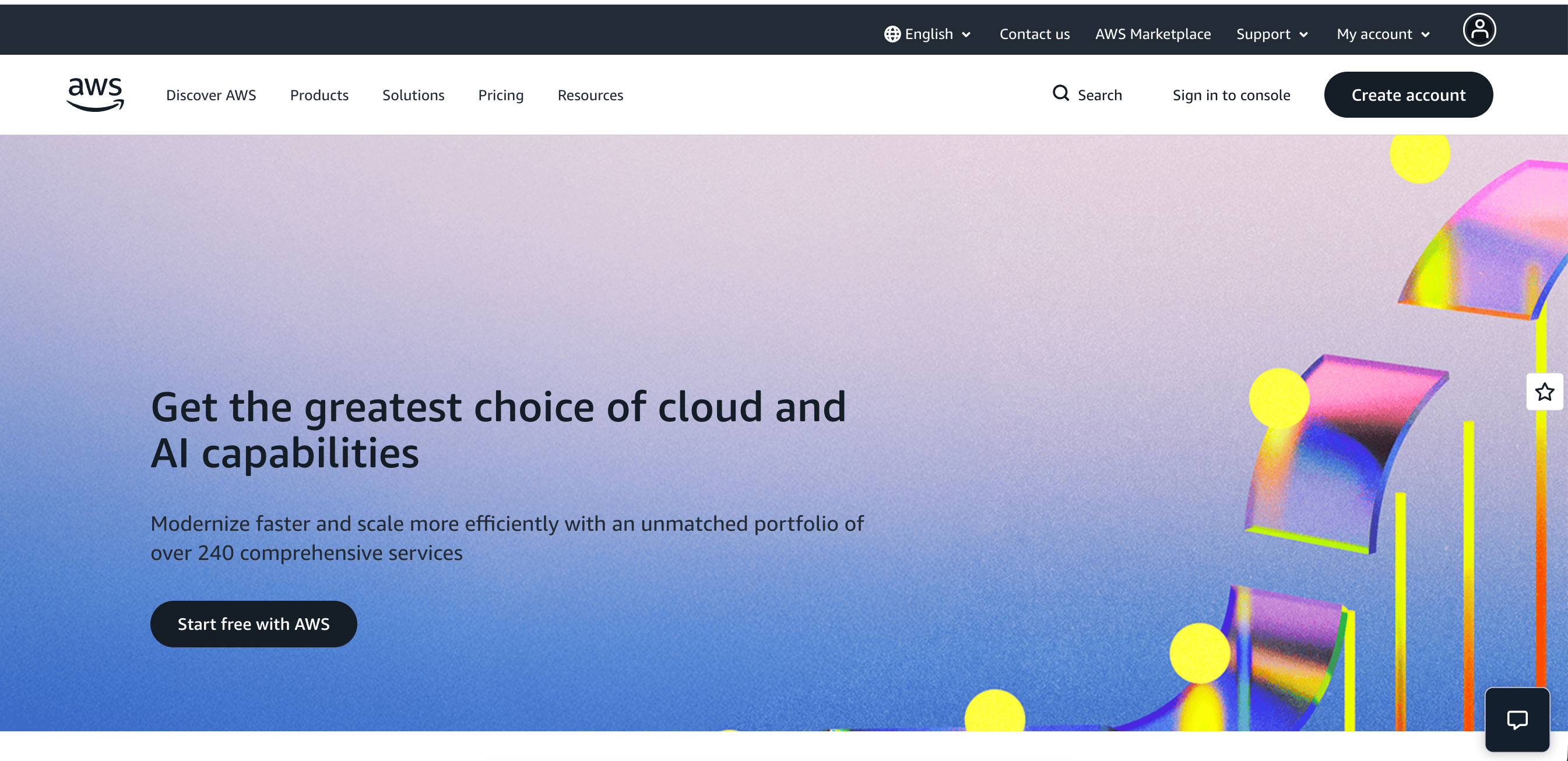
AWS operates a large-scale cloud infrastructure designed to support enterprise systems and distributed AI workloads across multiple regions. It can be used for foundation model training and regulated workloads that span multiple geographic regions. AWS offers P5 instances powered by NVIDIA H100 GPUs for high-performance training tasks that require significant memory bandwidth and interconnected performance. AWS integrates purpose-built accelerators with high-performance networking and distributed storage as part of its cloud platform. Its networking services enable tightly coupled distributed training across multiple compute nodes. Organizations often consider AWS when they need extensive global infrastructure and tightly integrated managed services for complex enterprise environments. However, the breadth of its ecosystem and pricing model can introduce operational complexity that smaller teams may need to manage carefully.
AWS key features:
-
Multi-account architecture through AWS Organizations to segment AI workloads across teams and environments.
-
Private networking options that enable AI clusters to operate without public internet exposure.
-
High-performance compute options, including GPU-powered EC2 instances, for scalable AI and general-purpose workloads.
-
EC2 instances - $6.13/month for t4g.micro shared instance with 2 vCPUs, 1 GB RAM, EBS-only storage, and up to 5 Gbps network
-
App Runner - $0.007/vCPU-hour and $0.007/GB-hour starting for active container instances, with configurations ranging from 0.25 vCPU/0.5 GB to 4 vCPU/8 GB
-
GPU instances - $6.88/hour on-demand for p5.4xlarge GPU instance with 16 vCPUs, 256 GiB RAM, 100 Gigabit network, and 1x 3840 GB SSD
AWS delivers extensive global scale, but may not be the most practical fit for every workload. AWS alternatives appeal to teams that value simple operations, transparent cost models, and quick onboarding while still running production-ready infrastructure.
4. Microsoft Azure with support for hybrid and enterprise AI workloads
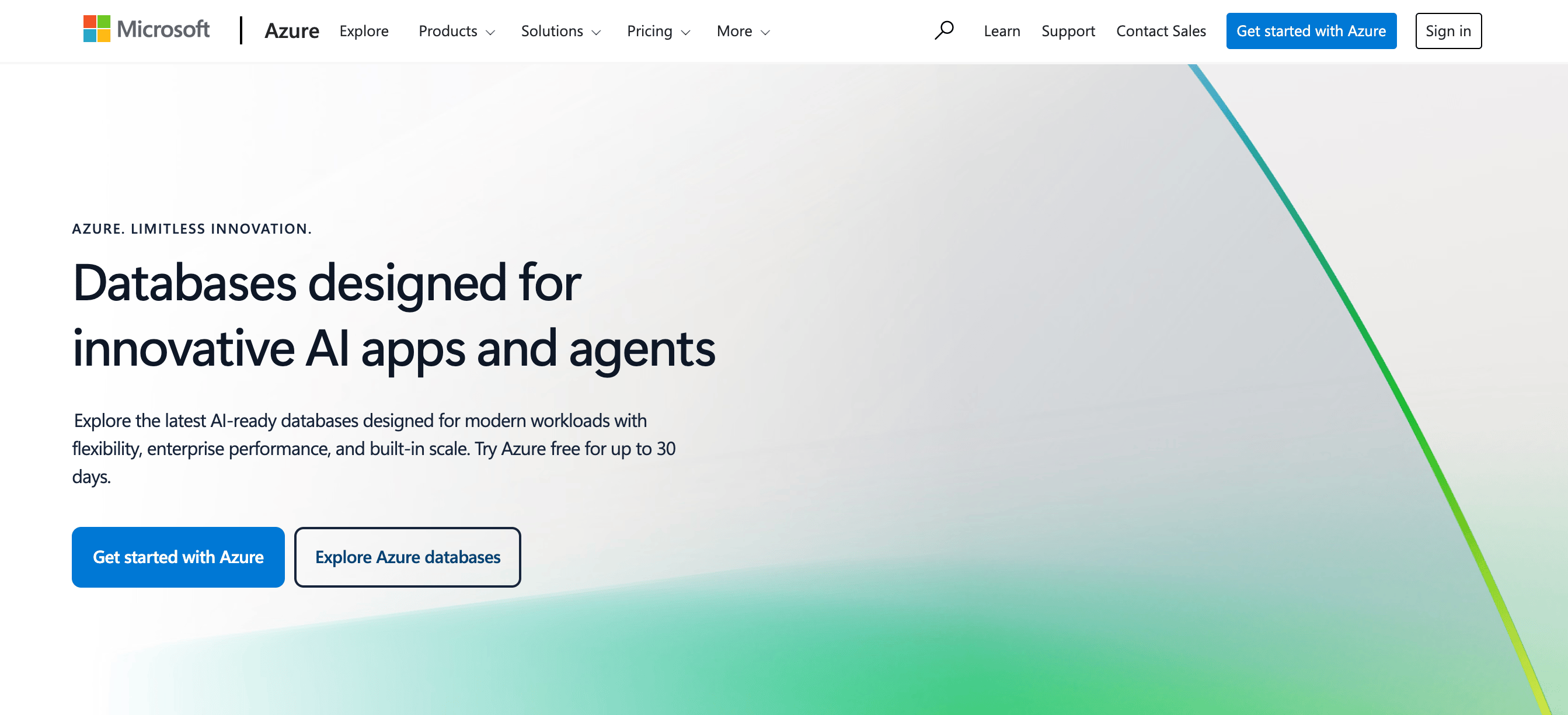
Microsoft Azure is an enterprise cloud infrastructure platform deeply integrated with Microsoft’s identity and hybrid systems portfolio. It is commonly adopted by organizations operating Windows Server estates and Active Directory-based identity models that extend into AI-enabled services. Azure provides ND and NC series virtual machines equipped with GPUs for training and inference workloads. Azure Machine Learning supports experiment tracking and model registry management. It also provides managed endpoints for model deployment. Azure Arc extends policy control across hybrid and on-premises environments, which helps enterprises to apply consistent governance while modernizing AI workloads. Teams often adopt Azure when AI systems must align tightly with enterprise identity boundaries and existing Microsoft infrastructure.
Microsoft Azure key features:
-
Azure Synapse Analytics connects AI workloads with enterprise data warehouses for large-scale model training.
-
Microsoft Defender for Cloud provides threat protection tailored to cloud-based AI environments.
-
Microsoft Entra ID (formerly Azure AD) integrates AI workloads with enterprise identity and access control frameworks.
-
Virtual machines - $6.132/month for basic B2ts v2 series (pay-as-you-go pricing)
-
Azure App Service - $0 for F1 Free Plan; $9.49/month per site for D1 Shared Plan
-
Cloud GPUs (H100) - $8.820/hour for NC40ads H100 v5 with 40 vCPUs, 320 GB RAM, 3576 GB temporary storage
Azure alternatives are often considered by teams seeking a more streamlined cloud experience with simple operations and transparent pricing. While Azure supports complex enterprise environments, other platforms may better align with organizations that prioritize transparent pricing and focused infrastructure capabilities.
5. Google Cloud Platform with support for data-intensive and ML-driven workloads
Google Cloud Platform is a global cloud infrastructure provider known for its strengths in data analytics, containerized applications, and AI services. It can be adopted by organizations building cloud-native systems and large-scale data platforms. The platform offers a broad portfolio of compute, storage, and networking services across multiple global regions. Google Cloud general-purpose and accelerator-enabled virtual machines to support application workloads and machine learning use cases. Managed services such as BigQuery and Vertex AI integrate analytics and model development into production environments. Its private global fiber network supports high-throughput traffic movement between regions, which benefits distributed applications and data-intensive systems. Organizations often evaluate Google Cloud when analytics depth and Kubernetes-based architectures are central to their cloud strategy.
Google Cloud Platform key features:
-
Cloud Storage provides multi-class object storage with lifecycle policies for archival and active workloads.
-
Cloud Load Balancing distributes traffic across regions using a global anycast architecture.
-
Identity and Access Management (IAM) supports fine-grained role-based access control across projects and services.
Google Cloud Platform pricing:
-
Compute Engine - $6.11/month for e2-micro shared instance with 2 vCPUs and 1 GiB RAM
-
App Engine - $0.05-$0.10/hour per instance, depending on environment (Standard or Flexible) and instance class, with free tier quotas available
-
GPU instances - $88.49/hour on-demand for A3 High(a3-highgpu-8g) instance with 8 GPUs, 208 vCPUs, and 1872 GiB RAM
Google Cloud is strong in data and AI capabilities, but its broad ecosystem can introduce operational complexity for some teams. Google Cloud alternatives often appeal to organizations seeking a focused infrastructure platform with simple management and transparent pricing.
Regulated and hybrid modernization platforms
These providers emphasize compliance, data sovereignty, and structured modernization of existing infrastructure estates. Their platforms focus on centralized governance, hybrid connectivity, and consistent policy enforcement across cloud and on-premises environments.
6. IBM Cloud with support for regulated and hybrid enterprise workloads
IBM Cloud is an enterprise-focused cloud platform designed for hybrid modernization and regulated industry workloads. It provides GPU-enabled virtual servers and dedicated bare metal infrastructure within environments that emphasize governance and compliance enforcement. Integration with Red Hat OpenShift enables container orchestration across both cloud and on-premises systems. IBM Cloud is commonly evaluated by financial institutions and government agencies, modernizing legacy enterprise systems that require strict operational controls. The platform supports hybrid deployment patterns where policy consistency and audit readiness are mandatory.
IBM Cloud key features:
-
Built-in encryption services protect data both at rest and in transit, helping to ensure secure handling of critical business information across applications and storage systems.
-
Hybrid connectivity options maintain centralized policy enforcement across cloud and on-premises systems, helping teams to manage distributed environments without losing control or visibility.
-
Bare metal GPU nodes provide single-tenant performance and infrastructure isolation, helping teams run AI workloads securely and consistently without interference from other tenants.
-
Virtual Servers for VPC - $53.29/month for nxf-2x1 Flex instance with 2 vCPUs, 1 GB RAM, and 2 Gbps bandwidth
-
GPU instances - $85.00/hour for a GPU virtual server instance with 8x H100 GPUs, 160 vCPUs, 1792 GiB RAM, 61440 GB storage, and 200 Gbps network
IBM Cloud is built for hybrid and regulated enterprise environments, but not every organization needs deep legacy integration or complex governance layers. IBM Cloud alternatives compare platforms that differ in operational simplicity, pricing transparency, hybrid support, and global infrastructure reach.
7. Oracle Cloud Infrastructure with support for enterprise databases and HPC workloads
Oracle Cloud Infrastructure (OCI) is a high-performance cloud platform engineered for database-intensive workloads and distributed AI training systems. It provides GPU clusters connected through RDMA-based networking that supports low-latency communication between nodes. Bare metal configurations are available for organizations that require deterministic performance without virtualization overhead. OCI is commonly selected by enterprises running mission-critical Oracle databases that are extending into AI-driven analytics or model training workflows. The platform emphasizes predictable throughput and sustained high utilization performance.
Oracle Cloud Infrastructure key features:
-
Flat network architecture improves east-west traffic within clusters, making large-scale model training and high-throughput data transfers smoother and more predictable.
-
HPC-optimized storage delivers reliable and consistent throughput, helping to ensure large datasets for AI and analytics workloads are ingested and processed without bottlenecks.
-
GPU cluster scaling supports sustained, high-utilization workloads, helping enterprises to run continuous AI training and inference pipelines without hitting performance limits during peak operations.
Oracle Cloud Infrastructure pricing:
-
Dense I/O E5 - $0.03 per OCPU/hour
-
Virtual Machine Standard- X7 - $0.0638 OCPU/hour
-
VM GPU (NVIDIA P100) - $1.275/GPU/hour
-
Dense I/O E5 - $0.0612 per TB NVMe/hour
Region-focused cloud platforms
These cloud providers maintain a strong regional presence and align closely with local regulatory requirements. They are frequently adopted when data residency, sovereignty, or geographic proximity are primary decision factors within regulated cloud hosting environments. AI infrastructure is delivered within the context of regional compliance and localized network performance.
8. Alibaba Cloud with support for Asia-Pacific enterprises and AI workloads
Alibaba Cloud is a global cloud infrastructure platform with strong regional dominance across the Asia Pacific markets. It is frequently adopted by enterprises expanding into China and Southeast Asia that require local compliance alignment and regional network proximity. Alibaba Cloud provides GPU-accelerated Elastic Compute Service instances that support training and inference workloads. The platform integrates with its proprietary Apsara distributed operating system, which underpins compute, storage, and networking control. High-performance storage systems, including scalable object storage and parallel file systems, support low-latency data access and sustained throughput for large-scale AI training pipelines.
Alibaba Cloud key features:
-
ECS GPU instances help enable teams to run AI training and inference workloads with predictable performance on NVIDIA accelerators.
-
Dedicated Express Connect provides private, high-speed links to mainland China, reducing latency and improving security for cross-region applications.
-
Object Storage Service supports durable, high-performance storage for large AI datasets and model checkpoints.
-
ECS instances - $4.55/month starting for economy instance e with 2 cores, 0.5 GB memory, 40 G Standard ESSD, and 200Mbps bandwidth
-
Serverless App Engine - $0.000006859/CU starting for pay-as-you-go, or $6.85/year starting for resource plans with 1 million CU
-
GPU instances - $2.26/hour for ecs.gn8is.2xlarge GPU-accelerated compute-optimized instance with 8 vCPUs and 64 GiB RAM
9. OVHcloud with support for European data sovereignty and dedicated infrastructure
OVHcloud is a European cloud infrastructure provider and may be a good choice when focused on data sovereignty and infrastructure transparency. It operates its own data centers and designs its own server hardware, which gives it tight control over cost structures and operational design. OVHcloud provides GPU-enabled bare metal servers and hosted private cloud environments that support AI workloads for entities operating under European regulatory and compliance standards like GDPR. Enterprises may adopt OVHcloud when data residency and sovereignty are strategic infrastructure priorities.
OVHcloud key features:
-
Dedicated bare metal GPU servers give direct access to hardware, enabling low-latency model training and inference.
-
Flexible network architecture reduces reliance on third-party transit, improving reliability and predictability for high-volume data transfers.
-
Hosted private cloud options enable teams to isolate workloads for security, performance, or testing purposes without managing physical infrastructure.
-
Public Cloud Instances - $8.59/month starting for shared-resource instances with 2 GB RAM, 1 vCore, and 25 GB storage
-
AI Training GPUs - $4.59/hour starting for NVIDIA H100 GPU instances
When teams are focused on European data sovereignty and dedicated infrastructure, OVHcloud may be a good choice, but not every team needs region-specific hosting constraints. OVHcloud alternatives compare providers that differ in global reach, compliance support, managed services, and infrastructure flexibility.
10. Scaleway with support for European sovereign workloads
Scaleway is a French cloud infrastructure provider offering virtual machines across multiple workload tiers and Elastic Metal bare metal servers for dedicated performance. It includes S3-compatible object storage, Managed Databases (PostgreSQL, MySQL, MongoDB, Redis, Kafka), Managed Kubernetes (Kapsule for single-cloud and Kosmos for multi-cloud or hybrid deployments), and a serverless stack supporting Functions, Containers, and Jobs. For AI workloads, Scaleway offers GPU instances powered by NVIDIA accelerators (including H100, L40S, L4, and P100) and managed inference services. The company operates renewable energy–powered data centers and positions itself as a European cloud alternative.
Scaleway key features:
-
Instances support both ARM and x86 architectures powered by AMD EPYC processors, with NVMe SSD storage and rapid provisioning.
-
Compute instances carry a 99.9% SLA and GPU instances a 99.5% SLA, with private VPC networking and integrated DDoS protection.
-
The serverless platform supports automatic scaling, per-minute billing, CRON scheduling, and container-based workloads.
-
Virtual Instances - €0.10/month for STARDUST1-S Development Instance with 1 vCPU, 1 GB RAM, and 100 Mbps bandwidth
-
GPU Instances - €2.52/hour for NVIDIA H100 GPU instances
Cloud service providers FAQ
Can developer-focused cloud providers support AI workloads at production scale?
Yes. Platforms like DigitalOcean provide GPU-enabled Droplets (virtual machines) and production-ready infrastructure designed for model fine-tuning and inference. For startups and growing teams, this helps enable AI deployment at scale with predictable pricing and reduced operational overhead.
Which cloud providers offer the best AI and GPU infrastructure?
The best cloud providers will depend on your specific needs. DigitalOcean provides GPU Droplets designed for AI infrastructure, model fine-tuning, inference, and production AI applications. Hyperscale providers like Amazon Web Services, Microsoft Azure, and Google Cloud Platform also offer GPU instances and managed ML services, but often with more complexity.
How do cloud service providers differ in pricing and scalability?
Cloud service providers vary in how they structure pricing models and how resources scale as workloads grow. Some platforms offer highly granular pricing tied to many individual services and usage metrics, while others use simpler instance-based or tiered pricing structures that make cost estimation easier. When evaluating providers, teams typically compare billing transparency, autoscaling capabilities, and the availability of predictable pricing options such as reserved capacity or fixed resource plans.
Which cloud service is most beginner-friendly?
Beginner-friendly cloud platforms typically focus on clear documentation, intuitive interfaces, and straightforward provisioning workflows. Many providers invest in learning resources, tutorials, and simplified management tools to help new users deploy infrastructure and applications more easily. For example, platforms such as DigitalOcean provide extensive documentation, guided tutorials, and a user-friendly control panel to help developers set up and manage cloud resources while still supporting scalable production workloads.
How important is vendor lock-in when selecting a cloud provider?
Vendor lock-in can limit flexibility when architectures rely heavily on proprietary services within a single cloud ecosystem. Teams pursuing multi-cloud strategies often use open standards, containers, and Kubernetes to preserve portability. DigitalOcean supports this approach with managed Kubernetes, open-source databases, and standard APIs that can make it easy to integrate into a multi-cloud architecture without proprietary dependencies.
Power modern applications and AI workloads with DigitalOcean
Accelerate your web applications, AI inference pipelines, machine learning workloads, and high-performance compute tasks with DigitalOcean. Deploy virtual machines, managed Kubernetes clusters, databases, storage, and GPU infrastructure on a developer-friendly cloud platform designed for simplicity and predictable pricing.
From production web apps to GPU-powered AI inference, DigitalOcean helps teams scale infrastructure without hyperscaler complexity. Launch in minutes, scale on demand, and manage everything from one intuitive control panel or API.
Key features:
-
Developer-friendly virtual machines (Droplets) with flexible CPU and memory options
-
Managed Kubernetes for containerized and AI-enabled applications
-
Fully managed databases with automated backups and high availability
-
Scalable object storage and block storage for application and model data
-
NVIDIA and AMD GPU infrastructure for AI training and inference workloads
-
Integrated networking, VPC, and load balancing for production deployments
Sign up today and bring your AI and application workloads into production on infrastructure built for developers. For custom solutions, larger GPU allocations, or reserved instances, contact our sales team to learn how DigitalOcean can power your most demanding AI/ML workloads.
Any references to third-party companies, trademarks, or logos in this document are for informational purposes only and do not imply any affiliation with, sponsorship by, or endorsement of those third parties.
About the author

Surbhi is a Technical Writer at DigitalOcean with over 5 years of expertise in cloud computing, artificial intelligence, and machine learning documentation. She blends her writing skills with technical knowledge to create accessible guides that help emerging technologists master complex concepts.
Start building today
From GPU-powered inference and Kubernetes to managed databases and storage, get everything you need to build, scale, and deploy intelligent applications.
