What is Jev (2026)? TypeSafe AI's System One model

By Maddy Osman
Senior Content Marketing Manager at DigitalOcean
- Updated:
- 16 min read
Jev is TypeSafe AI’s System One model, a schema-constrained AI that returns typed, calibrated decisions instead of text. What got me digging into it was the same thing that’s caught a lot of people’s attention: social posts with videos of Jev finishing a task in what looked like the blink of an eye. DigitalOcean added it to the Model Catalog around that same time.
TypeSafe’s first model from ex-OpenAI researcher Diogo Almeida answers structured questions in 70 to 500 milliseconds for $0.042 per million input tokens with free output, and mathematically can’t produce a type error. Its launch thread crossed 30+ million views in days, and developers are already swapping frontier LLMs out of classification and routing code for dramatic speedups, all without generating a single output token.
Whether Jev is still the model everyone’s talking about in six months matters less than what it’s already doing. Like OpenClaw, it will shape the next generation of building with AI. What it actually changes is narrower than the demos suggest. Let’s explore what Jev is, how Jev differs from the LLMs you’re used to, where it breaks if you use it wrong, and how to start running it on DigitalOcean today.
Key takeaways:
-
Jev is TypeSafe AI’s first model—a “System One” model that returns typed, calibrated decisions instead of generating text, built for classification, routing, scoring, and moderation.
-
It responds in 70–500 milliseconds at $0.042 per million input tokens (output free)—versus 3–329 seconds and 0.20-10 per million for frontier LLMs, per third-party benchmarks and TypeSafe’s own pricing comparison. This offers a real speed and cost advantage in the narrow workloads it fits.
-
It’s not a fit for everything: skip it for chat, code generation, or open-ended reasoning, and be cautious using it for coding-agent context compaction, where it can undercut the savings prompt caching already gives you.
-
Jev is available today on DigitalOcean in the Model Catalog via Serverless Inference.
What is Jev?

Jev is TypeSafe AI’s first public AI model, released in early access on September 15, 2026. It isn’t a large language model, and it doesn’t generate text.
Instead, you give it:
-
A block of unstructured state, such as a support ticket, a row of transaction data, a game’s current position
-
A set of typed questions
Jev returns structured answers with calibrated confidence scores, all in a single pass.
TypeSafe calls this a “frontier-intelligence function call”, taking an unstructured state in, and returning typed probabilistic decisions. There’s no string to parse, no chat turn, and—because the space of possible outputs is fixed before the call ever runs—no way for the model to return something your code doesn’t already know how to handle.
Ben Tossell, who writes the Ben’s Bites AI newsletter and previously founded no-code learning community Makerpad (acquired by Zapier), put the distinction more bluntly: “A new kind of AI came out last week. It does not talk. It decides.” and “Text goes in, a number comes out.”
The model’s name comes from William Stanley Jevons. The 19th-century economist is associated with the Jevons paradox, which claims that falling costs for a resource tend to increase total consumption of it, not shrink it. TypeSafe’s bet is that as the cost of a single AI decision falls by orders of magnitude, the number of decisions software asks AI to make will rise to match. It’s similar to how cheaper, more efficient steam engines increased coal consumption instead of reducing it.
What is a System One model?
“System One” is a deliberate reference to Daniel Kahneman’s Thinking, Fast and Slow, which splits human cognition into fast, intuitive System 1 thinking and slow, deliberate System 2 reasoning. TypeSafe considers today’s chat-oriented LLMs as System 2 tools: general, flexible, built for reasoning through novel problems with a human in the loop. Jev as something built for the opposite job: fast, repeatable, intuition-shaped decisions that software needs thousands of times a second, not once in a conversation.
How Jev works
TypeSafe was just as quiet about how Jev got built as it was about what it’s actually running on. Per TechCrunch, the model was trained entirely on synthetic data over two years in stealth. Almeida still hasn’t said what Jev sits on top of. Outside observers, per the same report, suspect it’s a transformer-based model built on an open-weight LLM, but TypeSafe hasn’t confirmed the architecture either way.
The mechanical difference between Jev and a standard LLM comes down to sampling.
A chat model generates one token at a time, each conditioned on everything that came before it. This is why a single response can take anywhere from 3 to 329 seconds for today’s frontier models, per TypeSafe’s own published comparisons.
Jev generates every output in a single parallel pass instead: you send it state plus a batch of typed questions, and it scores all of them simultaneously rather than threading them through one token stream.
Chat model — sequential, one path at a time

state → [token 1] → [token 2] → [token 3] → … → [token n]

         each token conditioned on every token before it


Jev — parallel, one pass

           ┌→ [question 1] → typed answer + confidence

state ─────┼→ [question 2] → typed answer + confidence

           ├→ [question 3] → typed answer + confidence

           └→ [question n] → typed answer + confidence

         every question scored simultaneously, no shared token stream
Example of the sequential-vs-parallel mechanism
TypeSafe reports 70 to 500 millisecond end-to-end response times as a result. This is a range the company attributes partly to a new training method it calls Reinforcement Learning for Calibrated Decisions (RLCD). RLCD is a deliberate echo of RLHF, but pointed at a different target. Where RLHF trains a model to write what a human rater would approve of, RLCD trains it to produce a probability that matches how often it’s actually right.
The tradeoff is real: Jev gives up open-ended text generation entirely. It’s not the right tool for chat, code generation, or anything that needs a written explanation. What it’s built for is the opposite category: high-volume, repeated decisions over shared state where the space of possible answers is already known. Jev also “never explains itself,” as Tossell put it: “You get a number, not a reason. Test it before you trust it.”
RLCD is a training-time bet, but the payoff shows up in your inference bill: faster, cheaper answers per call. Our guide to AI inference vs. training breaks down that cost structure, the workload types where each one matters, and why inference budgets keep climbing while training costs plateau.
Why Jev can’t hallucinate—but can still be wrong
Jev’s design traces back to a very specific disappointment. Diogo Almeida helped build ChatGPT at OpenAI, then co-invented reinforcement learning from human feedback (RLHF). This training technique is used to align a model’s answers with what human raters prefer and is largely responsible for making chatbots usable in the first place.
The problem? RLHF focused on optimizing for human language. Computers (and automation) speak a different language.
That’s the gap Jev is built to close. Instead of a model tuned to produce language a person would approve of, Jev is tuned to produce a typed decision that code can act on directly. Because there’s no parsing and no interpretation, a wrong answer comes with an explicit confidence score attached, instead of hiding behind confident-sounding prose.
Because Jev’s outputs are schema-constrained, the model has no way to return a value outside that schema. You define the typed questions and their possible answers before the call runs. TypeSafe describes this as mathematically guaranteed rather than empirically measured, but no one has disproven the theory at publication.
That doesn’t mean Jev is always right, it means Jev is always validly typed.
Jev vs. GPT, Claude, and other LLMs for decision tasks
It’s fair to say that Jev isn’t going to replace LLMs, but rather it can replace specific use cases: classification, routing, scoring, and yes/no gating.
Besides price, using Jev for decision tasks is a factor of three things working together:
-
Jev’s output is schema-constrained, so there’s no parsing a paragraph of prose to extract a decision and no risk of the model wandering into a malformed or off-topic answer.
-
Every response ships with a calibrated confidence score instead of a bare choice, so your code can threshold on certainty rather than trust a fluent-sounding guess.
-
Jev scores every question in a single parallel pass instead of generating a response token by token. Its cost and latency scale with how much state you send in, not with how much text comes back out. This is the opposite of how a chat model prices the same classification call.
TypeSafe prices Jev’s input tokens at 0.042 per million (42 per billion) with output free, against $0.20 to $10 per million input tokens for frontier LLMs—plus output tokens that typically run around 5x the input rate on those models.
| Model type | Latency | Cost (input) | Output cost | Best suited for |
|---|---|---|---|---|
| Jev (TypeSafe AI) | 70ms–500ms | $0.042/million tokens | Free | Classification, routing, scoring, structured decisions |
| Frontier LLMs (GPT, Claude, Gemini, etc.) | 3–329 seconds | 0.20–10/million tokens | ~5x input rate | Chat, code generation, open-ended reasoning |
Source: TypeSafe AI, “Introducing System One Models & Jev,” September 15, 2026. TypeSafe notes its published evals are run from its own infrastructure; independent, third-party benchmarks are still emerging.
Jev use cases
While it’s only been available for a short amount of time at publication, the clearest use cases for Jev are the ones where a decision needs to happen fast, cheap, and often. Or in other words, not those where a written response matters.
Here’s what teams are actually building with Jev:
Content moderation
Moderation is a natural fit for Jev’s two output types:
-
A Noul call answers “does this need review” as a yes/no probability.
-
A Choice call sorts anything that survives that filter into a policy category—including harassment, spam, and self-harm risk—all in a single ~100ms request that a moderation queue can run before content ever goes live.
Because the questions are independent, dozens of hazard checks fan out in one call instead of one slow pass per rule.
Check out “Jev Plays Pokémon” for an example of this in action: a livestream where Jev is both the player and the chat moderator simultaneously.
But as Dev Ed found out the hard way during a live moderation demo, a fast, cheap first-pass filter is only useful if its false-positive rate doesn’t wipe out legitimate content along with real violations. Tuning that boundary, not raw speed, is where a moderation deployment actually lives or dies.
Request routing
Routing a support ticket, an email, or an incoming agent task to the right queue or model is a bounded Choice call. The option set (billing, technical, sales, spam, or which downstream model should handle a request) barely changes week to week, which is exactly the shape a schema-constrained model is built for.
The highest-leverage version of this pattern is using Jev as the classifier in front of an LLM router: instead of paying frontier prices to decide which model should answer a request, a Jev call returns the choice and a confidence score, and only the genuinely ambiguous cases escalate to human review.
Read LangChain’s guide to building a harness with Jev to learn more about their ModelRouterMiddleware, a component built specifically for routing and classification tasks like this.
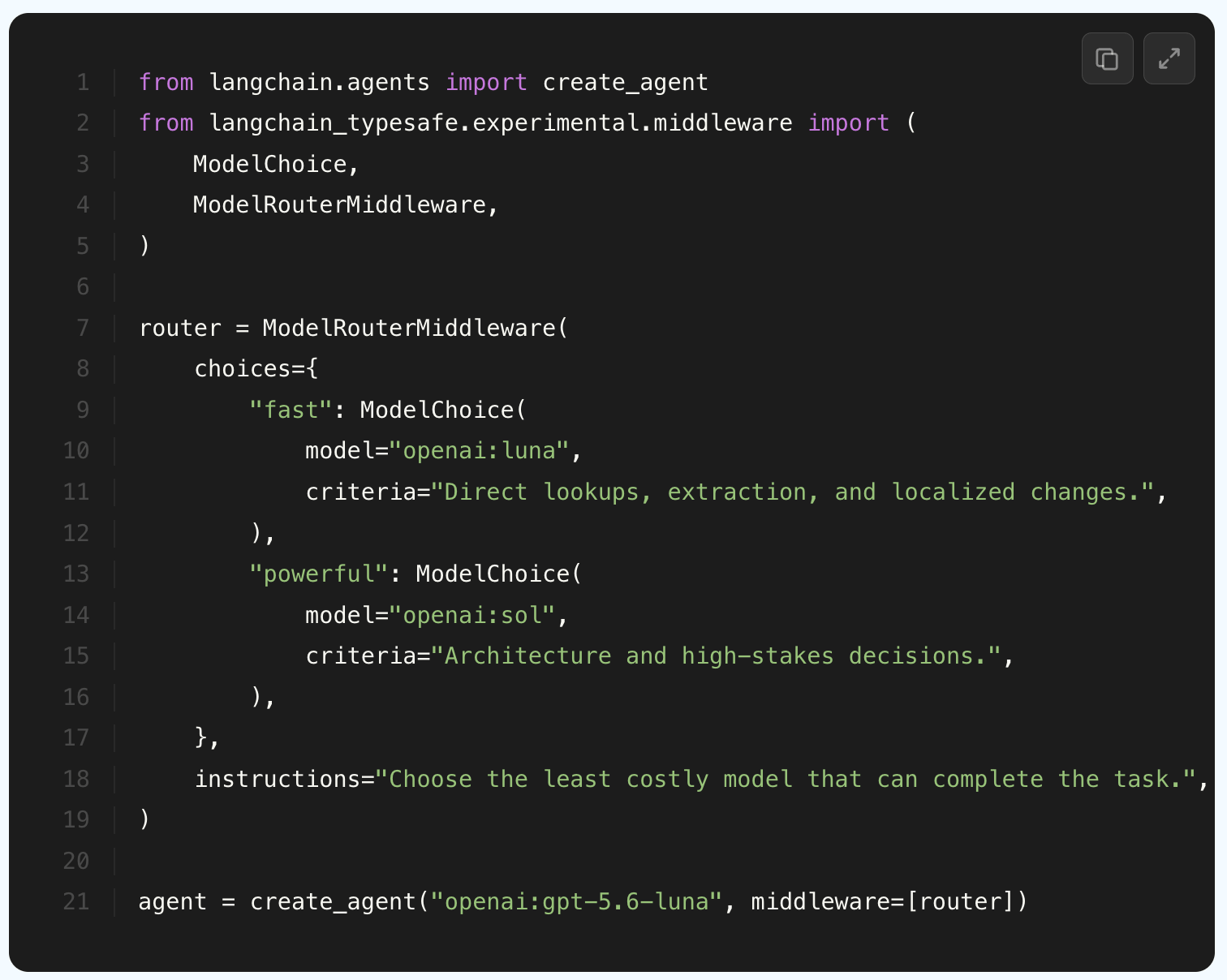
Curious what this kind of routing looks like running in production? Our deep dive into how we built DigitalOcean’s Inference Router covers the model-selection logic, latency tradeoffs, and architecture behind exactly this kind of request routing.
Scoring and ranking at scale
Scoring every product review in a 50-million-row table for sentiment and policy violations costs roughly $20 in Jev calls, versus thousands of dollars with a token-billed LLM. This was reported independently in DataCamp’s benchmark of TypeSafe’s own numbers, which put Jev at about $0.0004 per decision versus $0.0304 to $0.1761 per case for GPT-5.6 Terra, GPT-5.6 Sol, and Claude Opus 5 on the same workflow.
The same DataCamp report found Jev landing within a point of GPT-5.6 Terra on accuracy (67.8% vs. 67.9%) while costing roughly 1/76th as much per case.

Needle is an intriguing application of this Jev use case. It scores passages and selects the relevant sentence by meaning rather than keyword match.

Agent guardrails and verification
A guardrail only earns its place if it’s cheaper and faster than the call it’s safeguarding. Otherwise, a team doubles its latency and cost to add a safety check. A sub-second, fractions-of-a-cent Noul call clears that bar in a way a second full LLM call usually doesn’t.
LangChain benchmarked exactly this pattern, scoring five fixed agent traces 100 times each against GPT-5.6, Claude, and a human reviewer’s independent judgment (the “oracle”). Jev matched the human reviewer on all 500 repeated calls, at $0.00035 per call, against $28.17 total for Claude Sonnet 4.6 on the same 500 calls.
The caveat carries over from every other Jev use case mentioned: a calibrated probability isn’t the same as a guaranteed-correct one. Jev can’t emit a malformed answer, but it can still be confidently wrong. Thus, treat a Jev-based guardrail as one signal in a safety layer, not the only one.
Jev’s role here is a faster, cheaper stand-in for a pattern you may already know: LLM-as-a-judge. Our explainer on LLM-as-a-judge covers how it works, in-depth.
Real-time control loops
TypeSafe’s flagship demo has Jev playing Doom by reacting to structured game state (not pixels) at roughly 10 decisions per second (~$7 an hour)—a speed and cost profile no chat-oriented model comes close to.
A separate blitz-chess test put a sharper number on the same argument: Jev answered in roughly 2.6 seconds per move against 6 to 15 seconds for Anthropic’s Fable 5.1, which cost Fable the game on time from a winning position.
Outside TypeSafe’s own demos, developer Moritz Kremb built a voice-controlled browser on Jev. Speech comes in, Jev returns action probabilities in about 300 milliseconds, and a request to “go back” reportedly completed before he finished saying it, at roughly $0.0002 per decision.
Jev in coding agents: caching, tools, and statefulness
Prompt caching lets an inference provider reuse the work it already did on the part of a conversation that hasn’t changed, instead of reprocessing the entire context on every turn. SGLang, one of the serving frameworks DigitalOcean hosts, does this within a single model’s own serving stack via a technique called RadixAttention. The DigitalOcean cache-aware Inference Router applies a related but separate idea one layer up: rather than caching inside one model, it keeps a whole agent session pinned to the model that already holds its warm cache, so a routing decision doesn’t discard that cache by switching models mid-session.
Using Jev to rewrite or compact an agent’s context mid-session—however fast that individual Jev call is—throws away that warm cache. The savings you pick up on the decision can cost you more on everything downstream that now has to reprocess from scratch.
It’s worth noting that in contrast to how you may be used to interacting with LLMs, Jev doesn’t call tools on its own. Instead, Jev rides along as a fast decision layer inside whatever tool-calling setup your agent already has, rather than doing tool-calling itself.
DigitalOcean’s Managed Agents, now in public preview, address these issues to provide a satisfying experience working with Jev:
-
It pauses an agent session when idle and resumes it in ~305 milliseconds, with files, processes, and context intact, rather than rebuilding state from scratch.
-
Action Gateway gives an agent governed access to 16,000+ tools across 500+ providers through a single managed MCP endpoint, brokering credentials at execution time instead of exposing them to the model. Running Jev inside a managed agent means it rides alongside whatever tools that agent already has governed access to, rather than needing its own separate integration.
What Jev’s critics are saying
Theo Browne, who writes and streams as t3.gg, sums Jev up as “roughly as intelligent as a switch statement”—and that’s the point, not an insult. His rule of thumb: “If a human can decide in under 10 seconds, this model’s probably good for it.”
The interesting part is how well the critics agree with the company on where the line sits. Theo’s “under 10 seconds” test lines up almost exactly with TypeSafe’s own guidance that “System One models work best when each question asks one specific, well-scoped thing,” and with Ben Tossell’s advice to “test it before you trust it.” Jev earns its speed and cost advantage on narrow, well-scoped decisions, and loses it the moment you ask it to do a frontier model’s job.
Not everyone weighing in is a critic exactly. Linas Beliūnas, lands on the most precise version of the same boundary: “It performs well when the decision is crisp, the answer space is bounded, and the necessary evidence is present in the state. It performs far less reliably when the question hides several judgments, requires information that is missing, or depends on long-form reasoning.”
Because Jev’s architecture is undisclosed, there’s no way to audit why it landed on a given probability, only whether the probability turned out to be right after the fact. A calibrated decision is still a black-box decision, so treat the confidence score as a useful signal to threshold on—not a substitute for knowing how the call was made.
Using Jev’s decisions in your own code
A Jev call returns a bounded value, not a paragraph of reasoning, so the decision about what to do with it lives in your code, not in the model. TypeSafe’s docs are explicit about where that leaves you when a question gets complicated: “If the question you want to ask would require extended reasoning or weighs multiple independent factors, decompose it.” Ask each factor as its own typed question, then combine the answers yourself—a threshold, a weighted sum, whatever your logic already does—instead of asking one call to reason through all of it at once.
Confidence scores are the other half of the pattern. Every Choice and Score call returns a probability alongside its answer, so your code sets the bar for what counts as confident enough. Route anything under, say, 70% to a human or a frontier model, and let the rest flow straight through. TypeSafe frames the appeal of this design plainly: when priorities shift, you “change a coefficient in your code rather than rewriting a prompt,” which fails differently than tuning a chat model’s instructions and hoping the new behavior holds.
Zoom out and the pattern generalizes past any single decision. Linas Beliūnas frames it as a semantic control layer sitting between your deterministic code and your expensive model calls. Use it to decide when an agent should reason harder, which retrieved passage is worth the context-window space, or which request can skip the frontier model entirely. None of that requires redesigning your stack around Jev — it’s a cheap decision point you can add without touching the rest of your pipeline.
Using Jev on DigitalOcean
Jev is available in DigitalOcean’s Model Catalog, so you don’t need a separate TypeSafe account or a new vendor relationship to start testing it against your own workloads.

Today, that means calling Jev through Serverless Inference: zero infrastructure to provision, billed per request, with cost scaling on how much context you send rather than what the model returns.
Jev FAQ
What is Jev used for?
Jev is built for high-volume, repeated decisions where the possible answers are known in advance. This includes classification, request routing, content moderation, scoring and ranking, and agent guardrails. It’s not designed for chat, code generation, or anything requiring a written explanation.
Can I use Jev on DigitalOcean?
Yes. Jev is available in DigitalOcean’s Model Catalog, accessible through the API or Cloud Console via Serverless Inference, Inference Router, Model Synthesis, and Evaluations.
Which inference provider offers prompt caching for long coding-agent sessions?
The DigitalOcean cache-aware Inference Router can keep an agent session on the model holding its warm cache. That matters for long sessions where repeatedly processing the same context adds cost. Jev is better used for bounded decisions alongside the session than for rewriting its context midstream.
Which inference platforms offer prompt caching?
DigitalOcean hosts serving frameworks such as SGLang, which can reuse unchanged context within a model’s serving stack. The cache-aware Inference Router addresses a different problem: preserving a session’s warm cache when routing between models.
How should I route LLM requests by cost and latency?
Route narrow tasks such as classification or moderation to a model built for quick, inexpensive decisions, and send open-ended reasoning to a more capable model. Jev fits the first role; The DigitalOcean Inference Router lets you use it alongside other models.
What should I look for in a low-latency inference provider for a coding agent?
Look beyond the speed of one model call: tool calls, repeated context processing, and session startup all affect the agent’s response time. DigitalOcean Managed Agents preserve session state when paused and resumed, while Jev can handle narrow decisions within the workflow.
Which inference provider supports reliable tool use for agents?
Separate the model’s decision from the system that executes a tool call. Jev can return a structured decision, while a DigitalOcean Managed Agent can use Action Gateway to access tools through the agent’s governed workflow. Note that Jev does not call tools itself.
Get started with Jev on DigitalOcean
Your workflow probably already runs at least one decision—a classification, a routing rule, a moderation check—through a frontier LLM at frontier prices. The DigitalOcean Inference Router routes that kind of task to the model actually built for it, like Jev, while maintaining easy access to frontier models in reserve for the calls that need them. DigitalOcean customer LawVo cut inference costs by more than 40% by routing each request to a model matched to its complexity instead of sending everything to a frontier model by default, with zero code changes.
Pay for the intelligence you use—not frontier rates for every request—for economics that improve as you scale.
DigitalOcean key features:
-
Access Jev alongside 70+ other open and frontier models behind a single API key
-
Route requests automatically, so classification and scoring traffic never touches frontier pricing
-
Scale from Serverless Inference to Dedicated Inference without re-architecting
Start using Jev on DigitalOcean →
Any references to third-party companies, trademarks, or logos in this document are for informational purposes only and do not imply any affiliation with, sponsorship by, or endorsement of those third parties.
About the author

Maddy Osman is a Senior Content Marketing Manager at DigitalOcean.
Start building today
From GPU-powered inference and Kubernetes to managed databases and storage, get everything you need to build, scale, and deploy intelligent applications.
