
Teams shipping features on top of large language models eventually hit the same wall: determining whether a model’s output is actually good requires some level of human judgment, which doesn’t scale to the speed and volume at which LLMs generate output. Eyeballing a spreadsheet of outputs works for a handful of examples, not thousands, and public benchmarks are fast but say nothing about how a model handles your production traffic. Human review is the obvious fallback, but it has the same problem as the original Mechanical Turk. The 18th-century “chess-playing machine” that beat the likes of Napoleon and Benjamin Franklin wasn’t a machine at all. It was a person hidden inside, moving the pieces by hand. The illusion worked because it only ever had to play one game at a time. Ask human reviewers to keep pace with everything an LLM generates, and you’re stretching the same trick past its limits, which is convincing for a sample, but impossible at scale. The gap isn’t that judgment is impossible. It’s that consistent, reliable judgment doesn’t scale the way LLM output does. That’s why so many engineering teams have turned to LLM-as-a-judge.
Whether you’re evaluating a chatbot or a fine-tuned model, you need a repeatable way to measure quality before changes reach production. LLM-as-a-judge makes that possible by automating evaluation at scale while producing consistent scores across thousands of responses. It helps you compare models and validate deployment decisions using consistent evaluation criteria. Let’s explore what you need to know before building LLM-as-a-judge into your pipeline.
Key takeaways:
-
LLM-as-a-judge evaluates AI outputs against predefined criteria, making model evaluation faster and more consistent.
-
It works best for applications like retrieval-augmented generation (RAG) systems and fine-tuned models, where traditional metrics like Bilingual Evaluation Understudy (BLEU) and Recall-Oriented Understudy for Gisting Evaluation (ROUGE) fall short. For tasks with one clearly correct answer, like translation or classification, simpler metrics still work well.
-
Reliable evaluations depend on clear rubrics, representative datasets, and periodic validation against human reviewers.
-
DigitalOcean Evaluations helps you compare AI models using reusable evaluation workflows and custom metrics.
What is LLM-as-a-judge?
LLM-as-a-judge is an LLM evaluation method where a large language model reads a prompt, and the AI-generated response (also known as a candidate response) is evaluated. The judge model compares the response against a predefined rubric (set of evaluation criteria) and returns a structured assessment. The rubric can be created from scratch or adapted from an existing evaluation framework like G-Eval. For example, a RAG rubric might say: “Score the response from 1–5 based on factual accuracy and whether claims are supported by the retrieved context.”
Enrique Perez, an AI educator, clearly explains how LLM-as-a-judge is used to score and compare the outputs of other AI models:
The 2023 foundational paper, “Judging LLM-as-a-Judge with MT-Bench and Chatbot Arena” evaluated open-ended chatbot responses, in which multiple answers can be correct, and no single reference answer exists. Traditional text-overlap metrics such as BLEU (which measures word and phrase overlap with a reference answer) and ROUGE (which measures overlap in key words and phrases, commonly for summarization) perform poorly in these scenarios because they compare wording rather than response quality.
Unlike a binary email classifier that labels an email as spam or not spam, an LLM judge is not limited to a fixed set of labels. It evaluates qualities like factual accuracy or adherence to brand guidelines using natural language instructions. The flexibility makes LLM-as-a-judge suitable for evaluating tasks with no single correct answer, like chatbot conversations, Retrieval Augmented Generation (RAG) responses, and code reviews.
Explore how DigitalOcean Evaluations helps teams validate LLM changes against production workloads and automate evaluation in CI/CD before deployment.
LLM-as-a-judge vs. agent-as-a-judge
LLM-as-a-judge scores model outputs against a predefined rubric using one or more judge models. Common choices for judge models are GPT, Claude, and Gemini models, although the best judge depends on the evaluation task and should be validated against human judgments. The judge can be the same model being evaluated, but developers typically use one with stronger reasoning and instruction-following, or another independently selected model to reduce bias and improve evaluation quality. Judge models are chosen for their consistency and ability to assess nuanced responses against detailed criteria. Agent-as-a-judge goes a step further by orchestrating multiple evaluation steps: retrieving evidence, executing tools, or consulting multiple models, before reaching a verdict.
Let’s explore where each approach fits best:
| Point of comparison | LLM-as-a-judge | Agent-as-a-judge |
|---|---|---|
| Role | Scores or ranks outputs based on a prompt and a rubric. | Investigate a response before making a judgment. |
| Decision process | One model generates the evaluation in a single pass. | One or more agents perform planning, evidence gathering, tool use, and then produce a judgment. |
| Context | Limited to the prompt, rubric, and provided inputs. | Can retrieve external documents, query databases, execute code, or inspect logs before scoring. |
| Use cases | Standard benchmarks, response quality checks, RAG evaluation, summarization, and chatbot testing. | Complex evaluations that require verification, compliance checks, or multi-step reasoning. |
| Example | An LLM scores a customer support response for correctness and tone on a 1–5 scale. | An agent verifies cited facts against a knowledge base, runs code to check policy documents, and then determines whether the response passes or fails. |
Build evaluation metrics around what matters to your application. Learn how to combine built-in metrics with custom scoring prompts for consistent model validation with DigitalOcean Evaluations.
How LLM-as-a-judge works
LLM-as-a-judge follows a structured review process. An LLM judge (or LLM evaluator) receives the original prompt, the candidate response, and a scoring rubric. It then returns a verdict in a format for human review.
Consider the example of an LLM that generates summaries of cloud infrastructure incidents for DevOps engineers. Before sharing the summary with the operations team, an LLM judge evaluates whether the output meets the required quality standards by following a set of processes:
-
Criteria definition: Create a rubric that defines what the judge should assess. It might focus on correctness, safety, or another related quality. For example, the rubric might delineate that the summary must identify the root cause, describe the customer impact, and avoid unsupported claims. The LLM evaluator then uses the same rubric for every incident as a consistent baseline.
-
Evaluation input: Send the judge model the original user prompt and the candidate response. Add any reference answer or policy document as context to deliver a fair judgment. For example, once the root cause of the cloud incident is identified, send the original incident log and the AI-generated summary to the LLM judge. Include the incident report or runbook as the reference document when factual verification is required. These details give the judge sufficient context to compare the summary against the source information.
-
Structured verdict: Instruct the LLM judge to return a score, a pass or fail label, or a choice between two responses. Use a fixed output format like a JSON object with fields for the score and explanation. This is the same pattern that frameworks like G-Eval use: structured scoring prompts that keep results comparable across runs. A consistent output format makes it easier to compare summaries across incidents, model versions, and evaluation runs.
-
Judgment generation: The judge model applies the rubric to the response and produces a verdict. If the rubric asks for it, the judge also returns a brief rationale explaining the score. For example, the LLM evaluator compares the generated incident summary against the rubric. If the summary states that a database outage caused the incident, but the logs point to a network failure, the judge marks the response as failed and explains the mismatch.
-
Result processing: Save the verdict with the response and evaluation metadata. Teams can then compare model versions, inspect failures, or send uncertain cases to human reviewers. The verdict, together with the summary and evaluation, is stored as metadata. Engineering teams can monitor, compare model versions, and manually review responses that receive low scores.
Walk through an end-to-end model evaluation in DigitalOcean Model Evaluations to understand how to set up, run, and interpret a Model Evaluation for inference workflows.
LLM-as-a-judge vs. human evaluation vs. traditional NLP metrics
The options for grading LLM outputs sit at a real trade-off between cost, speed, and how well the result tracks to match human judgment:
-
Traditional NLP metrics compare an output to a reference string using word overlap
-
Human evaluation asks a person to read and judge
-
LLM-as-a-judge sits in between, approximating human judgment at a fraction of the cost and time.
In traditional NLP, BLEU and ROUGE can tell you two strings overlap, but they can’t tell you whether a paraphrase using entirely different words is still the correct answer. This is exactly the gap that LLM-as-a-judge evaluation metrics were built to close for free-form generation.
Here’s a more in-depth look at how these evaluation metrics and methodologies compare:
| Point of comparison | LLM-as-a-judge | Human evaluation | Traditional NLP metrics |
|---|---|---|---|
| Who/what performs the evaluation | Reviews the response against a predefined rubric. | A human reviewer reads and assesses the response. | An algorithm calculates similarity scores such as BLEU, ROUGE, or BERTScore. |
| How the response is judged | Uses natural language instructions to evaluate qualities such as correctness, reasoning, factual accuracy, or safety. | Uses human expertise, judgment, and domain knowledge. | Measures token, phrase, or semantic overlap with a reference answer. |
| Need for a reference answer | Optional. A rubric or supporting context is often sufficient. | Optional. Humans can evaluate responses with or without a reference answer. | Usually required because the score depends on comparison with a ground-truth response. |
| Evaluation consistency | High when the rubric and prompt remain unchanged. | Can vary across reviewers because of subjective judgment. | High because the same formula always produces the same score. |
| Use cases | Production evaluation of LLM applications, RAG pipelines, and content quality checks. | Final quality assurance, regulated workflows, legal review, and medical validation. | Research benchmarks, summarization benchmarks, and baseline model comparisons. |
Learn how to design evaluation datasets and metrics that measure AI agent quality under real-world conditions.
Types of LLM-as-a-judge evaluation
Different types of evaluation require different judging strategies. Some tasks require a judge to score a single response, while others require combining opinions from several judge models. Choosing the right evaluation type depends on the availability of reference answers and the complexity of the task.
| Evaluation type | Description | Use case | Example |
|---|---|---|---|
| Single-output (reference-free) | An LLM judge evaluates one response using only a predefined rubric. No reference answer is required. | Creative writing, chatbot conversations, brainstorming, and open-ended tasks where multiple responses can be correct. | A judge scores a product description for clarity, brand voice, and persuasiveness without comparing it to an expected answer. CampusX, an online education platform, demonstrates using reference free evals to design rubrics for the judge model. |
| Single-output (reference-based) | An LLM judge compares one response against a reference answer, policy document, or source material before assigning a score. | RAG evaluation, summarization, question answering, and factual verification. | A judge compares an AI-generated answer about a company’s leave policy against the retrieved HR handbook to verify that every claim is supported by the source documents. Elena Samuylova, an AI educator, provides a walkthrough on how reference-based evals are used for binary correctness. |
| Pairwise comparison | An LLM judge reviews two candidate responses to the same prompt and selects the better one based on a rubric. | Model benchmarking, A/B testing, prompt optimization, and regression testing. | Two versions of a coding assistant generate different SQL queries. The judge chooses the query that best satisfies the user’s request. Lance Martin, an AI developer, explains how to build custom pairwise evaluations to choose between a set of LLM outputs based on user-defined criteria. |
| Panel-of-judges | Multiple LLM judge models independently evaluate the same response. The final decision is based on majority voting, weighted scoring, or score aggregation. | High-stakes evaluations, production benchmarking, AI safety testing, and research experiments. | GPT, Claude, and Llama each evaluate the same legal document summary. The final score combines the judgments from all three models. Enrique Perez, an AI educator, demonstrates how the panel-of-judges concept is used to maintain the integrity of LLMs. |
Choosing an AI inference platform? Compare leading platforms across model availability, deployment options, performance, and cost to find the right fit for your workload.
LLM-as-a-judge use cases
LLM-as-a-judge is useful when AI outputs need to be evaluated at scale against criteria that are difficult to capture with traditional metrics, such as BLEU and ROUGE. Top use cases include:
Determining chatbot quality
LLM-as-a-judge helps evaluate chatbot responses at a production scale. The judge scores each reply against a predefined rubric that measures qualities like correctness, helpfulness, or tone. The results make it easier to compare chatbot versions and identify responses that need improvement.
Walk through dataset creation, evaluation metrics, and model comparison using LangChain and LangSmith with AI educator Krish Naik to understand how LLM-as-a-judge metrics are applied to real chatbot and evaluation workflows.
RAG pipeline performance
RAG systems have failure modes that traditional metrics often miss. An answer can read fluently while ignoring the documents it should be grounded in. An LLM evaluator checks faithfulness by comparing the answer directly against the retrieved context.
Tarun Jain, an AI developer, shares tutorials on how to evaluate a RAG pipeline with LLM-as-a-judge. Instead of relying only on similarity scores, he creates an evaluation dataset and measures faithfulness with an LLM judge.
Fine-tuned model benchmarking
A loss curve (a graph showing how a model’s training error changes during training) doesn’t show whether a fine-tune actually improved. LLM-as-a-judge scores a fine-tune against its base model on the defined rubric. The judge measures the generated outputs directly, which makes it easier to determine whether fine-tuning delivers better real-world performance.
Siddhardhan S, an AI educator, demonstrates this type of workflow in code by comparing responses from two LLMs and using a third LLM as the judge. His tutorial walks through how structured evaluation prompts and JSON outputs can benchmark candidate models before selecting one for production.
Human-in-the-loop labeling workflows
Organizations use LLM-as-a-judge to reduce the manual effort required for labeling large AI datasets. The judge evaluates each response against a predefined rubric and automatically assigns an initial score. Human reviewers then validate only the responses that require additional review for model training.
Dave Ebbelaar, an AI engineer, explains how production AI teams combine LLM judges and human review to improve application quality over time. His evaluation framework aligns LLM judges with human expectations.
Code generation quality
Developers use LLM-as-a-judge to compare code generated by different models and rank candidate solutions before deployment. The judge evaluates outputs against criteria like correctness, code quality, and adherence to the prompt, which helps engineers identify the strongest candidate for a given task.
In CodeJudgeBench, Hongchao Jiang and colleagues benchmarked 26 LLM judges across code generation, code repair, and unit test generation. Their work evaluates how effectively LLM judges rank coding responses. They also explore strategies like pairwise comparison, which improves evaluation quality for selecting the better of two code responses.
With the DigitalOcean AI Platform, you can build and deploy LLM applications without requiring advanced technical expertise thanks to prebuilt AI services and simplified deployment workflows. Brainforest, a digital communication agency, shares how DigitalOcean products helped their team move from complex cloud workflows to a more simplified development experience.
Pitfalls of LLM-as-a-judge
While LLM-as-a-judge can effectively evaluate responses at scale, it is not without the potential for errors. The quality of the evaluation ultimately depends on the judge model, the evaluation prompt, and the supporting context available during scoring.
Judgment drifts across model versions
The nature of LLM judge scores can change after a model upgrade, even when the prompt and rubric remain the same. This is because new model versions may interpret the same evaluation criteria differently or apply stricter reasoning. In these situations, identical responses can receive different scores. This makes it difficult to compare evaluation results across releases.
Imagine a marketing team evaluates 5,000 AI-generated product descriptions every month. After upgrading the judge model, descriptions that previously scored 8/10 now receive scores of 6/10, despite no change in content. In this situation, you can assume that the score shift reflects a change in the judge rather than an improvement or decline in writing quality.
Inherent non-determinism
Unlike a deterministic formula, an LLM judge won’t necessarily return the exact same score every time, even with an unchanged prompt and rubric. For example, a response might receive a score of 4/5 in one evaluation run and 3/5 in another. This is because the model samples from a probability distribution when generating its judgment. Lowering the judge model’s temperature, like setting it to zero, can reduce this variance but does not guarantee identical results.
Bias in evaluation
An LLM judge develops systematic preferences for certain writing styles, languages, reasoning patterns, or model families. These AI biases can produce incorrect scores even when multiple responses are equally valid. A self-preference bias is documented in a 2024 study, LLM Evaluators Recognize and Favor Their Own Generations, which explains that GPT-4 (and similar LLM evaluator models) score their own outputs higher than human reviewers do.
To help understand the impact of bias, consider an example where two AI assistants explain the same cybersecurity concept. One uses concise technical language, while the other uses conversational language with analogies. The judge consistently favors the longer explanation even though both are equally accurate.
Prompt-sensitive scoring
Small changes to the evaluation prompt or scoring rubric can influence the final verdict. Changing the wording of the instructions or the evaluation criteria shifts what the judge considers most important. As a result, identical responses can receive different scores even when the underlying output has not changed.
Consider an evaluation prompt that asks the judge to prioritize technical accuracy, while another emphasizes readability. The same API documentation receives a high score under the first rubric but a lower score under the second because the evaluation criteria changed.
Limited factual verification
An LLM judge cannot reliably detect hallucinations unless it has access to trusted reference material or a retrieval system to check. Without supporting evidence, it may treat plausible statements as factual.
For instance, an AI generates a biography of a public figure and invents an award that the person never received. Without access to a trusted source, the judge accepts the fabricated achievement because it appears credible and fits the writing style.
Preference for persuasive over correct answers
Detailed, confident, and well-structured responses can receive higher scores than shorter but more accurate answers. Judge models may rely on surface-level signals like structure and alignment with expected patterns instead of deeply verifying factual correctness. The 2024 Length-Controlled AlpacaEval paper found that many LLM judges over-weight response length, rewarding longer answers even when length has nothing to do with quality. As a result, well-presented but incorrect answers may receive higher scores and result in misleading outputs that pass unnoticed.
For example, two AI models answer a math question. One provides the correct numerical result in two sentences. The other produces a lengthy explanation with polished formatting but makes an arithmetic error. The LLM judge assigns the higher score to the second response because the explanation appears more comprehensive.
Is your AI project bill growing faster than expected? Use our LLM cost calculation guide to estimate workload spend and plan production budgets more accurately.
When can you trust an LLM judge?
LLM-as-a-judge is not equally reliable for every evaluation task. Its effectiveness depends on how objective the evaluation criteria are, whether supporting evidence is available, and whether multiple valid answers exist. Before replacing human review, assess how consistently an LLM judge performs on the specific task and whether the results require additional verification. Before replacing human review, determine whether the judge model performs consistently on the task. Keep additional verification for high-stakes cases, such as safety-related outputs that require expert review.
Consider the following factors when deciding whether an LLM judge is appropriate for your use case:
-
Tasks with clear rules and evidence-backed evaluations are where LLM judges are most reliable. They can compare responses against predefined requirements or evidence with less ambiguity. Projects involving policy compliance checks and structured output validation are well-suited for LLM-as-a-judge workflows.
-
Regulated industries require human oversight beyond automated evaluation. Legal, medical, and financial outputs rely on expert judgment because errors can result in serious consequences. LLM judges can assist the review process, but should not make final decisions.
LLM-as-a-judge best practices
Following a few best practices improves the consistency and reliability of LLM-as-a-judge evaluations. The goal is not just to automate scoring but to produce evaluations that remain meaningful across models and evaluation runs.
Define objective evaluation criteria
A judge cannot produce reliable scores without a clear rubric. Write evaluation criteria that describe exactly what the model should assess. Replace vague instructions such as “good answer” with measurable requirements involving factual accuracy, policy compliance, or completeness.
Suppose you’re evaluating AI-generated API documentation. Instead of asking the judge to score the “overall quality,” instruct it to verify whether every required parameter is documented, every response code is explained, and every code example is syntactically correct. The judge now evaluates against objective requirements instead of vague direction.
Use structured scoring outputs
Ask the judge to return results in a predefined format rather than open-ended text. A structured response may include a numeric score, a pass or fail result, and a short justification. Standardized outputs simplify comparison across evaluation runs and reduce ambiguity during analysis.
Let’s say 20,000 AI-generated product descriptions are published on an e-commerce website. The LLM judge evaluates each one. Every result includes a quality score from 1 to 10, a pass or fail label, and a one-sentence explanation.
{
  "quality_score": 8,
  "result": "PASS",
  "justification": "The description is accurate, clear, and highlights key product features."
}
Provide the context needed for evaluation
Do not expect the LLM judge to verify facts without supporting evidence. Supply a reference answer, retrieved documents, or policy guidelines whenever factual accuracy is important. The judge can only evaluate information that is available during inference.
Consider an AI assistant that answers questions about internal engineering standards. The judge receives the relevant design document along with each response before assigning a score. Access to the official documentation helps the judge verify whether the answer accurately reflects the published standard.
Validate the LLM judge against human reviewers
Treat the LLM judge as an evaluation tool rather than the source of absolute truth. Periodically compare its decisions with human evaluations on a representative sample of responses. Update the rubric or prompt whenever consistent disagreements appear between the judge and human reviewers.
For example, a team publishing AI-generated software release notes has the judge score every note. Then, it has technical writers manually review a random sample of 200 scored notes each week. Repeated disagreements reveal where the rubric needs refinement. The updated evaluation prompt improves agreement between human reviewers and the judge.
Keep the LLM judge prompt and model version consistent
Keep the judge model and prompt fixed for the length of an evaluation run. Even small prompt revisions or model upgrades can change scoring behavior. Freeze the prompt and model version for each evaluation cycle, then document any changes before starting a new round.
Suppose a team evaluates four code generation models over six weeks using the same judge model and prompt throughout. If they upgrade the judge model midway, they’d need to re-score every candidate under the new judge, since scores from before and after the switch reflect two different judges—not two different levels of model quality.
Build evaluations you can trust. Reuse the same judge model and parameters across runs to keep comparisons consistent. Our DigitalOcean Evaluations best practices help you develop a repeatable LLM-as-a-judge workflow for models and routers.
How to measure the effectiveness of an LLM judge
An LLM judge should be evaluated just like any other model in your AI pipeline. A high-quality judge produces consistent scores and distinguishes meaningful quality differences between candidate responses. Before relying on automated evaluations, validate that the judge performs reliably on representative production data.
| Evaluation criterion | Description | Example |
|---|---|---|
| Scoring consistency | The same input should receive the same score across repeated evaluation runs. | Re-evaluate the same summarization dataset after one week using the same judge configuration. |
| Rubric adherence | The judge model sticks to the criteria the rubric defines and treats anything outside that scope as irrelevant to the score, rather than introducing new preferences of its own. | Score customer support replies only for policy compliance, not writing style. |
| Sensitivity to quality differences | Better responses should consistently receive higher scores than weaker ones. | Compare two RAG answers, where one faithfully cites retrieved documents, and the other does not. |
| Stability across model updates | Judge model behavior should remain comparable across evaluation cycles. | Benchmark a new model version using the same judge, rubric, and evaluation dataset. |
Discover how DigitalOcean combined LLM judges with deterministic metrics to validate a documentation agent at scale.
How DigitalOcean uses LLM-as-a-judge to evaluate models and routing policies
DigitalOcean Evaluations applies an LLM-as-a-judge framework to automate the evaluation against custom datasets using predefined or custom evaluation rubrics. Rather than relying on public benchmarks, DigitalOcean evaluates the specific inference endpoints you plan to deploy—using the same system prompt, temperature, and parameters your app actually sends.
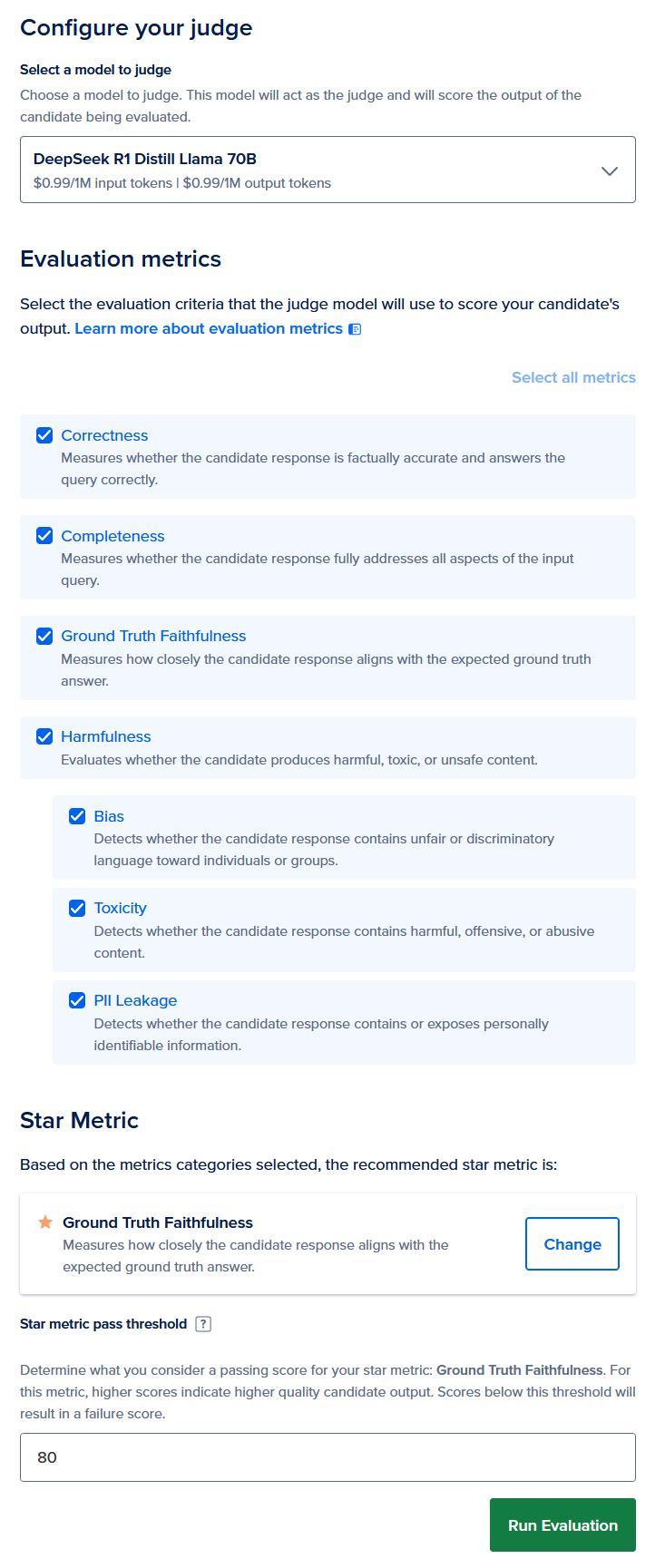
Configure an evaluation with your own dataset
Every evaluation begins by selecting the candidate models you want to test, uploading an evaluation dataset, and choosing an LLM judge. You can compare serverless models, dedicated deployments, Bring Your Own Model (BYOM) imports, and inference routers under identical evaluation settings. Every candidate is measured against the same dataset, judge model, and scoring criteria. You can also select built-in metrics—like ground truth faithfulness and PII leakage—or define your own custom evaluation metrics.
Reuse evaluation configurations as models evolve
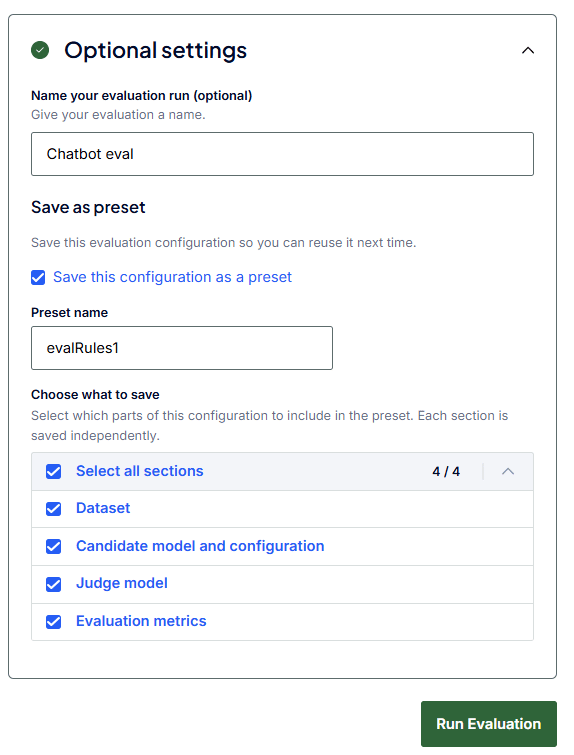
Production evaluation is not a one-time task. In the Optional settings, you can save evaluation presets for datasets and specified configuration metrics. You can then rerun the same evaluation after changing a model or routing policy, making results directly comparable across versions and reducing configuration drift.
Analyze quality, cost, and latency in a unified dashboard
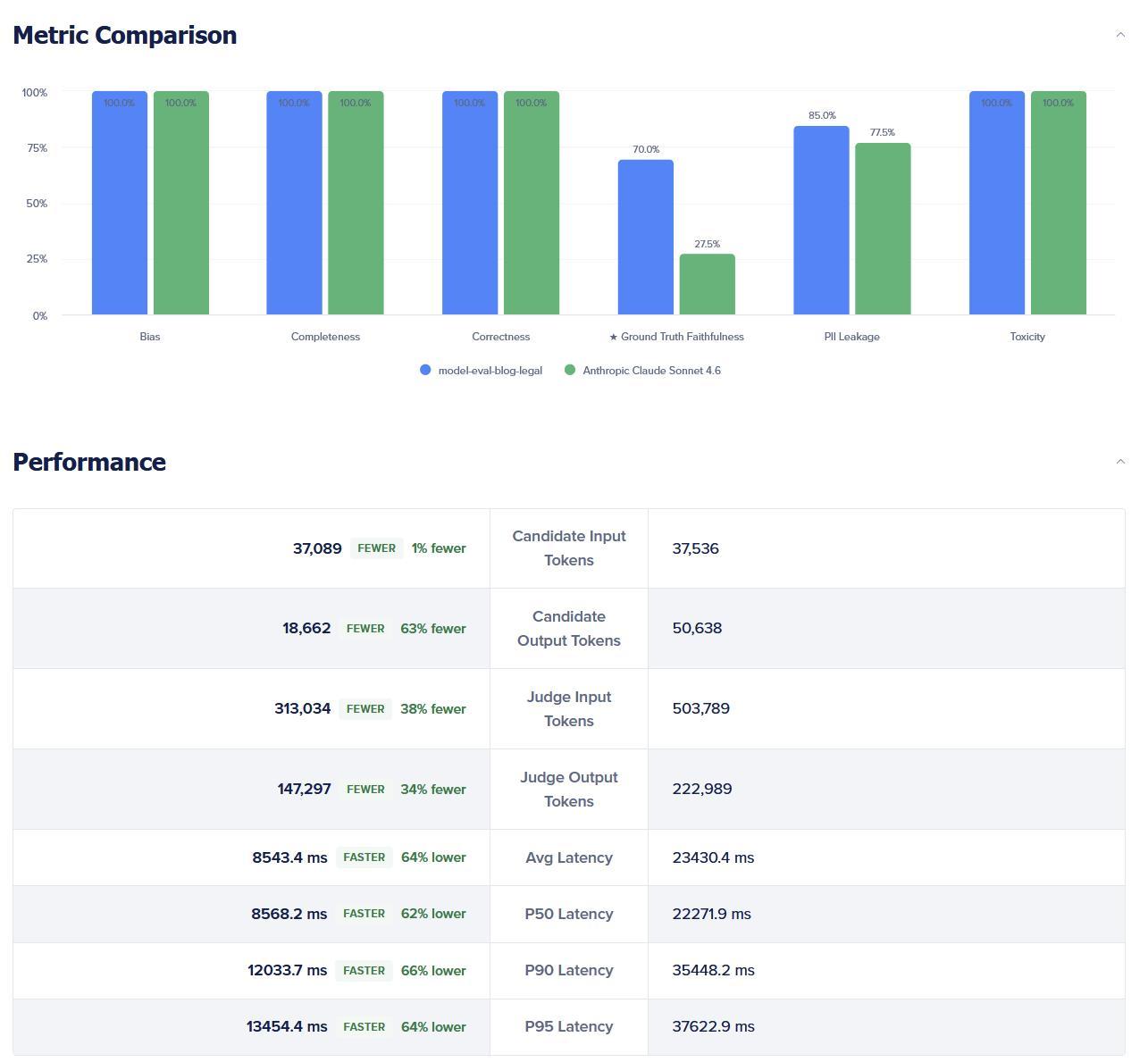
After an evaluation finishes, the DigitalOcean dashboard combines quality metrics with operational metrics. Alongside scores for correctness and other metrics, you can compare latency, token usage, and estimated inference cost. Individual evaluation rows also include the judge’s rationale, making it easier to understand why a response passed or failed.
This combination helps answer practical questions such as:
-
Does the routing policy preserve quality while reducing latency?
-
Does a fine-tuned model improve accuracy enough to justify deployment?
-
Which candidate delivers the best quality per dollar for your workload?
The evaluation results dashboard shows metric comparison across important performance parameters.
Access the latest AI models without changing your evaluation workflow. Run consistent LLM-as-a-judge evaluations across new DigitalOcean models before updating production applications.
LLM-as-a-judge FAQs
Does LLM-as-a-judge actually work?
Yes. When paired with a well-defined rubric and representative datasets, LLM-as-a-judge produces reliable and repeatable evaluations for many production workloads. Human review remains important for validating edge cases and confirming if automated scores align with real-world expectations. DigitalOcean Evaluations runs the LLM-as-a-judge framework against your own inference endpoints.
Is DigitalOcean Evaluations the same as LLM-as-a-judge?
DigitalOcean Evaluations is a managed implementation of that methodology. The platform evaluates models, BYOM deployments, dedicated endpoints, and inference routers using built-in or custom rubrics, then compares quality, latency, and cost in a single workflow.
What is the difference between LLM-as-a-judge and agent-as-a-judge?
LLM-as-a-judge uses a single judge model to score responses against a predefined rubric. An agent-as-a-judge performs additional steps, such as evidence retrieval or tool use, before producing a verdict. LLM-as-a-judge can be more cost-effective for straightforward evaluations, while agent-as-a-judge is useful when a task requires additional reasoning or verification.
How do I correctly report LLM-as-a-judge evaluations?
Keep the judge model, dataset, rubric, and evaluation settings consistent across every run so results remain comparable. Use DigitalOcean Evaluations to save evaluation presets and metrics that measure one behavior at a time instead of combining multiple requirements into a single score.
What is the difference between LLM-as-a-judge and traditional metrics like BLEU or ROUGE?
BLEU and ROUGE measure text similarity against a reference answer, which makes them suitable for tasks with expected outputs, such as machine translation or benchmark summarization (where a reference output already exists). LLM-as-a-judge evaluates qualities like correctness and safety using natural language rubrics, making it better suited to applications such as chatbots, RAG systems, and AI agents.
Evaluate your LLMs with confidence on DigitalOcean
Build repeatable LLM-as-a-judge workflows on DigitalOcean Evaluations. You can compare models, fine-tuned deployments, and routing policies against your own production workloads before you ship. The platform provides the essential tools for consistently evaluating your inference stack, with the ability to automate validation as your models evolve:
-
Evaluate your entire inference stack with serverless models, dedicated endpoints, BYOM imports, and inference routers using the same workflow.
-
Score what matters to your application using built-in metrics or custom rubrics, and keep evaluations consistent with reusable presets that retain your parameters across model versions.
-
Compare quality, latency, and cost together with per-item judge rationale in a single evaluation dashboard.
-
Integrate evaluations into CI/CD pipelines via MCP support and APIs to automate validation before deployment.
Deploy with confidence using DigitalOcean Evaluations.
About the author

Sujatha R is a Technical Writer at DigitalOcean. She has over 10+ years of experience creating clear and engaging technical documentation, specializing in cloud computing, artificial intelligence, and machine learning. ✍️ She combines her technical expertise with a passion for technology that helps developers and tech enthusiasts uncover the cloud’s complexity.
Start building today
From GPU-powered inference and Kubernetes to managed databases and storage, get everything you need to build, scale, and deploy intelligent applications.
