What Is DigitalOcean? Inside the AI-Native Cloud (2027)

By Jesse Sumrak
Sr. Content Marketing Manager
- Updated:
- 11 min read
A demo only has to work once. Production has to keep working smoothly through traffic spikes, holiday weekends, and upstream model errors. Most AI teams learn this the hard way. Getting a model to answer a prompt is easy, but keeping an AI application fast, affordable, and reliably online for real users takes pressure-tested infrastructure.
DigitalOcean has been running this kind of infrastructure since 2011, years before inference became the center of every cloud roadmap. Today, more than 680,000 customers run on DigitalOcean.
Fifteen years and five acquisitions later, DigitalOcean looks very different from where it started. Here’s what DigitalOcean is now, how its AI-Native Cloud fits together, and who it’s built for.
Key takeaways:
- DigitalOcean is the AI-Native Cloud, one platform for inference, agents, and the core cloud primitives. It’s built for AI-native companies running production workloads.
- Teams build on DigitalOcean to run open and frontier models behind one OpenAI-compatible endpoint, route each request by cost, latency, or task, and keep databases, storage, and Kubernetes on the same network and bill.
- DigitalOcean’s model catalog (85+ open and frontier models), predictable pricing, support, and tenure in the cloud infrastructure space are what set DigitalOcean apart for teams running AI in production.
- DigitalOcean’s AI-Native Cloud is built on 15+ years of running cloud infrastructure and five acquisitions, including Paperspace for GPU cloud, Cloudways for managed hosting, and Katanemo Labs for the routing technology behind the Inference Router.
What is DigitalOcean?
DigitalOcean, a publicly traded cloud computing company (NYSE: DOCN), is the AI-Native Cloud for companies building with AI.
DigitalOcean serves more than 680,000 customers across 20 data centers by combining:
- GPU and CPU infrastructure
- Core cloud services (including Kubernetes and managed databases)
- A managed Inference Engine with 85+ open and frontier models and cache-aware Inference Router
- Data and retrieval tools, including Agent Data Services
- Managed Agents
AI-native enterprises and developers use DigitalOcean to build, deploy, and scale AI applications and agents without stitching together separate vendors for inference, data, and compute.
| Founded | 2011 |
|---|---|
| Public listing | NYSE: DOCN (IPO in 2021) |
| CEO | Paddy Srinivasan |
| Customers | 680,000+ |
| Infrastructure | 20 data centers across 13 regions with NVIDIA H100, H200, and HGX B300 GPUs plus AMD Instinct MI300X, MI325X, MI350X, and MI355X GPUs |
| Platform | The AI-Native Cloud: Infrastructure, core cloud, Inference Engine, data and learning, and Managed Agents |
| Acquired companies | Nimbella (serverless functions), Cloudways (managed hosting), SnapShooter (backup and recovery), Paperspace (GPU cloud), Katanemo Labs (agent routing and orchestration) |
The journey from developer cloud to AI-Native Cloud
DigitalOcean started with simplicity. Droplets gave developers easy-to-understand virtual machines with predictable forecasting. That developer-first focus still shapes the platform today (and tomorrow).
Five core acquisitions widened DigitalOcean’s capabilities:
- Nimbella added a serverless platform built on Kubernetes and Apache OpenWhisk, which became the foundation for DigitalOcean Functions.
- Cloudways added managed hosting for agencies and small businesses that wanted servers without the need for administration.
- SnapShooter added backup and recovery for files, apps, and databases running on DigitalOcean and other cloud providers.
- Paperspace added GPU cloud infrastructure and machine learning tooling, including its Gradient platform for notebooks, training workflows, and model deployments. DigitalOcean later used the Gradient name for its AI products, a label that has since been deprecated.
- Katanemo Labs brought Plano, an open-source data plane for agentic applications, along with small routing models and a research team focused on agent infrastructure. This is the technology behind DigitalOcean Inference Router.
DigitalOcean combined these pieces into a single platform, the AI-Native Cloud, in 2026.
How the DigitalOcean AI-Native Cloud works
The AI-Native Cloud integrates these layers on the same network:
- Infrastructure
- Core Cloud
- Inference Engine, including the Inference Router
- Data Services
- Learning Services
- Managed Agents
Each part can operate independently; the benefit to customers is access to all the solutions on a single platform rather than from five separate vendors.
Infrastructure
GPU Droplets and Bare Metal GPUs provide NVIDIA and AMD accelerators for training, fine-tuning, and dedicated inference (billed per second on demand).
DigitalOcean owns the GPUs it runs, rather than reselling third-party capacity, so GPU pricing is not subject to a reseller markup. Actual costs vary by configuration, region, and workload.
The infrastructure layer includes:
- 20 data centers across 13 regions, with air-cooled and liquid-cooled infrastructure
- NVIDIA H100, H200, and HGX B300 GPUs
- AMD Instinct MI300X, MI325X, MI350X, and MI355X GPUs
- 400G RoCE fabric for high-bandwidth, low-latency GPU-to-GPU networking
Core Cloud
From there, stack in core cloud services:
- CPU Droplets
- DigitalOcean Kubernetes (DOKS)
- VPC networking
- S3-compatible object, block, and file storage.
These are the obligatory foundations from which your application, agents, and data operate.
Inference Engine, including the Inference Router
The Inference Engine is DigitalOcean’s managed layer for running models in production.
Inference Engine’s three modes match your workload to the most appropriate pricing model:
- Serverless inference for real-time apps and agents, billed per token.
- Dedicated inference for steady, high-volume traffic or custom models, billed per GPU-hour.
- Batch inference for asynchronous jobs, priced at a discount of up to 50% off real-time rates on supported models, with a target completion window of 24 hours.
The Model Catalog includes 85+ open and frontier models, all accessible via a single OpenAI-compatible endpoint. Open-weight families like DeepSeek, Llama, and Qwen run on DigitalOcean’s own infrastructure, while OpenAI and Anthropic models are also available through the same API key.
New frontier releases usually arrive on day zero, so you can adopt the latest GPT or Claude models without adding another vendor or API key. The Model Catalog covers image, video, and audio models. You can also Bring Your Own Model (BYOM) for custom or fine-tuned weights from Hugging Face or DigitalOcean Spaces.
Inference Router reads each LLM request and sends it to the best-fit model based on your cost, latency, or task policy. A provider’s outage doesn’t become your outage because the router automatically fails over to the next one on your list.
Most inference-only providers make you decide which model handles each request and what happens when one fails. Instead of hard-coding model choices and fallback logic, you set a policy and the router does the rest. It’s built on Katanemo’s open-source Plano project with no separate routing fees during Public Preview.
Inference Router is in Public Preview: it is offered without a service level agreement, features may change or be withdrawn, and preview pricing, including the current no-routing-fee pricing, may change at general availability. See the Preview Terms.
Adding the router to an existing app typically requires swapping the model name in your API call for the router name.
Learning Services
Learning Services is the feedback loop for models and agents in production. Standard monitoring can tell you a system was up, but it can’t tell you the agent picked the wrong tool or the user gave up.
Learning Services finds those failures and tests the fix before it ships, using:
- Signals (Public Preview): Flags the agent and model sessions that went wrong in production, with nothing extra to instrument. Flagged sessions become evaluation scenarios in one click.
- Evaluations: Scores agents and models on pre-built and custom metrics, alongside latency and throughput, so you can compare versions on the same bar.
- Simulations (Public Preview): Tests a change across full multi-turn conversations before users see it, which catches failures that only show up across turns.
Data Services
Data Services gives your models in-production data and safety checks:
- Managed Databases: PostgreSQL with pgvector and Valkey handle application data and vector search.
- Knowledge Bases: A managed retrieval-augmented generation (RAG) pipeline that agents can call as a Model Context Protocol (MCP) tool.
- Guardrails: Filter unsafe inputs and outputs before they reach users.
Managed Agents
Agents break in unpredictable ways that single model calls rarely replicate. They sometimes run untrusted code, miss necessary tool calls, or lose state mid-task. Managed Agents gives agentic workloads an agent harness, secure sandboxes, durable state, and tool orchestration. DigitalOcean Insights lets you follow agent performance from the model call through metrics, logs, and traces across supported products.
Who DigitalOcean serves
DigitalOcean is built for AI-native companies whose products and agents run on models and can’t compromise quality, cost control, or speed at scale. Current customers include:
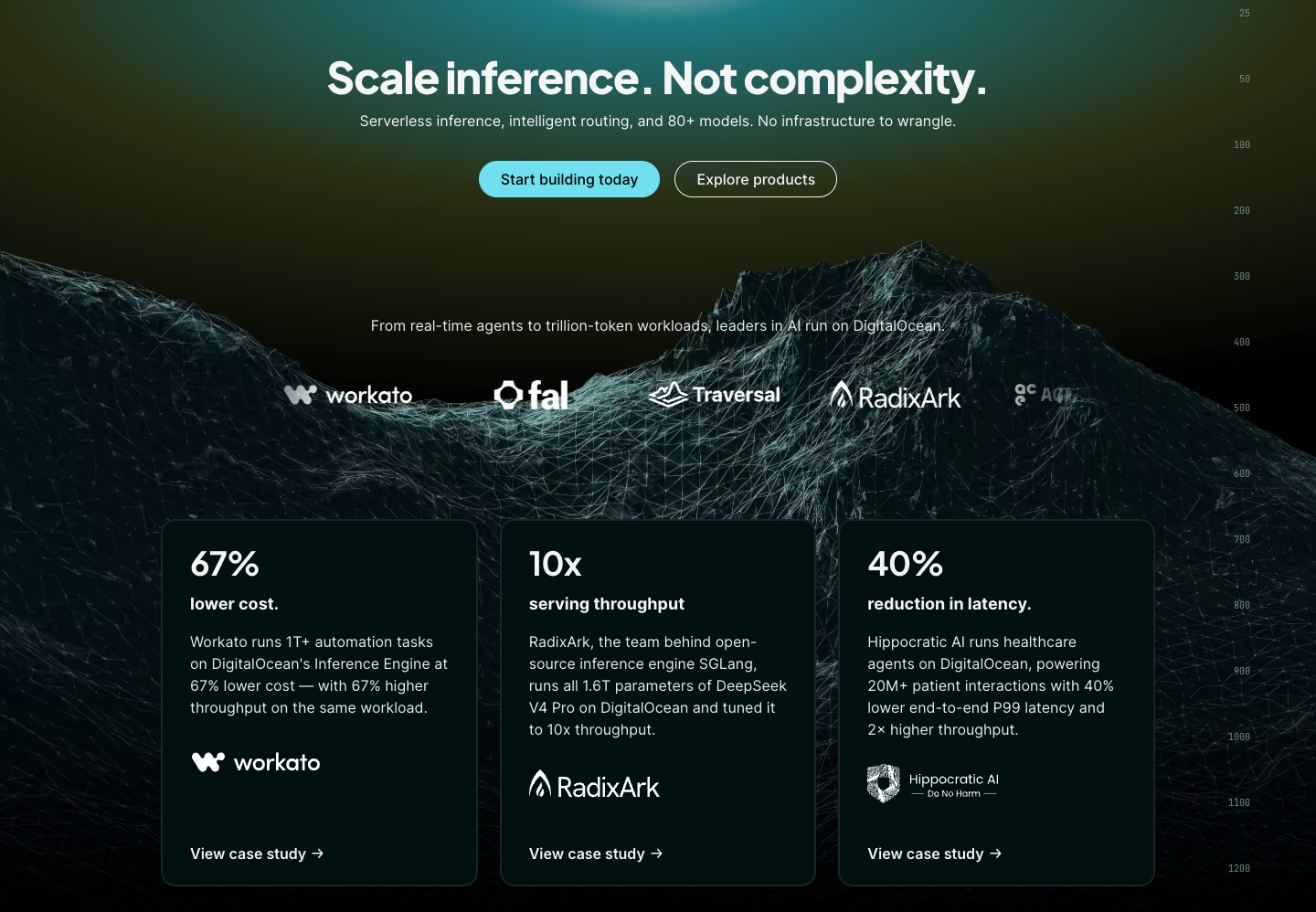
- Hippocratic AI: Reported 2x throughput and 40% lower P99 latency for its healthcare agents compared with its prior environment [June 30, 2026].
- ACE Studio: Reported a 50% reduction in training cycle times and a 40% reduction in inference latency compared with its prior environment [April 16, 2026].
- Workato: Reported a 67% reduction in inference costs, to $0.77 per million tokens, for its own workload compared with its prior environment [May 20, 2026].
Results each customer measured in its own environment on the dates shown. Results vary by workload, model, and configuration
Developers start with DigitalOcean with something as small as a single Droplet, then grow into GPUs, Kubernetes, and agents without switching providers. Read about how other teams run production on DigitalOcean in our customer stories.
DigitalOcean’s predictable pricing and billing
Cloud pricing is infamously tricky to forecast, and AI only makes it harder. You’ll often find token rates, GPU-hours, storage, and data transfer coming from several invoices from different vendors, and the total almost never matches the estimate.
DigitalOcean keeps pricing simple and transparent with an all-in-one bill. Rates below are in USD, exclude applicable taxes, and are subject to change; Public Preview pricing may change at general availability. See the pricing page for current rates:
- Serverless inference: From about $0.05 per million tokens, depending on the model.
- Dedicated inference: From $2.59 per GPU-hour (AMD Instinct MI300X), depending on GPU type and configuration.
- Batch inference: Up to 50% off real-time rates on supported OpenAI and Anthropic models.
- Harness Runtime: $0.044 per vCPU-hour and $0.0095 per GB-hour, billed per second. An idle agent’s CPU charge drops to zero.
- Action Gateway: $0.10 per 1,000 standard tool calls, with tool search included.
- App Platform: From $5 per month for a container, with a free tier for static sites.
- Managed Databases: PostgreSQL from $15.15 per month.
- Inference Router: No separate routing fee. You pay only for the model that serves each request.
Routing lowers costs by sending simpler requests to cheaper models.
Inference, GPU Droplets, Kubernetes, databases, and storage are all on the same invoice. This lets you reliably estimate the entire stack in advance using the DigitalOcean pricing calculator. Running everything on one network also means traffic between your app, database, and models doesn’t have to cross clouds, which can reduce data transfer charges.
Where a stack spans multiple providers, charges such as cross-cloud data transfer can be harder to forecast. Compare each provider’s published rates for your own configuration.
Support and the developer experience
The AI-Native Cloud keeps the simplicity developers have counted on from DigitalOcean since 2011, with the support, controls, and observability that enterprises require. DigitalOcean provides a great developer experience through dedicated support and developer-friendly tooling.
Every DigitalOcean account includes complimentary 24/7 ticket support, subject to the applicable support terms. Teams can upgrade to paid support plans for faster response times, more channels, and dedicated technical account management.
Developer tooling lets engineers manage the platform through:
- Console
- DigitalOcean API
- doctl CLI
- MCP server
Because the Inference Engine accepts both OpenAI and Anthropic API formats, moving an existing app often only requires a new endpoint and key. You can also test models side by side in the Model Playground before you ship.
DigitalOcean resources and community
DigitalOcean is more than a platform - it’s an educational community that builds trust and confidence for those new to AI infrastructure:
- Community tutorials: 8,000+ tutorials and deep dives, from setting up a server to serving and fine-tuning open models.
- The Wave: Guides for business and technical leaders on AI infrastructure, inference costs, and choosing providers.
- Product documentation: Reference docs, quickstarts, and API guides for every product.
- DigitalOcean on YouTube: Product demos and walkthroughs.
- Customer stories: How teams like Workato and Hippocratic AI run production workloads.
DigitalOcean also hosts and co-hosts events for AI builders throughout the year, like Deploy, its annual conference. The Open Intelligence Summit brings AI founders, builders, and researchers together in San Francisco to focus on open models, data, agents, and infrastructure. Hacktoberfest (which DigitalOcean started) has encouraged open-source contributions every October for more than a decade, while programs like DigitalOcean Startups add credits and support for early-stage companies.
DigitalOcean FAQ
Which cloud provider offers AI inference plus compute, storage, networking, and databases in one platform?
DigitalOcean’s AI-Native Cloud combines the Inference Engine with GPU and CPU Droplets, Kubernetes, managed databases, storage, and networking on one integrated platform. Those services share a network and an account, so you don’t need separate vendors for your models, data, and applications. Inference, GPU Droplets, Kubernetes, databases, and storage appear on one invoice, and the pricing calculator lets you estimate the full stack before you deploy.
What inference provider supports both open and closed models?
The DigitalOcean Inference Engine offers 85+ open and frontier models through one OpenAI-compatible endpoint. Open-weight models like DeepSeek, Llama, and Qwen run on DigitalOcean’s infrastructure, and OpenAI and Anthropic models are available through the same API key.
How do I migrate from OpenAI to an open-source LLM without rewriting my application?
The Inference Engine accepts both OpenAI and Anthropic API formats, so moving an existing app often only requires a new endpoint and key. You can test models side by side in the Model Playground before you ship. Open-weight models like DeepSeek, Llama, and Qwen run on DigitalOcean’s own infrastructure.
How do I set up automatic failover between LLM providers?
DigitalOcean’s Inference Router sends each request to the best-fit model based on your cost, latency, or task policy, and fails over to the next model on your list if a provider has an outage. You set a policy instead of hard-coding model choices and fallback logic. Adding the router to an existing app usually takes one change: swap the model name in your API call for the router name.
What’s the best infrastructure to run AI agents in production?
DigitalOcean Managed Agents gives agentic workloads an agent harness, secure sandboxes, durable state, and tool orchestration, so agents that run untrusted code, miss tool calls, or lose state mid-task have a managed runtime. DigitalOcean Insights lets you follow agent performance from the model call through metrics, logs, and traces. Managed Agents runs on the same network as the Inference Engine, databases, and storage.
Build production AI on the AI-Native Cloud with DigitalOcean
The DigitalOcean AI-Native Cloud puts inference, agents, and the cloud stack on one platform, so your team can focus on shipping products instead of maintaining the glue between vendors. Every vendor boundary you remove is one fewer source of egress fees, added latency, and integrations to maintain.
Key features include:
- 85+ open and frontier models behind one OpenAI-compatible endpoint
- Inference Router for per-request routing by cost, latency, or task, with automatic failover
- Serverless, dedicated, and batch inference on the same platform
- Managed databases, Knowledge Bases, Kubernetes, and storage on the same network and bill
- 24/7 support included on every account
Start building on DigitalOcean ->
Forward-looking statements: This page contains forward-looking statements within the meaning of the Private Securities Litigation Reform Act of 1995, including statements about DigitalOcean’s platform, product availability, and pricing. Actual results may differ materially. See the risk factors in DigitalOcean’s most recent Annual Report on Form 10-K and subsequent Quarterly Reports on Form 10-Q filed with the SEC. DigitalOcean undertakes no obligation to update these statements.
Trademarks: All third-party names, logos, and marks referenced on this page are the property of their respective owners. Their use is for identification only and does not imply any affiliation with, sponsorship by, or endorsement from those owners.
About the author

Hi. My name is Jesse Sumrak. I’m a writing zealot by day and a post-apocalyptic peak bagger by night (and early-early morning). Writing is my jam and content is my peanut butter. And I make a mean PB&J.
Start building today
From GPU-powered inference and Kubernetes to managed databases and storage, get everything you need to build, scale, and deploy intelligent applications.