9 Nebius Alternatives for AI Workloads in 2027

By Maddy Osman
Senior Content Marketing Manager at DigitalOcean
- Updated:
- 19 min read
If you’re weighing Nebius alternatives, the first decision is how much of the cloud around your GPUs you want to assemble yourself. Specialists such as Nebius and CoreWeave are built around large GPU clusters and fast interconnects, but a team shipping a production AI product also needs databases, storage, networking, and the infrastructure to serve models. Depending on your workload, that might mean using a full-stack AI cloud, a GPU specialist, a GPU marketplace, or a complete managed inference platform.
Nebius competitors fall into four groups: full-stack AI clouds, GPU specialist clouds, GPU marketplaces, and inference and deployment platforms. Let’s find the one that matches your AI workload.
Key takeaways:
- Top Nebius alternatives differ less in the GPUs they rent than in the surrounding ecosystem: cluster networking, orchestration, managed inference, and general-purpose cloud services.
- The best-match provider can mean fewer vendor boundaries, billing that fits your traffic, hardware sized to the job, and less serving infrastructure to run yourself.
- Workload shape should drive the decision: cost per request for inference-heavy apps, interconnect and Slurm or Kubernetes for large training runs, preemption terms and quotas for capacity planning, and certification coverage for regulated data.
- This guide to Nebius alternatives includes DigitalOcean, AWS, CoreWeave, Lambda, Runpod, Vast.ai, Together AI, Baseten, and Modal.
What is Nebius?
Nebius is an AI-focused cloud, often called a neocloud (a cloud provider built around GPU and AI compute rather than a broad service catalog), that sells GPU compute, managed orchestration, and managed inference for open models. Its catalog covers NVIDIA GPUs from inference-class to the newest training-class hardware, and which types you can rent depends on the region. Quotas apply per region and per project, so teams that need a specific GPU in a specific region should check capacity early. H100 instances are self-service, while larger reserved capacity goes through Nebius’s sales team. Because its catalog centers on GPU infrastructure, teams that also need databases and storage in the same account often compare it with a broader cloud.
Nebius key features:
- Non-virtualized GPUs and InfiniBand, a high-bandwidth, low-latency network between GPU servers, connect single VMs and multi-node clusters.
- Managed Service for Kubernetes and Managed Soperator, an open-source Slurm-on-Kubernetes operator, cover container and batch-training orchestration.
- Token Factory runs serverless and dedicated inference endpoints for open models and supports post-training on your own data.
- H100: $4.50 per GPU-hour on-demand
- Reserved clusters: below on-demand rates for multi-month commitments
Benefits of choosing a Nebius alternative
A better-matched provider can reduce how much infrastructure your team has to build and maintain, which leaves more time to ship.
The benefits of switching can include:
- Fewer vendor boundaries: Keeping compute, data, and serving in a single account can reduce egress charges and latency associated with moving data between vendors. Connect GPUs to vector databases using DigitalOcean GPU Droplets, Spaces object storage, and Kubernetes clusters in the same account.
- Billing that matches your traffic: Per-token, per-second, and committed billing suit different traffic patterns, so a provider whose billing model matches yours can help you avoid paying for idle GPUs. If your load is spiky, a serverless option that scales from zero can cost less than a reserved GPU that sits idle overnight.
- Hardware sized to the job: Catalogs differ, from NVIDIA H100, H200, B200, and B300 at specialists, plus AMD Instinct accelerators at DigitalOcean and consumer cards on marketplaces. Matching the GPU to the workload, such as a smaller GPU for inference instead of a training-class GPU, helps you avoid paying for capacity you aren’t using.
- Less serving infrastructure to run: Managed inference platforms handle batching, autoscaling, and failover, so your team can build against one API endpoint instead of tuning a serving stack such as vLLM. The DigitalOcean Inference Engine puts Serverless Inference, Batch Inference, and Dedicated Inference behind one endpoint, so you can get started with per-token pricing, with a path for moving to dedicated GPUs as traffic grows.
- Portability across providers: Using OpenAI-compatible APIs and standard Kubernetes or Slurm orchestration reduces lock-in. DigitalOcean’s Inference Engine is OpenAI-compatible, so you can point an existing client at it and compare results before moving any workload.
How to choose a Nebius alternative
Nebius alternatives solve different problems, and the right GPU cloud provider depends on which of these situations is true for your team:
- If your product needs a database, storage, and inference next to your GPUs, prioritize how many vendors you’ll have to manage, not just GPU specs. A full AI-Native Cloud, such as DigitalOcean, offers one account and one bill for the whole stack.
- If you’re training across dozens or hundreds of GPUs, prioritize interconnect and orchestration: InfiniBand networking and Slurm or Kubernetes support. This is where specialists lead, so a general-purpose cloud may not be the best fit for your largest training runs.
- If most of your spend is inference, prioritize cost per request over cost per GPU-hour: per-token pricing, batch discounts, and the ability to route each request to a model that fits the task. Managed inference from providers such as DigitalOcean, Together AI, and Baseten works this way, though raw GPUs can still come out cheaper when your utilization stays high.
- If you handle regulated or sensitive data, prioritize certification coverage and data-handling terms over sticker price: SOC 2 Type II or ISO 27001 reports, a signed BAA for health data, and zero-data-retention settings for inference. Confirm that a certification covers the specific product and region you plan to use, since coverage can vary by workload and data center.
- If you can’t tolerate interruptions or quota delays, prioritize the access model: on-demand versus preemptible or GPU spot capacity, how much notice you get before capacity is reclaimed, and how quotas are raised. Spot and interruptible tiers cost less for checkpointed training, but they can be reclaimed mid-job, so they fit fault-tolerant work better than production serving.
Wondering how busy a dedicated GPU has to be to beat serverless? We ran the same model through serverless, dedicated, and self-hosted setups and found dedicated could pay off when the GPU is busy roughly 25% to 50% of the time in our test; results vary by models and workload.
Top Nebius alternatives for 2027
The top alternatives to Nebius AI Cloud fall into a few groups: full-stack AI clouds, GPU specialist clouds, GPU marketplaces, and inference and deployment platforms.
Pricing and feature information in this article is based on each provider’s publicly available documentation as of November 10, 2026, and may vary by region, configuration and workload. Prices are in USD, exclude taxes, storage, egress, and other charges, and are subject to change. For the most current pricing and availability, please refer to each provider’s official documentation.
| Solution | Best for* (use cases) | Key features | Pricing |
|---|---|---|---|
| Nebius | Renting non-virtualized GPUs and managed inference from a neocloud | Non-virtualized GPUs with InfiniBand; managed Kubernetes and Slurm; Token Factory inference | H100 $4.50/GPU-hr on-demand |
| DigitalOcean | Running AI apps with GPUs, inference, databases, and storage in one cloud account | Same-account databases, Spaces, and Kubernetes; serverless-to-dedicated inference endpoint; Inference Router (Public Preview) | H100 $4.41/GPU-hr on-demand; Serverless Inference per token; dedicated inference per GPU-hr |
| AWS | Scaling AI workloads on a hyperscaler you already use | P5 H100/H200 instances with Elastic Fabric Adapter (EFA); SageMaker HyperPod; Bedrock models | H100 from $6.88/GPU-hr on-demand (p5.4xlarge, US East N. Virginia) |
| CoreWeave | Training and serving at cluster scale on Kubernetes-native GPUs | Bare-metal Kubernetes; Slurm on Kubernetes; serverless and dedicated inference | H100 $49.24 per 8-GPU instance-hr (about $6.16/GPU-hr) |
| Lambda | Launching on-demand GPUs and self-serve clusters for ML teams | 1-Click Clusters; UI, API, and CLI launch with Lambda Stack; Kubernetes and Slurm | H100 SXM $3.99/GPU-hr |
| Runpod | Renting on-demand and serverless GPUs by the second | Serverless FlashBoot cold starts; Instant Clusters up to 64 GPUs; custom Docker Pods | H100 SXM $3.99/GPU-hr (Secure Cloud) |
| Vast.ai | Renting marketplace GPUs at host-set prices | On-Demand, Interruptible, and Reserved rentals; Serverless endpoints; 68+ GPU types | H100 SXM from $1.87/GPU-hr (median $2.39; live marketplace, November 5, 2026) |
| Together AI | Serving and fine-tuning open models through one API | Dedicated inference rollouts; managed fine-tuning; self-serve GPU clusters | H100 clusters $3.99/GPU-hr; dedicated inference $5.49/GPU-hr |
| Baseten | Running dedicated model serving in production | Truss packaging; Baseten Cloud, VPC, or hybrid; Chains | H100 ~$6.50/hr; Model APIs per token |
| Modal | Running serverless GPU functions in Python | Inference endpoints or custom stacks; snapshot cold starts; Sandboxes | H100 $3.95/GPU-hr |
*This “best for” information reflects an opinion based solely on publicly available third-party commentary and user experiences shared in public forums. It does not constitute verified facts, comprehensive data, or a definitive assessment of the service.
Full-stack AI clouds
These providers pair GPUs with databases, storage, networking, and managed inference, so your AI workload and the rest of your application can share one account.
DigitalOcean for running AI apps with GPUs, inference, databases, and storage in one cloud account
DigitalOcean is the AI-Native Cloud that pairs the Inference Engine with GPU Droplets, managed databases, storage, and Kubernetes under one account. GPU Droplets cover NVIDIA H100, H200, and B300 as well as AMD Instinct accelerators, in single-GPU and multi-GPU sizes, so training and inference can run alongside the rest of an application. The Inference Engine adds managed serving of 85+ open and frontier models (as of November 2026), so the model layer doesn’t require operating your own GPU servers. GPU Droplets bill per second, which suits experiments and bursty workloads.
DigitalOcean key features:
- GPU Droplets connect to vector databases, Spaces object storage, and Kubernetes clusters in the same account and are provisioned from the console or API.
- Inference Engine serves Serverless Inference, Batch Inference, and Dedicated Inference through one OpenAI- and Anthropic-compatible endpoint.
- Inference Router, in Public Preview (Public Preview features are not covered by an SLA, may change or be withdrawn, and are subject to preview terms), selects a model for each request based on a balanced, budget, or quality routing preference.
- H100: $4.41 per GPU-hour on-demand. Billing is per second after a five-minute minimum, with spot and 12-month reserved plans available
- Serverless Inference: Usage-based per-token rates by model
Akshit Pratiush, a Senior Solutions Architect II at DigitalOcean, walks through serverless inference in production in a talk at CLOUDxAI 2026. He covers when serverless inference makes sense, how to keep costs predictable as usage grows, and what the move from prototype to production involves.
AWS for scaling AI workloads on a hyperscaler you already use
Amazon Web Services is a hyperscale cloud that offers GPU compute through EC2 P5-family instances (H100 and H200), alongside SageMaker AI for training and deployment and Amazon Bedrock for managed access to foundation models. It suits teams already running on AWS that want AI workloads to inherit existing networking, identity, and billing. Its range of purchase options, including Savings Plans, Spot, and Capacity Blocks for ML, gives teams many ways to match capacity to a job. That breadth also means more to configure and compare than a single-platform cloud, and GPU instance pricing varies by region. In our opinion, teams that want GPUs, inference, and storage managed in one place with fewer moving parts may find a smaller full-stack AI cloud easier to run.
AWS key features:
- EC2 P5 instances pair H100 or H200 GPUs with up to 3,200 Gbps of EFA networking and deploy in EC2 UltraClusters that scale to 20,000 GPUs.
- SageMaker HyperPod runs Slurm and Kubernetes on one training cluster with built-in fault recovery.
- Amazon Bedrock provides access to foundation models from multiple providers, with Guardrails and AgentCore for building agents.
- H100: starting at $6.88 per GPU-hour on-demand in US East (N. Virginia): $6.88 per hour for the single-GPU p5.4xlarge, and $55.04 per hour for the 8-GPU p5.48xlarge
GPU specialist clouds
These providers focus on GPU capacity, cluster networking, and orchestration for training and large-scale serving, so you’ll usually source other parts of your AI application from other vendors.
CoreWeave for training and serving at cluster scale on Kubernetes-native GPUs
CoreWeave is an AI-focused GPU cloud that runs Kubernetes directly on bare-metal NVIDIA nodes, built for labs and enterprises that train and serve models at scale. Because it concentrates on AI infrastructure, it fits cluster-scale training and serving better than full application stacks that also need databases and storage. CoreWeave Database, a managed PostgreSQL-compatible service that runs inside CKS clusters, is in limited availability, so many teams still source their database layer elsewhere. H100 is sold as an 8-GPU instance, so the minimum is higher than at providers that rent single GPUs, and teams that can’t keep a full node busy may prefer another option.
CoreWeave key features:
- CoreWeave Kubernetes Service (CKS) runs Kubernetes on bare-metal nodes without a hypervisor layer and uses NVIDIA BlueField DPUs for isolation.
- Slurm on Kubernetes (SUNK) runs Slurm as Kubernetes pods so batch training jobs and Kubernetes inference share one GPU pool.
- Forge offers Serverless Inference for curated open models, with zero data retention according to CoreWeave’s documentation, and Dedicated Inference on GPUs you choose.
- H100 (HGX, 8 GPUs): $49.24 per instance-hour on-demand, or ~$6.16 per GPU-hour. Pricing is quoted per instance, usually as full multi-GPU nodes, with spot and committed-use options, and several newer SKUs are available through sales.
Not sure a bare-metal GPU cloud fits an app that also needs a database? Our guide to CoreWeave alternatives breaks down per-node pricing, committed-use discounts, and full-stack options.
Lambda for launching on-demand GPUs and self-serve clusters for ML teams
Lambda is an AI-focused GPU cloud that offers self-serve on-demand instances in several GPU-count sizes and 1-Click Clusters for larger jobs. It serves ML teams from startups to frontier labs. Instance access is first-come, with no guaranteed capacity, and cluster terms run from short commitments up to a year. Lambda’s Inference API was retired, so teams that want managed model serving will need to deploy models on GPU instances themselves or look elsewhere. Teams that also need databases and storage will likewise need to source those from another provider.
Lambda key features:
- 1-Click Clusters provide self-service GPU clusters of 16 to 2,000+ GPUs with InfiniBand networking and managed Kubernetes or Slurm.
- On-demand instances launch from the UI, API, or CLI with Lambda Stack, which preinstalls PyTorch and CUDA.
- Orchestration options include Kubernetes, Slurm, NVIDIA Run:ai, dstack, and SkyPilot.
- H100 SXM: $3.99 per GPU-hour on-demand, billed by the minute
Hit capacity limits, or need managed inference now that Lambda has retired its Inference API? DigitalOcean’s Lambda Labs alternatives guide compares GPU availability, managed model serving, and whether databases and storage come in the same account.
GPU marketplaces
These platforms rent GPUs by the hour or second, often from a mix of data centers and independent hosts, with price and reliability varying by listing.
Runpod for renting on-demand and serverless GPUs by the second
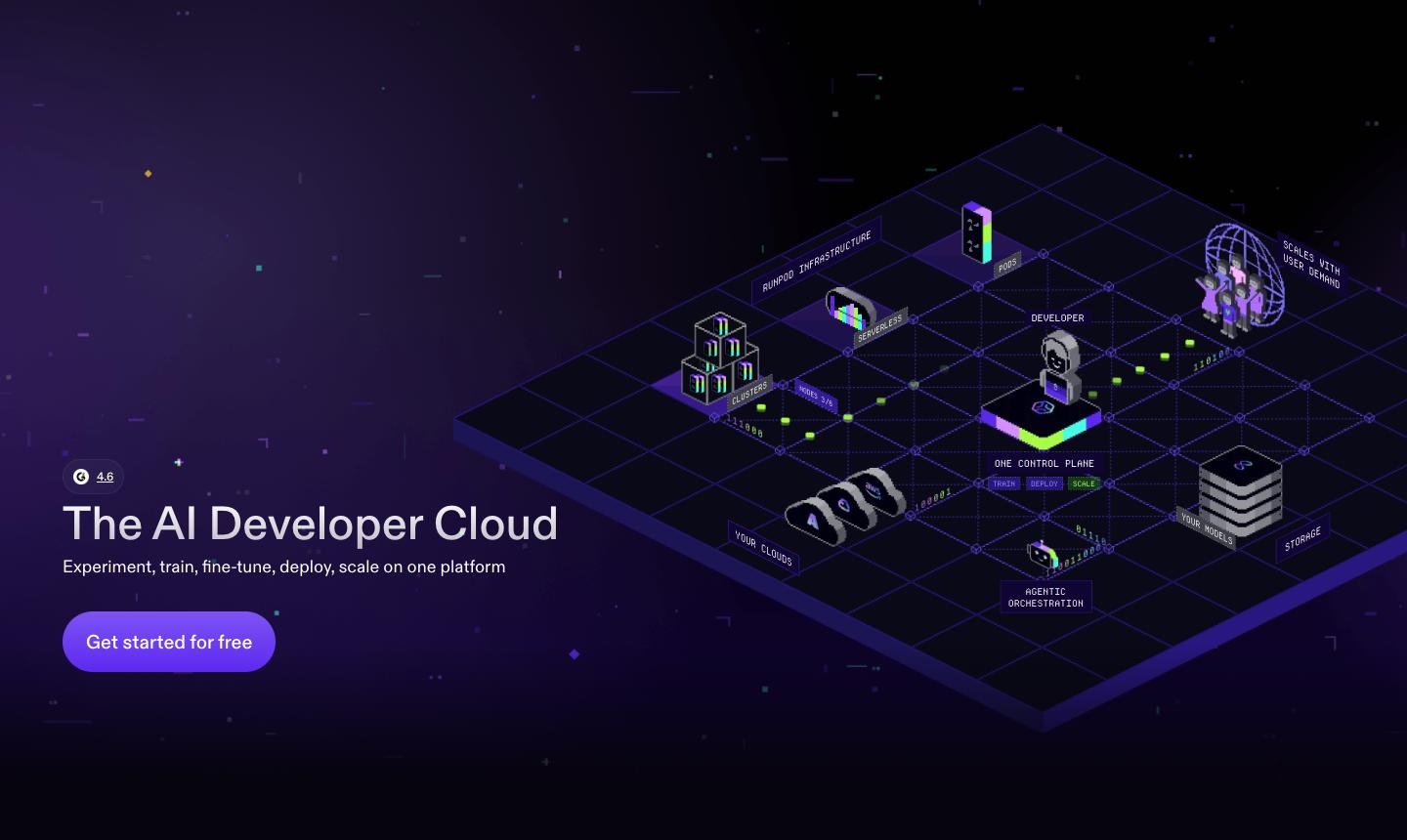
Runpod is a GPU cloud that offers on-demand Pods, Serverless GPU endpoints, and Instant Clusters. Pods come in two tiers: Secure Cloud in T3 and T4 data centers, and Community Cloud, a vetted peer-to-peer network of independent compute providers. Runpod states that it holds ISO 27001 and SOC 2 Type II certifications and notes that coverage can vary by workload and data center. According to Runpod’s documentation, Pods don’t support Docker Compose, and Instant Clusters don’t support Kubernetes, so teams that rely on those tools will need to adapt their setup or consider other vendors.
Runpod key features:
- Serverless endpoints scale from zero and advertise sub-200 ms FlashBoot cold starts, with optional pre-warmed active workers.
- Instant Clusters give self-serve access to up to 64 GPUs with Slurm support, InfiniBand or RoCE networking, and no minimum lease term.
- Custom Docker images deploy to Pods directly from GitHub, and you manage them through the API, CLI, and SDK.
- H100 SXM Pod: $3.99 per GPU-hour on Secure Cloud, or from $2.69 on Community Cloud
- Serverless H100: $5.39 per hour, billed by the second
Cold starts on larger models costing you more than the per-second pricing saves? Our guide to Runpod alternatives compares top providers on startup speed, tiered pricing, and compliance.
Vast.aj for renting marketplace GPUs at host-set prices
Vast.ai is a GPU rental marketplace where hosts list machines and set prices, and renters search for capacity by GPU type, price, and reliability. Because listings come from many hosts, price and reliability vary by machine, which suits cost-sensitive and fault-tolerant work more than steady production serving. Vast.ai offers a Secure Cloud filter that limits results to vetted data center providers and recommends it for sensitive or production workloads. Instances run Linux Docker containers, with SSH, Jupyter, and command-only access-Windows isn’t supported. Teams that need databases, storage, and managed inference in the same account will source those elsewhere.
Vast.ai key features:
- On-Demand, bid-based Interruptible, and discounted Reserved rentals let you trade price against interruption risk.
- Serverless GPU endpoints include an autoscaling SDK, custom worker types, and reserve workers for faster cold starts.
- The catalog spans more than 68 GPU types, from consumer RTX 3060 cards to B200s.
- Host-set marketplace rates, billed per second. For example, on November 5, 2026, pricing for H100 SXM started at $1.87/GPU-hr
Outgrowing a GPU marketplace now that your experiment is heading to production? Our Vast.ai alternatives guide weighs security features, CI/CD and tooling integrations, and compliance coverage against marketplace pricing.
Inference and deployment platforms
These inference providers handle model serving and deployment, so you call an endpoint or deploy a model instead of managing GPU servers.
Together AI for serving and fine-tuning open models through one API
Together AI is an inference, fine-tuning, and GPU cluster platform for open models. Teams typically start on serverless inference and move to dedicated endpoints as traffic grows, and both share one OpenAI-compatible API. The deployment menu also includes Provisioned Throughput and Dedicated Container Inference, with several dedicated and cluster SKUs available only through sales. Together AI describes its serverless performance as best-effort, which may suit spiky or early-stage traffic better than steady production load. Its scope is the model layer, so databases and storage for the rest of an application live elsewhere.
Together AI key features:
- Dedicated inference runs on single-tenant GPUs with canary, blue/green, and rolling rollouts, traffic shadowing, and multi-region failover.
- Managed fine-tuning supports supervised fine-tuning and preference tuning, using LoRA or full training, on models of 100B+ parameters.
- Self-serve GPU clusters from H100 through B300 include InfiniBand and managed Kubernetes or Slurm-on-Kubernetes with node auto-remediation.
- Dedicated inference, H100: $5.49 per GPU-hour
- GPU clusters, H100: $3.99 per GPU-hour on-demand
Juggling multiple separately metered products and no router for picking the right model? Our guide to Together AI alternatives weighs bursty vs. steady traffic, native routing, and what it takes to migrate off an OpenAI-compatible API.
Baseten for running dedicated model serving in production
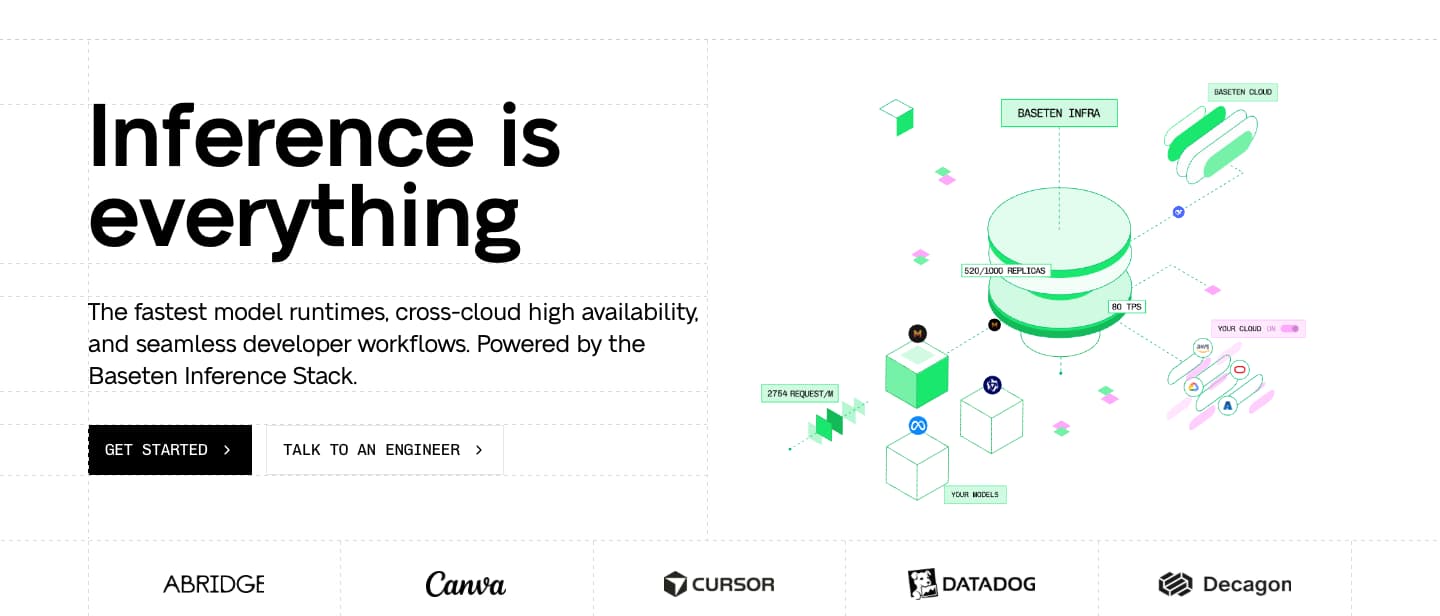
Baseten is a production inference platform for deploying custom, fine-tuned, and open-source models on dedicated deployments, with hosted Model APIs for calling open models by token. It targets teams running latency-sensitive production inference, including regulated workloads, and lists SOC 2 Type II and HIPAA compliance. Its autoscaling documentation notes that new replicas take time to come online, so a scale-to-zero deployment pays a cold start on the first request. Its scope is model serving and training rather than a general-purpose cloud, so the rest of an application’s stack lives elsewhere.
Baseten key features:
- Truss, Baseten’s open-source packaging framework, supports config-only YAML for many LLMs, custom Python model classes, or custom Docker servers such as vLLM, SGLang, and Triton.
- Deployments can run on Baseten Cloud, in a self-hosted VPC, or in a hybrid setup, with cross-cloud autoscaling.
- Chains orchestrate multi-model pipelines where each step has its own hardware and scaling rules.
- H100 (80 GiB) dedicated: $0.10833 per minute, ~$6.50 per hour
- Model API: Usage-based per-token rates by model
Cold starts and warm replicas inflating your serving bill? Our guide to Baseten alternatives weighs usage-based billing, frontier-model access, and migration effort across top providers.
Modal for running serverless GPU functions in Python
Modal is a serverless AI infrastructure platform where workloads are defined in Python and billed per second for the GPU, CPU, and memory a container uses, with nothing charged while it’s idle. Because containers scale from zero, it suits spiky or unpredictable workloads. GPU concurrency is capped by plan, and Enterprise customers negotiate higher limits. Workloads are defined through Modal’s Python SDK, which ties deployments to that SDK rather than to standard container or VM tooling.
Modal key features:
- Modal Inference offers shared OpenAI-compatible endpoints, dedicated optimized endpoints, and custom stacks (vLLM, SGLang, or your own server) on GPUs you choose.
- A custom runtime uses GPU snapshotting and nearby weight caches to load models quickly and autoscale from zero to thousands of containers.
- Sandboxes provide isolated environments for coding agents, RL rollouts, and untrusted code.
- H100: $3.95 per GPU-hour ($0.001097 per second)
Running coding agents that need a safe place to execute code? DigitalOcean’s Managed Agents run each session in its own microVM designed for hardware-level isolation, can resume from pause in about 300 ms in internal testing, and bill per second of active CPU.
Additional Nebius alternatives to consider
We’ve covered the top Nebius alternatives already, but here are a few other options worth considering:
- Crusoe: An AI-focused GPU cloud for training and inference, similar in focus to CoreWeave and Lambda. It offers object and block storage alongside GPU clusters, but teams will need to source managed databases elsewhere. DigitalOcean keeps GPUs, inference, databases, and storage in one account.
- Hyperstack: An on-demand NVIDIA GPU cloud comparable to Lambda and Runpod for self-serve GPU rental. It fits teams that mainly need GPU instances, while DigitalOcean adds same-account Spaces and managed databases.
- Anyscale: A managed platform for Ray-based workloads such as distributed training, batch jobs, and serving. It runs in your own cloud or on Anyscale-hosted infrastructure, so teams that bring their own GPUs typically pair it with capacity from one of the clouds above.
- Google Cloud Platform: A hyperscaler with NVIDIA GPUs, Google’s TPUs, and Vertex AI. It fits teams already on Google’s networking and data tools.
- Azure: A hyperscaler with NVIDIA GPU virtual machines and Azure AI Foundry for model access. It suits teams already committed to Microsoft’s ecosystem.
How to migrate from Nebius to DigitalOcean
Moving off Nebius works best as a workload-by-workload move rather than a single cutover, since it covers GPU instances, orchestration, and inference.
A practical migration path from Nebius to DigitalOcean involves:
- Auditing what runs on Nebius today: GPU VMs, multi-node training on InfiniBand, Kubernetes or Soperator-managed Slurm jobs, and Token Factory inference endpoints. Note the regions and GPU types you rely on, since Nebius quotas apply per region and per project.
- Sorting workloads by fit. Application, inference, and single-node or small multi-GPU jobs move well to GPU Droplets and the Inference Engine. Very large training clusters that depend on InfiniBand are a closer fit for a GPU specialist, so consider keeping those where they are while you move everything else.
- Pointing a test client at the Inference Engine’s OpenAI- and Anthropic-compatible endpoint, matching your Token Factory models to the catalog, and comparing outputs and latency. For custom or fine-tuned weights outside the native catalog, Bring Your Own Model (BYOM) supports importing from Hugging Face or Spaces.
- Moving the surrounding stack: Kubernetes workloads to DigitalOcean Kubernetes, data to Spaces or managed databases in the same account, and Slurm-based batch jobs only after confirming they can be reworked.
- Piloting on a slice of production traffic, including the Inference Router (Public Preview), before cutting over. Compare per-second GPU Droplet billing and per-token rates against your current Nebius bill.
Looking for the full cost picture first? Our LLM inference cost comparison guide breaks down pricing models across top providers side by side, so you can see where Nebius and DigitalOcean land for your workload before committing.
Nebius alternatives FAQs
Which cloud gives me one account for my LLM API, Postgres, object storage, and GPU runs?
DigitalOcean can cover all four: the Inference Engine for LLM APIs, managed PostgreSQL, Spaces object storage, and GPU Droplets, with one account and one bill. AWS also offers GPU instances, SageMaker, and Bedrock alongside its database and storage services, with more services to configure. GPU specialists such as Nebius and CoreWeave center their catalogs on GPU compute, orchestration, and inference.
Where can I get H100 GPUs without a long-term commitment?
Most of these providers rent H100s on demand without a contract, including DigitalOcean GPU Droplets, Lambda, Runpod, Modal, and Nebius. DigitalOcean bills GPU Droplets per second after a five-minute minimum, with spot and 12-month reserved plans available if you later want a discount. Check each provider’s minimum balance and spend limits, since terms differ.
What is the best inference provider for teams that don’t have dedicated MLOps and don’t want to configure vLLM?
Look for a managed inference platform that runs the serving stack for you. The DigitalOcean Inference Engine serves Serverless Inference, Batch Inference, and Dedicated Inference through one OpenAI- and Anthropic-compatible endpoint, so you don’t configure vLLM or manage GPU servers. Together AI and Baseten also run managed inference, and Baseten’s Truss supports a custom vLLM or SGLang server if you later need one.
Which inference provider has both serverless and dedicated GPU tiers on the same platform with one API?
The DigitalOcean Inference Engine offers serverless, batch, and dedicated inference behind one endpoint, so you can start on usage-based pricing and move to dedicated GPUs as traffic grows. Together AI shares one OpenAI-compatible API across serverless and dedicated endpoints, and CoreWeave offers serverless and dedicated inference through Forge. Nebius’s Token Factory also provides serverless and dedicated endpoints for open models.
Should I use spot or on-demand GPUs for model training?
Use spot or preemptible GPUs for fault-tolerant training that checkpoints often, and on-demand GPUs for jobs that can’t restart or for serving production traffic. Spot capacity can be reclaimed, and providers differ in notice: DigitalOcean aims for at least two hours on spot GPU Droplets, while Vast.ai interruptible instances stop when another renter bids higher. Reserved plans, such as DigitalOcean’s 12-month option, suit steady training schedules.
Build your AI app on one platform with DigitalOcean
The DigitalOcean AI-Native Cloud puts GPU Droplets, the Inference Engine, managed databases, and Kubernetes in one account, so you spend less time stitching vendors together and more time shipping. Start on serverless inference, then move to dedicated GPUs as your traffic grows.
Key features include:
- GPU Droplets with NVIDIA H100, H200, and B300 and AMD Instinct GPUs, in single-GPU and eight-GPU sizes
- Inference Engine with serverless, batch, and dedicated inference behind one OpenAI- and Anthropic-compatible endpoint
- Inference Router (Public Preview) that picks a model for each request based on a balanced, budget, or quality routing preference
- Managed databases for PostgreSQL, MySQL, MongoDB, Valkey, Kafka, and OpenSearch next to your GPUs
Get started with DigitalOcean ->
Higgsfield AI evaluated more than 15 neoclouds before routing its enterprise customers’ traffic to DigitalOcean GPU Droplets to meet higher uptime SLAs.
Results in customer environments may vary depending on configuration, implementation, and usage; results and/or savings are not guaranteed.
Any references to third-party companies, trademarks, or logos in this document are for informational purposes only and do not imply any affiliation with, sponsorship by, or endorsement of those third parties.
About the author

Maddy Osman is a Senior Content Marketing Manager at DigitalOcean.
Start building today
From GPU-powered inference and Kubernetes to managed databases and storage, get everything you need to build, scale, and deploy intelligent applications.