
Building an AI agent is becoming more accessible thanks to managed platforms and prebuilt frameworks. The harder part is running that agent reliably at scale, where latency and inference costs begin to compound. According to DigitalOcean’s February 2026 Currents report, 49% of respondents shared that the high cost of inference is their number one blocker to scaling AI. If your agents are doing more than answering a single prompt, every planning step, tool call, and retry involves additional token usage, which increases inference costs. And none of it is free.
Choosing the right inference provider helps you balance cost, latency, and reliability as your AI agents scale. Some platforms are built around the cheapest possible token price, others around enterprise governance, and other providers around raw GPU access, so you can host models yourself. The best inference providers for AI agents in 2026 differ in terms of built-in model options, deployment options, observability, and support for tool calling and structured output. Let’s compare each based on workload patterns and the level of infrastructure control your application needs.
Key takeaways:
-
Inference providers support AI agents that make repeated model calls for reasoning, retrieval, tool use, planning, and response generation, so provider choice affects the speed, reliability, and cost of the complete task.
-
The right inference provider for AI agents can reduce accumulated latency, improve tool-call consistency, keep multi-step workflows running through failures, and provide better control over cost per completed agent task.
-
Compare providers by end-to-end latency, tool calling, structured outputs, burst rate limits, routing and fallback, observability, model access, deployment options, and total workflow cost.
-
The best inference providers for AI agents include DigitalOcean AI Platform, Groq, Fireworks AI, Baseten, Fal,CoreWeave, Nebius, Amazon Bedrock, Microsoft Foundry, Gemini Enterprise Agent Platform, Anthropic, and OpenAI.
What is an inference provider for AI agents?
Inference providers for AI agents host trained AI models and return model outputs through an API when an agent sends a request. In an agent workflow, the provider handles repeated model calls for reasoning, tool use, retrieval, planning, and final response generation. These factors directly affect how your AI agents perform on an inference provider:
-
Latency: The total time it takes for the provider to return a complete response.
-
Time to First Token (TTFT): How quickly the first token or word begins appearing after a request is sent.
-
Streaming behavior: How smoothly and consistently the provider delivers the response token by token.
-
Context limit: The maximum amount of prompt, conversation history, retrieved data, and tool outputs the model can process in a single request.
With the DigitalOcean AI platform, you can build and deploy AI agents without requiring advanced technical expertise. Brainforest, a digital communication agency, shares how DigitalOcean’s focus on simplicity helped their team move from complex cloud workflows to a more simplified GenAI development experience.
General inference providers vs. inference providers for AI agents
A general inference provider and those built for agents operate based on the same underlying job: hosting a model and returning output through an API call. General-purpose platforms can run agent workloads, but they are not optimized for the repeated inference, tool orchestration, and observability that agents require. As usage grows, those additional steps can translate into higher costs and more overhead. Choosing inference providers for AI agents is about reliable support for relevant operational demands. Choosing a platform designed for agent workloads from the start makes it easier to manage those tradeoffs as your application scales.
| Agent workload requirement | General inference provider | Inference provider for AI agents | Use case |
|---|---|---|---|
| Request pattern | Handles single or independent model calls | Handles repeated model calls within one task flow | General: Chatbot answers a policy question. Agent: Customer support agent checks an order, queries a database, and drafts a response. |
| End-to-end latency | Measures the response time of one request | Measures TTFT and total latency across sequential model and tool calls | General: A code assistant explains what a function does. Agent: A coding agent inspects code, plans a fix, generates a patch, and reviews the result. |
| Tool calling and structured outputs | Helpful to have as an option, but not always required | Important for calling tools and passing reliable data between workflow steps | General: A chatbot extracts a customer’s name from a message. Agent: A support agent calls a ticketing API and returns the ticket ID, priority, and next action as structured JSON. |
| Routing and fallback | Selects another model or endpoint when one request fails | Routes different steps by complexity and prevents the full task from stopping midway | General: A chatbot retries the request using another model if the primary endpoint is unavailable. Agent: A planning step uses a larger model, while document classification uses a smaller one. If either endpoint fails, the workflow switches to a fallback. |
| Scale and cost | Compares token prices and rate limits for individual requests | Measures burst capacity and total cost per completed agent task | General: A chatbot answers 10,000 customer questions each day. Agent: A research agent performs multiple searches, verifies information, summarizes findings, and returns a final report for each user request. |
Benefits of using an inference provider for AI agents
Production AI agents require the use of specialized inference providers because each task can involve several model calls, tool calls, and follow-up steps. The right AI agent inference provider offers these benefits:
-
Lower latency across multi-step workflows: Faster inference reduces the delays that build up when an agent reasons, calls tools, retrieves data, and makes sequential model requests. This is useful for coding agents, support agents, and real-time assistants, where every extra second affects the user experience.
-
More dependable tool-driven actions: Agents need to call APIs, databases, search systems, and ticketing tools. Native tool-calling support helps the agent send structured arguments more consistently, which reduces failures from missing fields or incorrectly formatted requests.
-
Fewer failures between agent steps: One model response becomes the input for the next step in an agent workflow. Schema-constrained outputs with required fields reduce parsing errors and make downstream actions easier to process.
-
Greater resilience during multi-step tasks: A single failed inference call can interrupt the full workflow. Routing, retry, and fallback capabilities help the agent continue when a model is overloaded, unavailable, or not the right fit for a specific task.
-
Better control over cost per completed task: Agent costs can rise because one user request may trigger multiple model calls. Usage-based inference, model selection, and routing controls help you measure and manage the cost of completing the full task, not just the price of one request.
DigitalOcean’s AI Agent Builder combines model access, RAG-based knowledge, function calling, multi-agent orchestration, evaluations, tracing, and security controls in one platform. Connect agents to your business data, APIs, and tools, then test and monitor each step before production.
Have a look at how you build an Al RAG Agent in n8n in just 10 minutes.
How to choose an inference provider for AI agents
Choosing an inference provider for AI agents requires testing your full task flow, not just one model response. A provider that looks fast or cheap for one request may behave differently when an agent chains several calls together. You’ll want to evaluate how the provider handles repeated inference calls, tool use, structured outputs, burst traffic, fallback, and total workflow cost:
-
Benchmark the full agent loop, not one model call: General provider latency benchmarks measure an individual inference request. But an agent makes several sequential model and tool calls. Test the complete workflow end-to-end. When using serverless inference, check whether requests use the same model throughout a session, since switching models can affect prompt caching and tool-output consistency. DigitalOcean supports model affinity to keep subsequent requests routed to the same model when workflow consistency is important.
-
Verify structured output and tool schema enforcement: Check whether the provider offers native schema-constrained outputs and tool calling for your chosen model. Prompting alone for valid JSON does not guarantee the model will produce it. Because the model is still free to add stray text, use the wrong data type, or leave the output incomplete. On DigitalOcean’s DigitalOcean AI Platform, a function’s input schema must follow the OpenAPI 3.0 specification, and an invalid or incomplete schema causes the function route to fail registration. For agents, schema accuracy is important because one malformed response can break the next tool call, workflow step, or downstream action.
-
Match rate limits to agent burst patterns: Test request and token limits against concurrent agent loops rather than average user traffic, because a single agent task can trigger several model and tool calls in quick succession. DigitalOcean’s default rate limit is 5,000 requests per hour and 250 requests per minute. The per-minute figure is the one to check against your agent’s burst pattern, which, rather than a steady stream, involves several calls firing within seconds of each other, followed by a gap.
-
Evaluate routing and failover behavior: Check whether failed requests can move to another model or provider, or whether your team must build retry and fallback logic into the agent. DigitalOcean’s Inference Router helps you select the next best model in order of priority if the primary choice is unavailable, down, or rate-limited. Look for that distinction specifically: whether the provider handles routing natively, or whether it’s on you to write that logic yourself.

- Compare cost per completed agent task: A flat per-token number alone doesn’t encompass the full cost of a task. Calculate the combined cost of reasoning, tool-use, and follow-up model calls instead of comparing providers only by per-token prices. DigitalOcean prices batch inference at up to 50% savings compared to real-time inference, and prompt caching cuts costs further on repeated context.
12 best inference providers for AI agents in 2026
Pricing and feature information in this article are based on publicly available documentation as of July 2026 and may vary by region and workload. All pricing (including free tier) is subject to terms. For the most current pricing and availability, please refer to each provider’s official documentation.
*This “best for” information reflects an opinion based solely on publicly available third-party commentary and user experiences shared in public forums. It does not constitute verified facts, comprehensive data, or a definitive assessment of the service.
The best inference providers for AI agents span managed AI platforms, low-latency inference services, GPU clouds, hyperscalers, and direct model providers. Each one approaches agent workloads differently, with trade-offs in model access, latency, routing, infrastructure control, governance, and pricing.
| Company | Best for* | Key features | Pricing |
|---|---|---|---|
| DigitalOcean AI Platform | End-to-end AI agent development and inference for AI native enterprises | Serverless, batch, and dedicated inference; prioritized model fallback through Inference Router; agent evaluations and versioning; access to 70+ models; custom model imports via Hugging Face and DigitalOcean Spaces | Serverless inference starts at $0.05 per 1M tokens; Batch inference offers up to 50% lower costs on supported OpenAI and Anthropic models; GPU pricing varies by capacity model and commitment. |
| Groq | Low-latency, multi-step AI agents | Custom LPU architecture; high token throughput; server-side tools through Groq Compound; OpenAI-compatible APIs; native function calling and strict structured outputs | On-demand LLM ranges from $0.05 to $1.00 per million input tokens and from $0.08 to $3.00 per million output tokens, depending on the model. |
| Fireworks AI | Fine-tuned open-model agents | Serverless and dedicated open-model inference; reinforcement fine-tuning; production-trace evaluations; integrations with LangChain, CrewAI, LlamaIndex, and other agent frameworks | Standard per-token rates - range from $0.07 to $2.80 per million input tokens across the model list; On-Demand GPUs (H100) - Starts at $7.00 per hour. |
| Baseten | Custom-model agent pipelines | Custom and fine-tuned model deployment; independently scalable pipeline components through Baseten Chains; speech-to-text and text-to-speech support; cloud, hybrid, and self-hosted deployment | GLM 5.2 (Model API) - starts at $1.40 per million input tokens, $4.40 per million output tokens; Dedicated GPU - Starts at $0.10833 per minute for an H100. |
| fal | Serverless GPU inference for generative media agents | Serverless H100–B300 GPUs with per-second billing and autoscaling; 1,000+ image, video, audio, and 3D model APIs; queue-based async inference with webhooks; per-app observability and alerts | Model APIs priced per output unit (e.g., $0.08 per image for Nano Banana 2); H100 Serverless GPU $4.50 per hour list, as low as $2.49 per hour |
| CoreWeave | GPU-intensive agent inference at scale | Bare-metal NVIDIA GPU infrastructure; serverless reinforcement learning; fast model-weight loading through LOTA (Local Object Transport Accelerator; agent tracing and evaluations through W&B Weave | Single-GPU inference - $1.25 to $10.50 per GPU per hour, ranging from NVIDIA L40 to GB200 NVL72. |
| Nebius | Dedicated open-model inference with enterprise controls | More than 60 open models through Token Factory; fast and throughput-focused serving modes; dedicated endpoints and autoscaling; network isolation, audit logging, and regional data residency | Preemptible GPU instances - range from $0.70 to $4.30 per instance-hour, depending on the GPU configuration. |
| Amazon Bedrock | AWS-native enterprise AI agents | Models from several providers through one AWS service; AgentCore runtime, identity, memory, and gateway services; knowledge bases, guardrails, evaluations, and provisioned throughput | Model inference (on-demand) - ranges from $0.20 to $18.80 per million input tokens and $0.40 to $18.80 per million output tokens among the AI21 models. |
| Microsoft Foundry | Governed Azure-native agent development | Managed prompt agents and hosted code-based agents; Responses API for inference and tools; Entra identity, Azure RBAC, tracing, evaluations, versioning, and network isolation | Foundry does not use one platform-wide price. Each model, tool, agent runtime, storage service, monitoring feature, and supporting Azure resource follows its own billing model. |
| Gemini Enterprise Agent Platform | Google Cloud integrated AI agents | Agent Development Kit and Agent Engine; access to Google, third-party, and open models; enterprise data grounding; centralized registration and governance | Input token ranges from $0.10 to $4.00 per million tokens across the listed Gemini 2.5 and Gemini 3 models. Output tokens range from $0.40 to $18.00 per million tokens, across Gemini 2.5 Flash-Lite to Gemini 3.1 Pro with long context. |
| Anthropic | Claude-based AI agents | Claude API and Agent SDK; structured tool-use blocks; MCP integration; prompt chaining and orchestration patterns; context compaction and memory management | Input tokens range from $1 to $10 per million. Output tokens range from $5 to $50 per million, depending on the Claude model. |
| OpenAI | Multimodal and multi-agent applications | Agents SDK; manager-agent and handoff patterns; layered guardrails; text, voice, translation, and image models; enterprise agent governance through Frontier | Input tokens range from $1 to $5. Output tokens range from $6 to $30 per million output tokens across the listed GPT-5.6 models. |
Are your AI inference costs growing faster than expected? Follow the LLM cost calculation guide to forecast production costs.
Specialized inference providers for AI agents
Specialized inference providers focus primarily on serving models efficiently, with features like low-latency APIs, model routing, custom deployments, fine-tuning, and agent-specific tool support. They are a good fit when you want more control over inference performance without adopting a full hyperscaler stack.
-
DigitalOcean AI Platform with end-to-end AI agent development and inference for for AI native enterprises
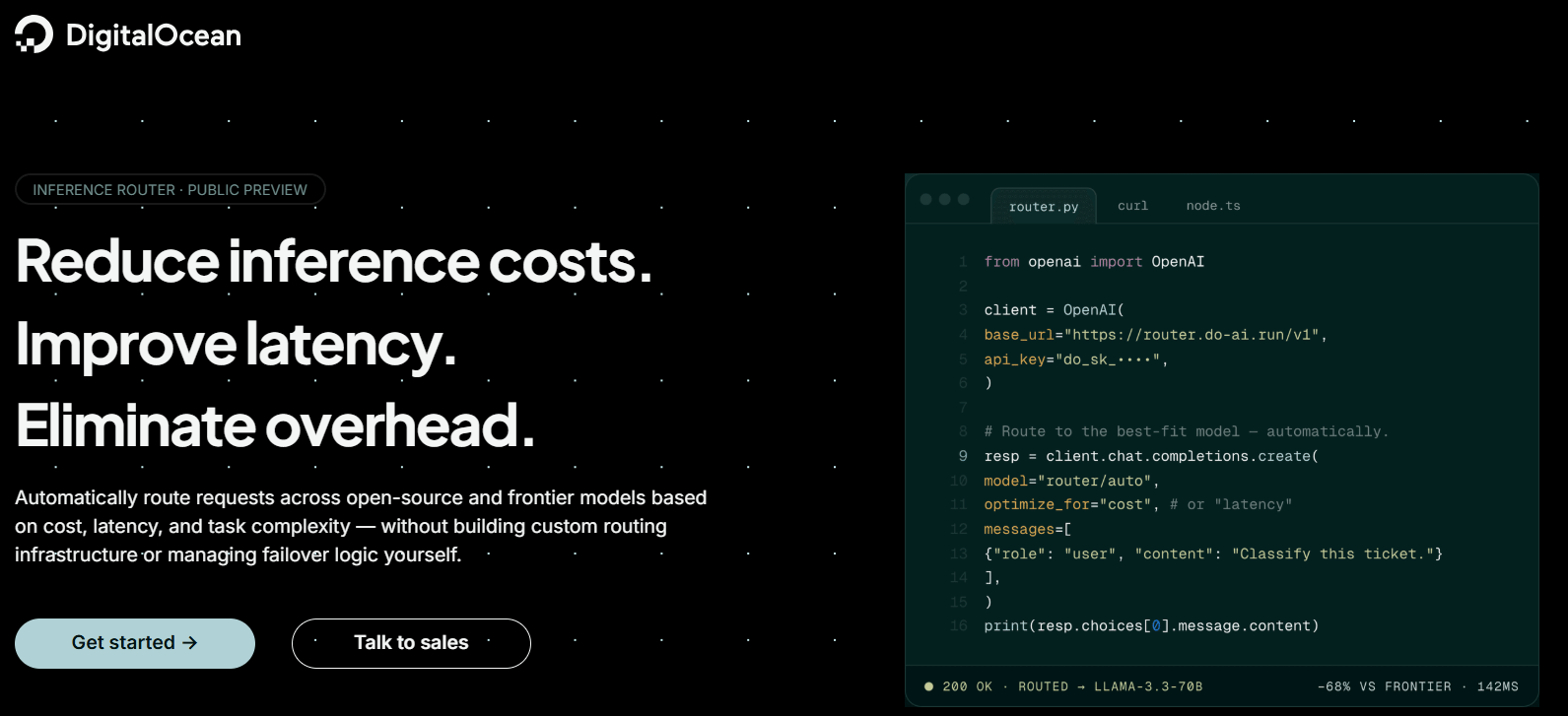
DigitalOcean’s AI Platform is a managed service for building production-ready AI agents, combining serverless, dedicated, and batch inference with tools for knowledge bases, function calling, evaluations, and versioning in one platform. Agents move through a single lifecycle on the platform: starting with no-code templates or SDKs, then connecting knowledge bases and data sources, followed by evaluation, and finally production deployment with monitoring built in. Serverless endpoints support models from providers like OpenAI and Anthropic. The platform supports open-weight models, like Llama, Mistral, and DeepSeek, so your teams are not limited to a single model family. DigitalOcean’s combination of managed inference, agent development tools, knowledge bases, evaluations, and monitoring suits teams that want to build and operate agents without managing separate platforms for orchestration and model serving.
DigitalOcean key features:
-
If the primary model is unavailable, down, or rate-limited, Inference Router automatically reroutes a request to the next available model, in priority order, without requiring custom retry logic in the agent.
-
Versioning and insights track agent changes over time to give visibility into performance, built-in evaluation tools for testing prompts, and comparing models before an agent reaches production.
-
Offers access to 70+ models. Directly import custom models into the Model Catalog from DigitalOcean Spaces or gated Hugging Face models through BYOM (Bring Your Own Models).
-
Serverless inference - Starts at $0.05 per million tokens
-
Batch inference - Offers up to 50% lower costs on supported OpenAI and Anthropic models
-
GPU Droplets - Starts at $1.88 per GPU per hour on a multi-month commitment, or $0.76 per GPU per hour on demand
Discover how DigitalOcean helped Character.ai achieve a 2x inference throughput performance increase with AMD hardware.
-
Groq for low-latency, multi-step AI agents
Groq is an inference platform that runs language, speech, and vision-capable models on its custom LPU chips. Developers access Groq through GroqCloud, with LLM pricing based on input and output tokens. GroqRack provides on-premises deployment by request. Its catalog includes models such as Llama, Qwen, Kimi K2, and OpenAI’s GPT-OSS models. For agent workloads, Groq’s low-latency inference is useful when an agent chains several model calls together. It supports LoRA fine-tunes for enterprise customers by request. GroqCloud focuses primarily on a curated catalog of open-weight models. Teams that require direct access to proprietary model families may need an additional provider.
Groq key features:
-
Groq’s LPU chips store model weights in on-chip memory and schedule every operation before execution starts, a different design from general-purpose GPUs.
-
Groq’s Compound systems handle tool use, web search, code execution, and browser automation on Groq’s own servers within a single API call.
-
Discovers and executes tools from MCP servers on the server side, which is useful for connecting agents to databases, GitHub, external APIs, and shared internal tools.
- Groq’s on-demand LLM - Ranges from $0.05 to $1.00 per million input tokens and from $0.08 to $3.00 per million output tokens, depending on the model.
From simple rule-based agents to collaborative multi-agent systems, each agent use case is designed for a different level of autonomy and complexity. Understand the seven types of agents to help you build your next AI project.
-
Fireworks AI for fine-tuned open-model agents

Fireworks AI is an inference platform for AI models, built by engineers who previously worked on PyTorch. It serves models through a pay-per-token serverless API, on-demand GPU deployments, and reserved capacity. The API is compatible with OpenAI and Anthropic client libraries. The same platform also supports training and fine-tuning an open model. Fireworks offers prebuilt agent frameworks for LangChain, LlamaIndex, CrewAI, PydanticAI, Strands Agents, and AWS AgentCore. Future AGI notes that provider-specific quantization, serving kernels, and sampler defaults can influence JSON adherence, tool-call consistency, and latency under burst traffic. Teams with strict reproducibility requirements should validate the hosted model and production traffic patterns before deployment.
Fireworks AI key features:
-
Fireworks RFT is a managed reinforcement fine-tuning service for training open models like DeepSeek V3 or Kimi K2 against a custom reward function.
-
Fireworks open-sources Eval Protocol, a framework that wraps an agent wherever it already runs and scores it from real production traces.
-
Voice Agent Platform combines speech-to-text, the LLM, and text-to-speech in one co-located deployment.
-
Standard per-token rates - Range from $0.07 to $2.80 per million input tokens across their model offerings.
-
On-Demand GPUs (H100) - Starts at $7.00 per hour.
As AI applications move into production, many organizations need more than a fast inference endpoint. Explore the best Fireworks AI alternatives guide to understand the top options.
-
Baseten for custom-model agent pipelines
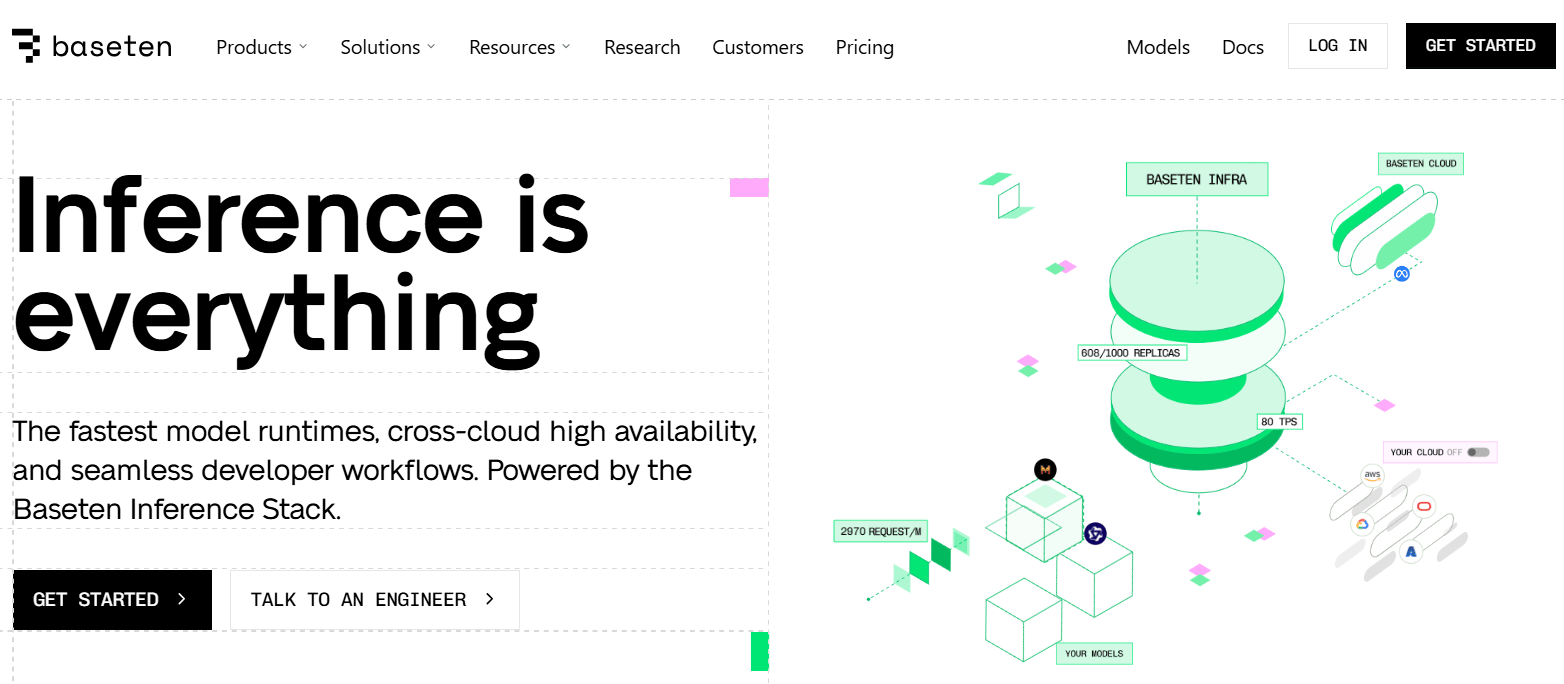
Baseten is an inference and training platform for deploying open-source, custom, and fine-tuned AI models. It offers ready-to-use Model APIs billed per token, dedicated GPU deployments, and training infrastructure. Deployment options are Baseten’s cloud, self-hosted infrastructure, and hybrid setups. Baseten’s model library includes open models such as GLM, Kimi K2, and DeepSeek. Baseten’s managed Model APIs cover a catalog of supported models. Models outside that catalog, fine-tuned weights, or workloads with custom serving logic require a separate Truss deployment, which might add operational overhead.
Baseten key features:
-
Baseten Chains helps in each step of an agent pipeline scale independently on its own hardware.
-
Compound AI architecture assigns separate autoscaling resources to each workflow step to prevent one model or tool from becoming a performance bottleneck.
-
Supports global capacity, fast cold starts, autoscaling, single-tenant deployments, and cross-cloud high availability for production workloads.
-
GLM 5.2 (Model API) - Starts at $1.40 per million input tokens; $4.40 per million output tokens.
-
Dedicated GPU - Starts at $0.10833 per minute for an H100.
Choosing an AI inference platform is about more than model support. Explore the best AI inference platforms for production workloads to determine the best choice for your production AI applications.
-
fal for serverless GPU inference and generative media

fal is a serverless inference platform for generative media. Developers can call more than 1,000 image, video, audio, and 3D models through a single API, or deploy their own models and pipelines on fal Serverless, which autoscales across thousands of GPUs and bills per second. fal suits agents whose output is media, such as an agent that storyboards a scene, generates clips, and adds a voiceover. Its catalog centers on media rather than language models, so fal pairs with an LLM provider for planning and tool calls. Teams that want both under one account can reach a subset of fal-hosted models through DigitalOcean Inference.
fal key features:
-
Serverless GPU inference for custom models: deploy Python models, ComfyUI workflows, LoRA training, and realtime or 3D workloads to the latest NVIDIA GPUs that autoscale with demand and bill per second.
-
Asynchronous queue-based inference with status streaming and webhook delivery lets agents submit long-running video or audio jobs and get results back without holding a connection open.
-
FlashPack model loading and persistent storage shorten cold starts, and per-app logs, traces, analytics, and Slack and email alerts track cold starts, execution time, and errors.
-
Model APIs - Priced per output unit, such as $0.05 per second for MiniMax H3 Max text-to-video, $0.08 per image for Nano Banana 2, and $0.10 per 1,000 characters for ElevenLabs Multilingual v2 text-to-speech.
-
Serverless GPU (H100) - $4.50 per hour list price, as low as $2.49 per hour, billed per second.
Neocloud inference providers for AI agents
Neocloud providers offer GPU-focused infrastructure and managed inference services for teams running large, open, or custom models at scale. They provide more infrastructure control than serverless APIs with options like dedicated capacity, autoscaling, custom model serving, and enterprise deployment controls.
-
Coreweave for GPU-intensive agent inference at scale
CoreWeave launched in 2017 as an altogether different company—Atlantic Crypto. Started by a trio of commodities traders who mined Ethereum using GPUs, the 2018 crypto crash upended that business. The founders redirected their GPU fleet toward a new purpose and relaunched the company as CoreWeave. Now, it is a cloud infrastructure provider built for GPU-based AI compute: training, fine-tuning, and inference workloads. It runs on bare-metal NVIDIA clusters. Deployment options range from pay-per-token serverless inference to dedicated infrastructure and fully self-managed Kubernetes environments. Its 2025 acquisition of Weights & Biases added tools for post-training, evaluation, and monitoring AI agents. Like any large-scale provider, CoreWeave has had publicly documented regional and service-specific incidents, so production teams should review its official status history and design failover around the components they use.
CoreWeave key features:
-
Serverless RL post-trains large language models for multi-turn agentic tasks using reinforcement learning.
-
CoreWeave AI Object Storage has a LOTA caching layer that, according to CoreWeave, loads model weights onto GPUs up to 5 times faster than object storage.
-
W&B Weave adds an observability layer built for multi-agent systems, with monitoring that surfaces failure modes and an evaluation framework that flags regressions as agents scale.
- Single-GPU inference - $1.25 to $10.50 per GPU per hour, ranging from NVIDIA L40 to GB200 NVL72.
The best GPU cloud isn’t the one with the most GPUs. If pricing is unpredictable, capacity is unavailable, or your workloads outgrow a single provider, it’s time to evaluate CoreWeave alternatives that better suit your AI infrastructure needs.
-
Nebius for dedicated open-model inference with enterprise controls
Nebius is an AI cloud platform providing managed and custom inference for production AI applications. Its Token Factory service exposes more than 60 open and custom models: Kimi, DeepSeek, and Qwen, through an OpenAI-compatible API. Developers can choose fast serving for latency-sensitive agent interactions or base serving when sustained throughput is the priority. Nebius supports dedicated endpoints, custom models, and GPU-based deployments for workloads that require greater infrastructure control. Teams that need direct API access to proprietary models such as Anthropic’s Claude may need to use a multi-provider platform like DigitalOcean that offers Claude through its inference API.
Nebius key features:
-
Nebius Agents Blueprint combines Token Factory with LangChain Deep Agents, LangSmith, Pinecone, Tavily, and Snowglobe, with each component independently deployable.
-
Capacity Blocks, dedicated endpoints, autoscaling, and a real-time dashboard support agents that need sustained inference without waiting for GPU availability.
-
Nebius provides network isolation, identity management, audit logging, EU and US data-residency options, and security certifications.
- Preemptible GPU instances - Range from $0.70 to $4.30 per instance-hour, depending on the GPU configuration.
Your AI model is not slowing your team down, but your cloud might be. Before optimizing prompts or GPUs, read the comparison between AI workflow-focused clouds to make an informed decision.
Hyperscaler inference providers for AI agents
Hyperscaler platforms combine model access with cloud-native services for identity, networking, storage, governance, monitoring, and agent deployment. They are well-suited to organizations already operating within a major cloud and seeking tighter integration with existing enterprise systems. For simpler AI agent deployments, however, the breadth of services might introduce additional operational complexity that teams may not need.
-
Amazon Bedrock for AWS-native enterprise AI agents

Amazon Bedrock is AWS’s managed platform for building generative AI applications and agents. It combines model inference with agent development, knowledge bases, guardrails, evaluation, and governance services. Bedrock suits teams already using AWS identity, networking, storage, and data services. However, a 2026 TrueFoundry report (from a vendor that sells competing gateway tooling) suggested that teams may encounter operational limitations when moving from proofs of concept to production workloads, around quotas, retrieval control, observability, latency consistency, and gateway functions.
Amazon Bedrock key features:
-
AgentCore splits agent infrastructure into separate services: Runtime, Gateway, Identity, and Memory, so teams can add authentication, tool access, and tracing to agents built with LangChain, the OpenAI Agents SDK, the Claude Agent SDK, or a custom framework.
-
Bedrock Managed Agents, powered by OpenAI, run OpenAI’s frontier models on the OpenAI harness, so request and response data stay on AWS instead of passing through OpenAI’s infrastructure—suitable for meeting data residency, governance, or compliance requirements.
-
Built-in tracing, debugging, and evaluation show which steps and tools an agent used, helping teams identify failures and test workflow changes.
- Model inference (on-demand) - Ranges from $0.20 to $18.80 per million input tokens and $0.40 to $18.80 per million output tokens among the AI21 models.
Lost in AWS’s complexity? If you want dependable cloud hosting with transparent costs and a simpler experience, explore AWS alternatives.
-
Microsoft Foundry for governed Azure-native agent development

Microsoft Foundry is an Azure platform for building, deploying, and governing AI applications and agents. It brings models, agent runtimes, tools, evaluations, and operational controls into one project structure. Teams can create fully managed prompt agents, deploy code-based hosted agents, or call Foundry models and tools from agent code. Foundry covers an agent lifecycle that includes identity, observability, publishing, and governance. Its model catalog offers options from Microsoft, OpenAI, Anthropic, Meta, Google, xAI, DeepSeek, Mistral, and Hugging Face. Foundry’s model and tool availability vary by region. AI agents deployed across multiple regions may not have consistent access to the same models and capabilities, which might add additional deployment overhead.
Microsoft Foundry key features:
-
Prompt agents use a fully managed runtime, and hosted agents support custom code built with Microsoft Agent Framework, LangGraph, OpenAI Agents SDK, and Anthropic Agent SDK.
-
Agents can use web search, file search, code interpretation, memory, MCP servers, custom functions, Azure Logic Apps connectors, and multi-agent workflows.
-
Microsoft Entra identity, RBAC, virtual network isolation, guardrails, tracing, metrics, evaluations, and Application Insights provide control across the agent lifecycle.
Foundry does not use one platform-wide price. Each model, tool, agent runtime, storage service, monitoring feature, and supporting Azure resource follows its own billing model.
Azure’s layered pricing model might make monthly costs hard to predict. If you’re looking to understand what contributes to high Azure bills, explore our detailed breakdown of Microsoft Azure pricing.
-
Gemini Enterprise Agent Platform for Google Cloud integrated AI agents

Gemini Enterprise Agent Platform is Google Cloud’s platform for building, deploying, governing, and optimizing production AI agents. It combines managed model inference with agent development, model tuning, evaluation, and MLOps services. Agents can use Gemini models, selected third-party models, and open models from the Model Garden. The platform is used by organizations that already store data or run applications in Google Cloud. Its agent stack combines managed deployment with enterprise data grounding and governance controls for agents running across Google Cloud services. Various Gemini models follow different capacity management models, where older models use fixed per-project quotas, and newer Gemini models use shared Standard PayGo throughput tiers. Managing both capacity models might add complexity for teams running mixed deployments.
Gemini Enterprise Agent Platform key features:
-
Builds agents through the Agent Development Kit for creating, deploying, scaling, and operating custom agents.
-
Access to more than 200 Google, third-party, and open models, then evaluate or tune models for a specific agent workload.
-
Agents can be grounded in organizational data and registered, managed, and governed through the Gemini Enterprise application.
Gemini Enterprise Agent Platform pricing:
Input token ranges from $0.10 to $4.00 per million tokens across the listed Gemini 2.5 and Gemini 3 models. Output tokens range from $0.40 to $18.00 per million tokens, across Gemini 2.5 Flash-Lite to Gemini 3.1 Pro with long context.
There can be a steep learning curve with GCP (Google Cloud Platform) and difficulty in forecasting pricing. The top Google Cloud alternatives include platforms with simpler workflows and more predictable costs.
Frontier lab inference providers for AI agents
Frontier labs provide direct access to their own leading model families and agent development tools. They integrate with new model capabilities, native tool calling, structured outputs, multimodal features, and first-party agent SDKs. But model choice tends to be narrower than what’s available on multi-provider platforms.
-
Anthropic for Claude-based AI agents
Anthropic provides the Claude API and Claude Agent SDK for building AI applications and agents. The platform offers tool calls, retrieves external information, maintains context, and makes model-directed decisions across multiple steps. It comes with a managed agent runtime, web search, and sandboxed code execution. As a direct model provider, Anthropic focuses on the Claude model family rather than routing requests across models from several vendors. Anthropic also notes that agentic systems can increase latency and cost, so a fixed workflow or single model call may be more suitable for well-defined tasks. As of this writing, Anthropic’s documentation does not describe native routing or fallback to other vendors’ models, so cross-provider resilience may require an external gateway or custom routing logic.
Anthropic key features:
-
Offers composable agent workflows with prompt chaining, routing, parallelization, orchestrator-worker, and evaluator-optimizer patterns for structuring multi-step tasks.
-
Provides developer tools for agent building with APIs, Workbench for prompt refinement, and jailbreak resistance.
-
Supports context and memory management techniques through tool-result clearing, context compaction, and file-based memory for retaining useful state without keeping the full interaction history in the active context window.
- Input and output - $1 to $10 per million input tokens and $5 to $50 per million output tokens, depending on the Claude model.
Is your agent using the right model for the task? Browse available models on DigitalOcean and compare their tool-calling support, context limits, output limits, and inference options.
-
OpenAI for multimodal and multi-agent applications
OpenAI is an AI research and product company that offers two major paths for building AI agents: a code-first developer framework called the Agents SDK, and Frontier, an enterprise platform for deploying and governing agent fleets across a business. The Agents SDK falls into the category of code-first agent frameworks like LangGraph and CrewAI. Frontier, which launched in February 2026, connects agents to a company’s CRM and data warehouse systems and adds per-agent identity controls along with compliance certifications, such as SOC 2 Type II. The Agents SDK persists history only when the same session is reused. Developers must manage session identity and history, which might add implementation complexity and the risk of lost context across conversations.
OpenAI key features:
-
Agent responses pass through layered guardrails with relevance and safety classifiers, rules-based checks that run alongside the agent.
-
Multiple agents can be coordinated through a manager pattern, where one agent calls others as tools and combines their answers, or through direct handoffs that pass full control of a task to a different agent.
-
Offers GPT-Realtime-2.1 for voice agents, GPT-Image-2 for image generation, and GPT-Realtime-Translate for live speech translation.
- Input and output tokens - $1 to $5 per million input tokens and $6 to $30 per million output tokens across the listed GPT-5.6 models.
Best inference providers for AI agents FAQ
Which inference provider offers image generation alongside LLM text inference on one platform?
Many providers support both capabilities. DigitalOcean offers text inference across proprietary and open models, along with image-generation models such as GPT Image, through the same Inference platform and API-compatible workflow. This can help agents generate text, reason through tasks, and create images without integrating a separate image-generation provider
What is the best inference provider for AI agents?
The best provider depends on your complete agent workflow rather than one model benchmark. Compare end-to-end latency, tool calling, structured outputs, routing, rate limits, observability, and cost per completed task. DigitalOcean Inference Engine combines serverless, batch, and dedicated inference with routing and model evaluations.
What should you look for in an inference provider for a coding agent with low TTFT?
Measure time to first token across the complete coding workflow, including planning, repository searches, tool calls, retries, and the final response. You should also test tail latency, cold starts, streaming consistency, and burst rate limits. In the DigitalOcean Inference dashboard, you can find metrics for latency, throughput, errors, token usage, cost attribution, and rate limiting.
Which inference provider offers reliable function calling and tool use for agents?
Choose a provider that supports native tool calling on the exact model you plan to use, then test missing fields, invalid data types, tool failures, and retries. DigitalOcean’s Model Catalog identifies supported model capabilities. Agent functions can connect models to external APIs and databases.
What is the best LLM router with fallback support?
A suitable router should select models by task, cost, or latency and move to a prioritized fallback when the first model is unavailable or rate-limited. DigitalOcean Inference Router supports model pools, cost and latency policies, manual model ordering, and automatic fallback across serverless and dedicated inference.
Can you move from a serverless agent prototype to dedicated inference without rebuilding the application?
You can reduce migration work by choosing a provider that offers serverless and dedicated inference through compatible APIs. DigitalOcean’s Serverless Inference is suited for real-time applications and AI agents. It is designed for sustained, high-throughput workloads that require dedicated GPU resources and greater control over scaling and performance. Verify model availability, regions, configuration requirements, and endpoint compatibility when planning your deployment strategy.
Build production AI with DigitalOcean Inference Engine
Run real-time, batch, and dedicated inference through one platform instead of stitching together separate model providers, routing systems, and monitoring tools. DigitalOcean Inference Engine supports multimodal models and provides a shared control plane for testing, routing, evaluating, and operating inference workloads in production.
-
Choose the right inference mode: Use Serverless Inference for real-time agents and applications, Batch Inference for asynchronous workloads, or Dedicated Inference for sustained traffic and custom models.
-
Route each request by policy: Select models based on cost, latency, or intent, add fallback priorities, override individual requests, and keep agent trajectories on a consistent model.
-
Compare models before deployment: Test text, image, audio, and video models side by side in the Model Playground, then export the configured API code.
-
Evaluate quality and performance: Run models and routing policies against your own datasets using reusable rubrics, performance metrics, and side-by-side comparisons.
-
Track production inference: Monitor token usage, time to first token, latency, errors, spend, and batch-job status without assembling a separate monitoring stack.
-
Scale different workload patterns: Process real-time requests, submit batch jobs with delivery within 24 hours, or deploy dedicated GPU endpoints with custom scaling controls.
-
Access multiple modalities through one platform: Run text, image, video, speech, and vision-language workloads with one API key and billing system.
Start building with DigitalOcean Inference.
Any references to third-party companies, trademarks, or logos in this document are for informational purposes only and do not imply any affiliation with, sponsorship by, or endorsement of those third parties.
About the author

Sujatha R is a Technical Writer at DigitalOcean. She has over 10+ years of experience creating clear and engaging technical documentation, specializing in cloud computing, artificial intelligence, and machine learning. ✍️ She combines her technical expertise with a passion for technology that helps developers and tech enthusiasts uncover the cloud’s complexity.
Start building today
From GPU-powered inference and Kubernetes to managed databases and storage, get everything you need to build, scale, and deploy intelligent applications.
