6 Together AI Alternatives for LLM Inference in 2026

By Maddy Osman
Senior Content Marketing Manager at DigitalOcean
- Updated:
- 16 min read
Together AI has built a reputation as an open-source model host: it owns and runs the GPU infrastructure behind its inference, fine-tuning, and training products, with a catalog spanning models like Kimi K3 and DeepSeek. This is a decidedly different position compared to providers that operate a routing layer that sits on top of another company’s hardware. That’s why providers like Together AI are worth a closer look before they become the permanent home for your inference traffic.
The Together AI catalog stays entirely open-weight—no GPT-5.x and no Claude—so a team that wants both open and closed frontier models requires the use of a second vendor and a second bill. Pricing is split across four separately-metered products: serverless tokens, dedicated endpoints, GPU clusters, and fine-tuning, each with its own rate card. Together AI remains a suitable pick for teams that focus on serving or fine-tuning open models. The comparison between additional options matters more once your workload has grown into a full application that also requires the use of frontier models, an inference router, and a full-stack cloud around it.
Let’s explore the top Together AI alternatives, including DigitalOcean, on cost, model catalog, deployment flexibility, and the surrounding cloud infrastructure.
Key takeaways:
-
Together AI alternatives span serverless model APIs, deployment platforms for custom models, and a full AI-native cloud. The right fit depends on whether you need open-model tokens or an entire inference-and-agentic stack.
-
Switching can consolidate four separate Together AI pricing meters into one bill, add access to frontier models Together doesn’t offer, and hand model selection to a policy-driven router instead of your own application code.
-
Weigh model catalog fit (open-only vs. open-plus-frontier), pricing structure, routing control, uptime guarantees, and migration effort before committing to a provider.
-
The best Together AI alternatives include DigitalOcean, Fireworks AI, Baseten, Modal, OpenRouter, and RunPod.
What Is Together AI?

Together AI is a GPU cloud built around open-source and custom models, founded in 2022 by a team with roots in Stanford’s ML and systems research. It runs serverless, pay-per-token inference across a large open-weight catalog, plus dedicated endpoints, rentable GPU clusters, and a fine-tuning service, on its Together Inference Engine with FlashAttention-3 kernels and speculative decoding. Because the catalog stays open-weight only, teams that also want frontier models like GPT or Claude need a second vendor.
Together AI key features:
-
Async Batch API processes up to 30 billion tokens per model in a single asynchronous job, suited for large offline workloads like dataset labeling or bulk summarization.
-
LoRA, full fine-tuning, and DPO preference tuning, including multi-node training on 100B+ parameter models.
-
A Code Sandbox/Code Interpreter product for agentic workloads, alongside the core inference and training stack.
Together AI pricing: Serverless tokens from roughly $0.03 to $4.50 per million depending on model; dedicated GPU endpoints from about $3.99 to $6.49 per hour for a single H100 depending on commitment and source; rentable GPU clusters from around $3.49 per hour on-demand; fine-tuning billed per training token on top of a separate post-training hosting bill. No permanent free tier—new accounts get a small evaluation credit.
DigitalOcean adds select new frontier models from OpenAI and Anthropic on day zero of release. Read about our latest model releases and feature updates.
Benefits of switching from Together AI
Moving off a single open-model host is rarely just about the per-token rate. Here’s what you gain by consolidating onto a broader platform:
-
A vendor scope that actually matches your stack: Together AI’s model-only focus means the moment you need a frontier model, a vector store, or GPU compute for anything beyond inference, you’re already managing a second vendor relationship. Together’s narrow scope doesn’t remove that need, it just doesn’t help with it. The question worth asking isn’t whether to consolidate, but which unmet need (frontier access, surrounding infrastructure, deployment control) is forcing today’s second vendor, and which Together AI alternative actually closes that specific gap.
-
A pricing model that matches how you actually buy: Reconciling per-token, per-GPU-hour, and per-training-token bills against three separate rate cards is its own kind of overhead. Depending on what you’re optimizing for, the fix looks different: granular per-second GPU billing for teams that want to pay for exactly what they use, or one consolidated bill for teams that want fewer invoices to reconcile.
-
A path to frontier models, if you need them: Together AI’s catalog stops at open-weight. Some alternatives solve this with frontier access proxied onto the same key as your open models; others solve it by routing across whichever provider already hosts the model you want. Either removes the second vendor relationship Together AI’s catalog gap forces today.
-
Routing logic you don’t have to write yourself: Deciding which model handles which request, and building the fallback logic for when one’s unavailable, is a lot of code to write, test, and maintain. Whether that logic lives in a configurable router or in provider-level failover, offloading it is a common reason teams move off a host that leaves it entirely in application code.
-
Migration effort that’s front-loaded, not recurring: An OpenAI-compatible endpoint means most of the switching cost is a one-time integration change, not an ongoing tax—true regardless of which Together AI alternative you choose.
How to Choose a Together AI Alternative
Together AI alternatives solve different problems, and the right one depends on which of these is true for you:
-
If your app requires a closed model alongside open-weight models, catalog fit decides everything else—narrow the list to alternatives that put both behind one key before comparing anything else.
-
If your traffic is bursty or unpredictable, per-second or per-token billing protects you from paying for idle capacity the way Together AI’s dedicated and cluster tiers can; if it’s steady and high-throughput, dedicated GPU pricing usually wins on cost per request.
-
If you’re maintaining your own model-selection logic today, look hardest at native routing—hand-rolled fallback logic is easy to underestimate, since the cost shows up as ongoing maintenance rather than a single line item.
-
If you’re in a regulated industry or have a customer contract requiring an uptime commitment, filter first on SLA tier and compliance certifications (SOC 2, HIPAA); the best-fit provider on every other axis is a non-starter if it can’t clear this one.
-
If migration timeline is the constraint, weight OpenAI-compatibility and feature parity (streaming, function calling, fine-tune export) above cost or catalog breadth—cheapest-on-paper isn’t cheapest if the switch takes a quarter.
Comparing inference providers more broadly than these Together AI alternatives? Our comprehensive guide to AI inference platforms for production workloads covers Together AI, DigitalOcean, and others with a focus on routing and the surrounding cloud.
The 6 Best Together AI Alternatives
Pricing and feature information in this article are based on publicly available documentation as of August 2026 and may vary by region and workload. For the most current pricing and availability, please refer to each provider’s official documentation.
This “best for” information reflects an opinion based solely on publicly available third-party commentary and user experiences shared in public forums. It does not constitute verified facts, comprehensive data, or a definitive assessment of the service.
| Solution | Best for* | Key features | Pricing |
|---|---|---|---|
| DigitalOcean | Scaling inference and agentic workloads for AI-native enterprises | Inference Router, 70+ frontier and open models behind one key, one-bill cloud, Zero Data Retention by default | Serverless tokens from ~$0.10–$1.05/M input tokens; dedicated inference from $2.59/GPU-hour; batch inference up to 50% off on OpenAI/Anthropic models |
| Together AI | Hosting a broad open-source catalog with mature fine-tuning tooling | 200+ open models, LoRA/full fine-tuning, GPU clusters, Code Sandbox | Serverless ~$0.03–$4.50/1M tokens; dedicated H100 ~$3.99–$6.49/hr; fine-tuning per training token |
| RunPod | Training and inference under one account with flexible tiers | Community/Secure Cloud/Serverless tiers, per-second billing, sub-200ms cold starts | H100 roughly $2.69–$3.29/hr depending on tier |
| Fireworks AI | Fast serving of open-weight models without a surrounding cloud | FireAttention inference engine, 400+ models, multi-LoRA fine-tuning, dedicated GPUs | Per-token, ~$0.07–$0.90/1M tokens by model; ~50% batch discount |
| Baseten | Dedicated, autoscaling infrastructure for custom or fine-tuned models | Truss packaging, dedicated autoscaling GPUs, scale-to-zero, HIPAA-eligible | Dedicated per-hour (H100 ~$6.50/hr, A100 ~$4.00/hr); Model APIs from ~$0.10/1M tokens |
| Modal | Code-first model serving on serverless GPUs | Python-native decorators, per-second billing, 9 GPU types, scale-to-zero | Per-second GPU (H100 ~$0.0011/sec) before regional multipliers |
| OpenRouter | Routing across a third-party model marketplace without hosting the underlying models | Single API across dozens of providers, provider fallback, free-tier access to some open models | Pass-through provider pricing per token; 5.5% fee on prepaid credits or 5% on BYOK usage |
The 6 Best Together AI Alternatives in 2026
The top Together AI alternatives fall into a few groups based on what you’re actually buying. Full-stack platforms like DigitalOcean bundle a model catalog, router, and surrounding cloud together on one bill. Serverless inference hosts give you a pre-built catalog to call without managing infrastructure yourself. Deployment platforms hand you more control over how a model actually runs—GPU capacity, custom containers, your own training jobs—at the cost of managing more of that infrastructure yourself.
Full-stack platforms
DigitalOcean is the one Together AI alternative here that bundles a model catalog, router, and the surrounding cloud (databases, storage, Kubernetes) on a single account and bill, rather than asking you to assemble that infrastructure yourself.
-
DigitalOcean for scaling inference and agentic workloads for AI-native enterprises
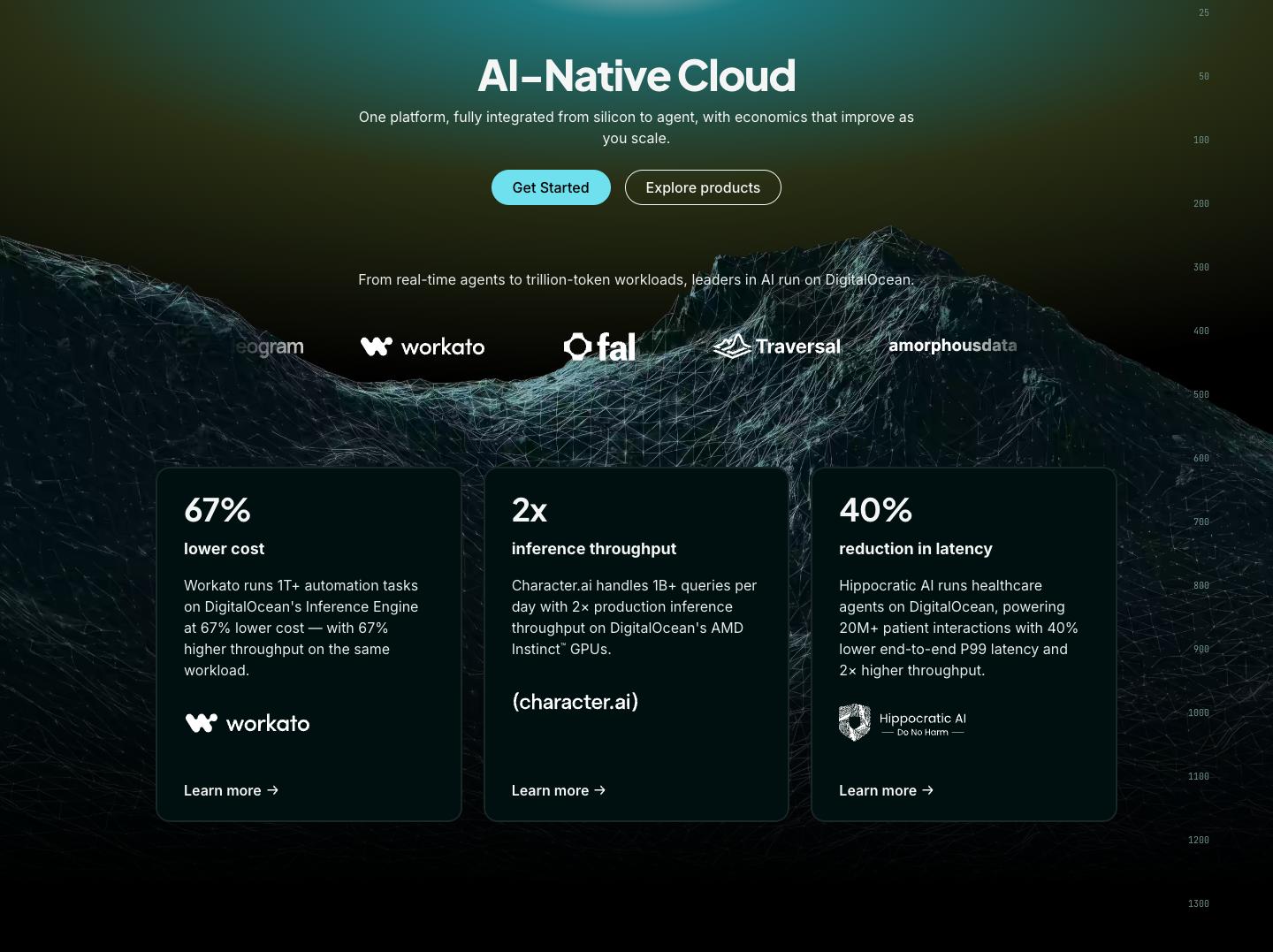
DigitalOcean, the AI-Native Cloud, offers a vertically integrated stack spanning infrastructure, core cloud services, Inference Engine, and data and learning tools. The Inference Engine serves 70+ open and multimodal models behind a single OpenAI-compatible key, alongside proxied access to frontier models like GPT and Claude—a gap in Together AI’s open-only catalog. The Inference Router selects a model per request based on a policy you set by cost, latency, or task, and a real-time dashboard shows model and router distribution. Because inference runs on the same network as GPU Droplets, managed databases, Kubernetes, and storage, teams manage costs with one bill instead of reconciling separate meters and vendor bills for frontier access.
DigitalOcean key features:
-
Zero Data Retention by default on DigitalOcean-hosted models, with VPC-on-serverless and prompt-injection guardrails for security.
-
A Model Playground and Evaluations suite let you test and compare model quality side by side before committing production traffic to a new model or provider.
-
Day-zero access to select new frontier and open-model releases as they launch.
DigitalOcean pricing: Serverless tokens from about $0.10 to $1.05+ per million input tokens depending on model; dedicated inference billed per GPU-hour from $2.59 (AMD MI300X) to $83.10 (8x NVIDIA B300); batch inference up to 50% off on OpenAI and Anthropic models.
Consolidating four meters into one bill isn’t hypothetical. LawVo runs 130+ legal AI agents processing 500 million tokens per week, and cut inference cost by 42% after switching to the DigitalOcean Inference Router—zero code changes required.
Results in customer environments may vary depending on configuration, implementation, and usage. Results and/or savings are not guaranteed.
Serverless inference platforms
There are several serverless inference platforms to consider as Together AI alternatives. Fireworks AI hosts open models behind a single API call, similar to Together AI itself. OpenRouter takes a different approach—it doesn’t host models at all, instead routing your request across dozens of other providers’ endpoints.
-
Fireworks AI for fast serving of open-weight models without a surrounding cloud
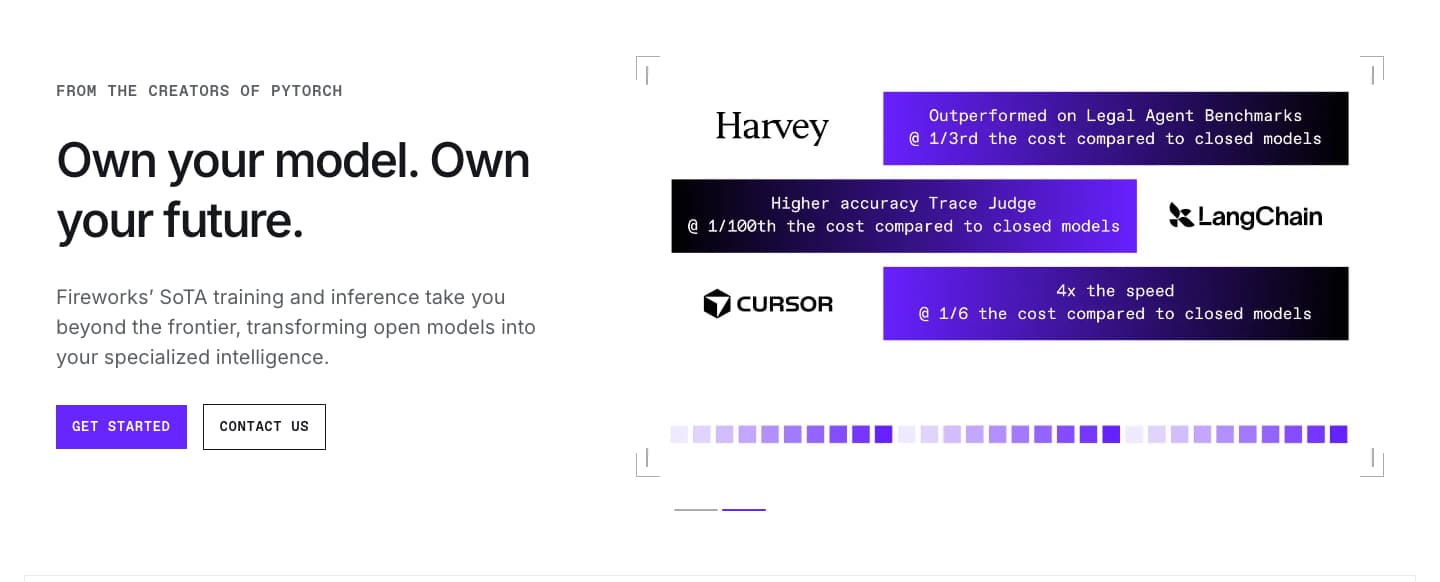
Fireworks AI is built by a team with roots in Meta’s PyTorch group and is one of the closest direct substitutes for Together AI. It serves 400+ open-source and multimodal models through its own FireAttention inference engine, with fine-tuning (including multi-LoRA), dedicated GPU deployments, and compound-AI features like function calling. Similar to Together AI, it centers on the model layer alone—databases, storage, and the rest of your application infrastructure sit with a separate provider.
Fireworks AI key features:
-
FireOptimizer ties training decisions like early stopping to application-level KPIs instead of proxy metrics alone.
-
A Custom Training API supports bringing your own training loop and objectives for post-training work.
-
Dedicated GPU deployments alongside the core serverless catalog for workloads that outgrow shared capacity.
Fireworks AI pricing: Pay-as-you-go per token, roughly $0.07 to $0.90 per million tokens depending on model, with a small free starter credit and about 50% off for batch jobs.
Comparing serverless inference hosts more broadly than Fireworks AI’s fit here? Read our guide to Fireworks AI alternatives.
-
OpenRouter for routing across a third-party model marketplace without hosting the underlying models

OpenRouter is a routing layer rather than a host. It doesn’t run its own inference infrastructure, but instead passes requests through to whichever of its dozens of connected providers (including both Together AI and DigitalOcean) serves a given model. That means every request crosses an added administrative hop, and OpenRouter’s terms note it provides access only on an “as-available” basis—so an upstream provider’s outage can still affect your app. Model selection and fallback logic largely live in the platform’s routing rules rather than a policy you configure per workload (the way the DigitalOcean Inference Router works).
OpenRouter key features:
-
Routes requests across 400+ models from dozens of providers through one OpenAI-compatible API.
-
Automatic failover to a backup provider if the primary one errors or hits capacity limits.
-
Configurable provider preferences per request—order specific providers, exclude others, or sort by price/throughput, rather than accepting only the default routing logic.
OpenRouter pricing: Passes through each model’s underlying provider rate with no markup, plus a 5.5% fee (minimum $0.80) on prepaid credit purchases; BYOK usage is free for the first million monthly requests, then 5%.
Comparing multi-provider gateways and routing layers more broadly than OpenRouter’s fit here? Read our guide to OpenRouter alternatives.
Deployment platforms for custom & fine-tuned models
RunPod, Baseten, and Modal all trade a managed catalog for more control over how a model actually runs. This is useful if you’re deploying something custom or fine-tuned, training across multiple GPUs, or running your own serving logic—rather than calling a stock catalog entry.
-
RunPod for training and inference under one account with flexible tiers

RunPod offers three GPU capacity tiers: Community Cloud is peer-hosted and cheapest but with variable reliability, Secure Cloud is RunPod-operated, SLA-backed, and covers SOC 2 Type II, HIPAA, and GDPR compliance. Serverless auto-scales, with cold starts fast enough for latency-sensitive workloads. Training and inference workloads run under one account, and cost relative to first-party GPU clouds is a common reason teams consider it—though, like Together AI’s dedicated tier, idle provisioned capacity still bills.
RunPod key features:
-
High-performance network volumes attachable across Pods, Serverless endpoints, and Instant Clusters for faster model load times.
-
Support for custom Docker images, including private registry integration such as AWS ECR.
-
Instant Clusters provision multi-node GPU clusters with InfiniBand interconnect, scaling up to 64 H100s for distributed training jobs that outgrow a single node.
RunPod pricing: H100 pricing roughly $2.69–$3.29/hour depending on tier; A100 from about $1.19–$1.49/hour.
Comparing full GPU marketplaces and raw compute providers rather than managed platforms? Read our guides to RunPod alternatives, CoreWeave alternatives, and Vast.ai alternatives.
-
Baseten for dedicated, autoscaling infrastructure for custom or fine-tuned models

Baseten is built around Truss, its open-source model-packaging framework. It’s suitable for teams running custom or fine-tuned models rather than Together AI’s broader catalog-first approach. Its core product is dedicated, autoscaling GPU deployments with configurable scale-to-zero, alongside a smaller serverless Model APIs catalog. Baseten is HIPAA-eligible, matching a compliance-sensitive workload profile, but like Together AI and Fireworks AI, it centers on the model layer rather than the surrounding application stack.
Baseten key features:
-
Built-in observability with per-deployment dashboards for request volume, latency, GPU utilization, and logs.
-
Chains SDK for orchestrating multi-model workflows such as voice AI, agents, and RAG pipelines.
-
Baseten Training supports multi-node fine-tuning jobs that promote directly to production endpoints.
Baseten pricing: Dedicated GPU deployments billed per hour, from roughly $4.00/hr (A100) to $6.50/hr (H100) to $9.98/hr (B200); Model APIs from about $0.10 per million tokens on comparable open models.
-
Modal for code-first model serving on serverless GPUs

Modal is a code-first serverless compute platform. Teams write Python functions, decorate them with the GPU type they need, and Modal handles container builds and scheduling. It’s a decidedly different model from Together’s hosted-catalog approach. It suits teams that want to run their own model-serving logic, and its scale-to-zero model works well for bursty traffic. The tradeoff shows up for steady, high-utilization workloads, where Modal’s effective GPU rates tend to run higher than dedicated GPU clouds.
Modal key features:
-
Sub-second cold starts for GPU workloads and model initialization.
-
Secure sandboxes for running untrusted code, alongside support for distributed multi-GPU fine-tuning.
-
Turn any function into an HTTPS web endpoint or a scheduled cron job with a single decorator.
Modal pricing: Per-second GPU billing, roughly $0.0002/sec (T4) to $0.0017/sec (B200), with an H100 around $0.0011/sec before regional multipliers.
Our guide to serverless, dedicated, and batch inference walks through the utilization math that determines which mode actually costs less for a given workload.
Together AI vs. DigitalOcean
Together AI is a strong open-model host—it owns the underlying GPU infrastructure for inference, fine-tuning, and training, which is a real structural advantage over a pure routing proxy. But that focus stops at the model layer:
-
Catalog: Together AI’s catalog is open-weight only, so a team that also wants access to frontier models needs a second vendor relationship, a second API key, and a second bill. DigitalOcean puts the same caliber of open-model hosting behind the same key as OpenAI and Anthropic’s models, so routine work can go to a lower-cost open model while frontier capability stays available for more complex tasks—without requiring a second integration and its associated configuration.
-
Pricing: Together AI splits billing across four separately-metered products—serverless, dedicated, clusters, fine-tuning. DigitalOcean’s inference is pay-per-token, with the Inference Router layered on top at no extra charge, next to managed databases, storage, and Kubernetes on the same bill.
-
Routing: Together AI, like most inference-only providers, doesn’t ship a task-aware router that picks a model per request—that logic lives in your application code. DigitalOcean’s Inference Router applies a policy you set by cost, latency, or task, with automatic failover to a hosted alternate on the same endpoint.
Teams whose entire inference need is fine-tuning and serving open models at scale may not need anything more than Together AI. The comparison matters most for teams whose AI workload has grown into a full application that also wants frontier models and less infrastructure to run themselves.
Migrating From Together AI to DigitalOcean
Moving off Together AI is less a like-for-like inference swap and more a move to a full-stack platform with GPU compute, managed databases and pgvector, and Kubernetes alongside inference, rather than just another place to send tokens. A practical path:
-
Audit current usage across all four Together AI pricing meters. Document which models you run on serverless, what’s on dedicated endpoints or GPU clusters, and any active fine-tuning jobs, so you can map the full bill—not just the headline token rate—to DigitalOcean’s feature catalog and pricing.
-
Match models on the Inference Engine. Confirm each production open model is available natively, and note that frontier models, which Together AI doesn’t offer, are available via proxy on the same key. If you’re running a custom or fine-tuned model that isn’t in the native catalog, DigitalOcean’s BYOM (bring your own model) support lets you import your own weights from Hugging Face or Spaces for dedicated inference, for supported architectures.
-
Pilot the Inference Router on shadow traffic. Run a percentage of real traffic through the Router before cutting over fully, comparing cost and latency against your current Together AI setup—including what you were previously handling in your own routing logic.
-
Consolidate the surrounding data layer. If retrieval or RAG currently depends on a separate vector store you stood up alongside Together AI, moving it into Knowledge Bases removes a cross-cloud hop and its egress cost. Our guide to choosing an AI abstraction layer walks through this same tradeoff in depth: Together AI’s Dedicated Endpoints versus a managed, database-backed approach.
-
Choose serverless or dedicated per workload. Steady, high-utilization traffic that’s currently on a Together AI GPU cluster or dedicated endpoint may cost less on dedicated GPU Droplets, while spiky traffic often fits serverless better. Note that either can change later without a migration.
Before cutting over, verify Zero Data Retention and VPC-on-serverless settings match your compliance requirements, and re-export any active fine-tunes from Together AI, since fine-tuned weights and hosting are billed and managed separately from the base model catalog.
Together AI Alternatives FAQs
Who are Together AI’s competitors?
The most commonly cited competitors include Fireworks AI, known for inference speed on a comparable open-model catalog; Baseten, focused on dedicated deployments for custom models; Modal, a code-first GPU platform; and OpenRouter, a multi-provider routing marketplace. DigitalOcean is a category apart—a full AI-native cloud rather than an inference-only host.
What is the best alternative to Together AI?
The strongest fit depends on what you need beyond open-model hosting. DigitalOcean offers a full AI-native cloud with frontier models and a managed router on one bill. Fireworks AI provides comparable catalog breadth and speed. Baseten or Modal are suitable for teams that want more deployment control. RunPod provides raw GPU access with more of the surrounding platform bundled in.
Is Together AI free, and are there free alternatives?
Together AI is not free for production use—new accounts get a small evaluation credit, after which usage is billed across whichever of its four separately-metered products (serverless, dedicated, clusters, fine-tuning) you’re using. Most competitors follow the same pattern. OpenRouter is the exception, offering free-tier access to a limited set of open models alongside its paid marketplace.
Does DigitalOcean support the same open-source models as Together AI?
The DigitalOcean Inference Engine hosts 70+ open and multimodal models natively, covering much of the same open-weight territory Together serves, while adding proxied access to OpenAI and Anthropic’s frontier models on the same key—coverage Together AI’s catalog doesn’t include at all.
How do you model cost-per-token for LLM inference?
Start with the published input and output rates, since they’re usually priced separately, then add anything outside the headline number: idle dedicated capacity, retries, or fine-tune hosting left running. Together AI’s four separately-metered products are a good example of why the sticker rate alone doesn’t capture real cost. Our LLM cost calculation guide walks through the full math.
DigitalOcean: One Platform for Inference, Frontier Models, and Everything Around Them
DigitalOcean’s AI-Native Cloud brings managed inference, frontier models, and the surrounding cloud together on one bill—no stitching together separate vendors for the database, storage, or orchestration around your model:
-
Inference Router applies a cost, latency, or task-based policy across every model in the mix, so switching between open and frontier models doesn’t mean hand-rolling that logic yourself.
-
Frontier models sit behind the same key as your open-weight models, so routine work and complex tasks can share one integration.
-
Managed databases and vector search are built into the same stack, powering retrieval and context management for RAG and agent memory.
Moving from a single-purpose open-model host typically doesn’t require a rebuild. Most migrations start with pointing existing OpenAI-compatible code at the new endpoint, then deciding case by case what else makes sense to consolidate.
Start building on DigitalOcean →
Any references to third-party companies, trademarks, or logos in this document are for informational purposes only and do not imply any affiliation with, sponsorship by, or endorsement of those third parties.
About the author

Maddy Osman is a Senior Content Marketing Manager at DigitalOcean.
Start building today
From GPU-powered inference and Kubernetes to managed databases and storage, get everything you need to build, scale, and deploy intelligent applications.
