10 Leading AI Cloud Providers for Developers in 2026

By Jess Lulka
Content Marketing Manager
- Updated:
- 20 min read
Companies are building AI agents that write code and automate customer service, while moving from early experimentation to production deployment on other AI initiatives. These projects depend on foundation models from providers like OpenAI, Anthropic, and Llama, with every action triggering inference calls against those models. DigitalOcean’s February 2026 Currents research found that 46% of organizations are now creating or deploying AI agents, and 44% are spending the majority of their AI budget on inference to power these workloads. All of this requires serious compute power and orchestration tooling capable of handling autonomous multi-step execution at scale.
Most organizations are not buying their own GPUs or building proprietary ML infrastructure to support these workloads. They turn to AI cloud providers that offer on-demand GPU clusters, pre-trained model serving, and end-to-end orchestration for agentic workflows. This approach lets teams move straight from model selection to production deployment without months of infrastructure buildout. The question becomes which provider best fits your requirements. Read on for a comparison of the leading options delivering these capabilities.
Key takeaways:
-
AI cloud providers offer businesses a way to run AI workloads, perform inference and training, and host AI models without directly managing AI infrastructure like GPU clusters.
-
AI cloud providers take the complexity out of running AI infrastructure by giving you on-demand access to GPUs, managed services, and pre-integrated AI tooling so your team can focus on building rather than maintaining backend servers.
-
When evaluating providers, think about what workloads you need to support, how the platform handles data privacy and compliance, what the true cost looks like at scale, and whether the developer experience and support resources will set your team up for success.
-
Top AI cloud providers include DigitalOcean, Replicate, RunPod, Lambda Labs, AWS, Microsoft Azure, Google Cloud Platform, CoreWeave, IBM Cloud, and Oracle Cloud.
What is an AI cloud provider?
An AI cloud provider is a company that owns and operates GPU servers and data centers, offering pre-configured infrastructure for running AI workloads so your team doesn’t have to procure or maintain the hardware yourself. Instead of a large upfront capital investment, you pay for compute on demand through usage-based pricing or reserved capacity plans. Their offerings include access to GPU and TPU computing power, AI model integration, and bandwidth to support AI inference and training.
These cloud computing providers can host AI workloads on private, public, or hybrid configurations, meaning your team can choose between dedicated resources for sensitive workloads, shared infrastructure for cost efficiency, or a mix of both, depending on your security and performance requirements. Many of these providers operate as an AI infrastructure-as-a-service, handling the configuration and maintenance so your team can focus on building and deploying your models and agents.
Benefits of AI cloud providers
Working with an AI cloud provider can remove the overall complexity of managing and scaling AI infrastructure. The main benefits of using an AI cloud include:
-
Accessibility: Using an AI cloud provider lowers the barrier to entry for adopting AI infrastructure. There’s no need for you or your team to have the upfront capital to deploy AI servers or data centers; the provider purchases and manages them.
-
Scalability and performance: AI clouds let you scale inference capacity and compute resources up or down based on your workload demands. If you need to increase computing power, storage, or memory, you can do so via a command-line interface or a dashboard. These providers provide instant access to additional GPUs and TPUs when needed.
-
Managed services: Working with an AI cloud provider lets you leverage additional managed services and tooling integrations that support the full lifecycle of an AI application—from data ingestion to model deployment to monitoring in production. This includes managed databases, Kubernetes deployments, and storage.
-
Accelerated development: Most offerings come with pre-integrated AI services, APIs, and support for popular development frameworks like PyTorch and TensorFlow. These integrations handle much of the underlying complexity around model loading, request routing, and version management, so your team can work directly at the application layer.
-
Automation and efficiency: Some AI cloud providers offer automation capabilities like auto-scaling that adjusts GPU resources based on inference demand and deployment pipelines that push model updates to production without manual intervention. This reduces the operational overhead of keeping AI applications running reliably at scale.
Considerations for AI cloud provider selection
Not all AI cloud providers are alike or designed for your organization’s specific workloads. If you’re in the process of AI cloud evaluation, here are the factors that you should consider:
-
Data privacy and compliance: How does the provider secure your internal (and potential consumer) data for your AI applications? Learn what security measures are in place to keep your cloud data secure and use any required compliance standards (such as ISO 27001) and laws that may apply to you (e.g., GDPR, HIPAA) to weed out any infrastructure providers that do not comply.
-
Workload support: Figure out what types of AI workloads you’re looking to run: AI agent creation, model training, inference, or something else entirely? Your infrastructure requirements (number of GPUs, storage, memory) will shift depending on what you’re doing with AI and whether your application is internal- or external-facing.
-
Developer experience: How easy is the AI cloud platform to use on a day-to-day basis? You’ll want something your team can easily understand, and that lets them consistently find the components they need to run AI applications, reducing overall confusion and frustration. Look for statistics on overall developer onboarding time, bug fix times, code coverage, API response times, development tool uptime, and error rates.
-
Training and community support: Even if your team is familiar with AI workloads or specific cloud computing products, there’s likely to still be a learning curve. Investigate which technical documentation, community forums, or support plans are available to help your developers learn about AI cloud workflows or get troubleshooting support when needed.
-
Cost: AI workloads at scale can quickly become costly, especially if there are hidden fees or management costs. Evaluate providers that are within your budget, offer cost-optimization tools, use price capping, or offer bundle discounts.
10 AI cloud platforms for training, development, and production
There’s certainly no shortage of AI cloud providers to meet your workload requirements. The market’s options range from straightforward GPU access to API-based deployment with no infrastructure provisioning involved. Before you fully commit to a cloud infrastructure provider for AI development or implementation, here’s a roundup of some of the main offerings available to developers and organizations.
Pricing and feature information in this article are based on publicly available documentation as of March 2026 and may vary by region and workload. For the most current pricing and availability, please refer to each provider’s official documentation.
*This “best for” information reflects an opinion based solely on publicly available third-party commentary and user experiences shared in public forums. It does not constitute verified facts, comprehensive data, or a definitive assessment of the service.
| Provider | Best for* | Key features | Pricing |
|---|---|---|---|
| DigitalOcean | Intuitive AI platform supporting inference at scale | Gradient™ AI platform with serverless inference; GPU Droplets with NVIDIA and AMD hardware; autoscaling infrastructure for AI workloads; built-in data pipelines and vector databases | Gradient AI Platform from $0.15 per million tokens; GPU Droplets from $0.76/GPU/hour (based on configuration) |
| Replicate | API-forward AI development | Large model library for image, voice, and LLM workloads; versioned models for reproducible outputs; asynchronous inference with streaming outputs; Cog tool for packaging ML models | Pay-as-you-go pricing based on model and hardware usage |
| CoreWeave | Direct, high-powered GPU access | NVIDIA Blackwell, Hopper, and Ada GPU architectures; Kubernetes integration for containerized workloads; ARENA environment for testing and deployment; high-throughput storage for training datasets | GPUs from $6.50/hour; CPU instances from $3.36/hour |
| RunPod | Global availability and exposed APIs, SDKs | GPU Pods, serverless endpoints, and instant GPU clusters; APIs and SDKs for infrastructure automation; custom Docker image support; compatibility with PyTorch, TensorFlow, CUDA, JAX, and ONNX | Pods from $0.16/hour; serverless from $0.00011–$0.00016/second; clusters from $1.79/hour |
| Lambda Labs | GPU-powered environments for AI training | 1-Click GPU clusters and instances; hosted Jupyter notebooks; preinstalled ML frameworks and drivers; multi-node GPU clusters with high-bandwidth networking | Instances from $0.63/GPU/hour; 1-Click clusters from $4.62/hour |
| AWS AI | End-to-end model development and deployment | Specialized EC2 instances for accelerated computing power; SageMaker Studio for model development; portfolio includes AWS Bedrock, Kiro, Nova, and Quick Suite | EC2 Capacity Blocks starting at $9.532/hr/instance; SageMaker Studio starting at $0.05/hr; Bedrock has custom pricing |
| Microsoft Azure | Windows support and data analytics use cases | Azure Machine Learning for model lifecycle management; multi-node GPU clusters with InfiniBand networking; GitHub Copilot integrations for DevOps; automated ML pipelines | Azure Machine Learning free; compute billed separately |
| Google Cloud Platform | Gemini access and Google ecosystem integration | Vertex AI managed ML platform; Gemini multimodal models; managed vector search for embeddings; Agent Garden templates for AI agents | GPU instances from $88.49/hour on-demand; Vertex AI: Custom |
| Oracle Cloud Infrastructure | Database automation and support | OCI Generative AI foundation models; GPU clusters with RDMA networking; bare metal GPU instances for training; integration with Oracle Autonomous Database | GPU instances from $1,897.20/month |
| IBM Cloud | Hybrid deployments in regulated industries | watsonx.ai model development environment; watsonx.data and governance tools; confidential computing for secure workloads; Granite foundation models | watsonx.ai from $1,050/month |
Cloud options for AI-native enterprises
With the rush of development and model creation, several cloud options on the market are designed for organizations focused on AI development. These offerings blend easy access to high-powered computing hardware and an intuitive developer experience. This not only accelerates AI production but also makes the process much more pleasant for developers overall.
1. DigitalOcean with an intuitive AI platform supporting inference at scale
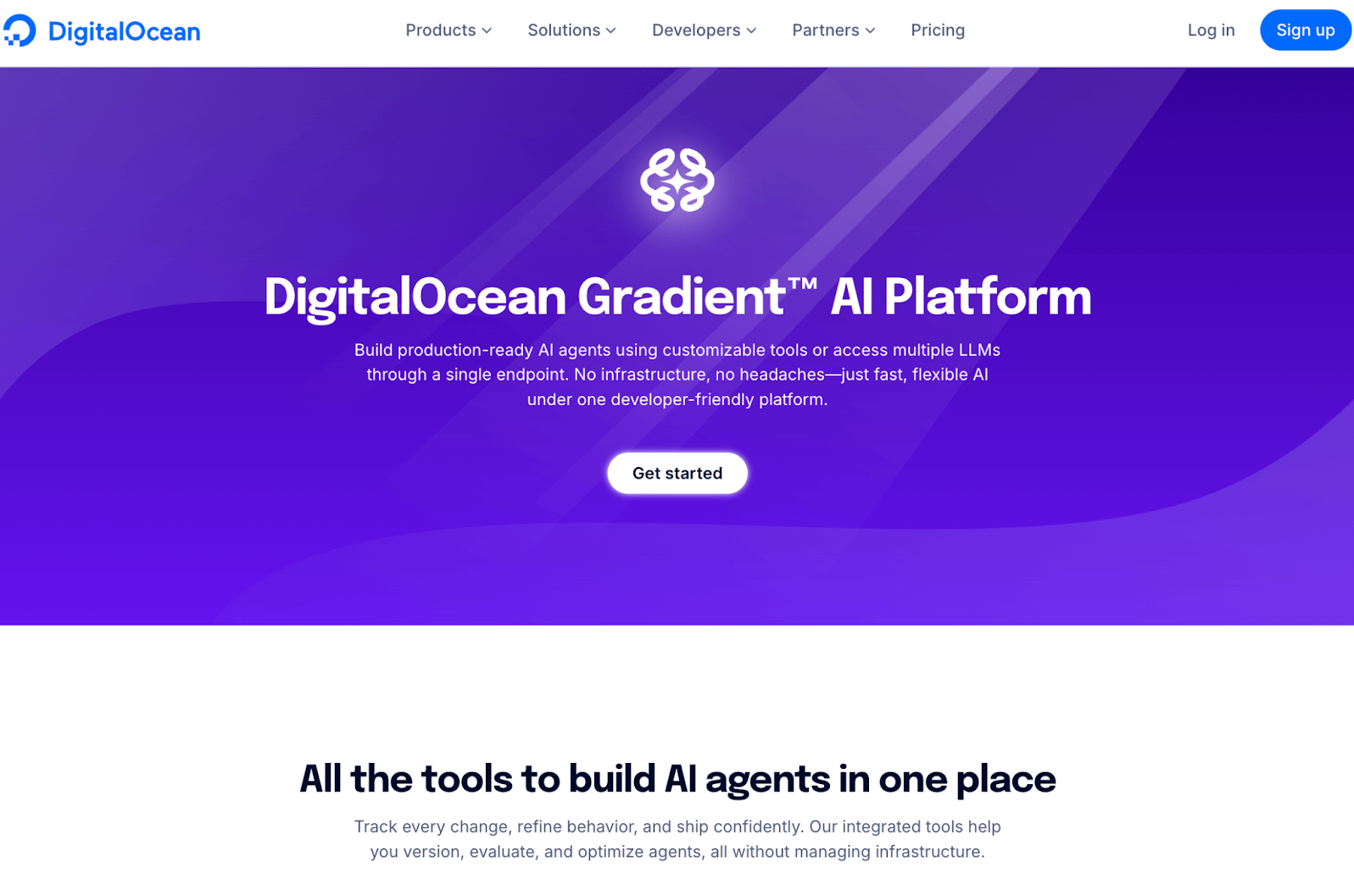
DigitalOcean’s Gradient™ AI Agentic Inference Cloud provides access to high-power computing infrastructure for AI inference and training workloads, regardless of your scale requirements. Designed with developers in mind, the Gradient AI Inference Cloud delivers production-ready inference performance on multiple access points and hardware configurations. With the connected Gradient AI Platform, you can run multiple AI agents in production with models from OpenAI, Anthropic, Mistral, DeepSeek, LLaMA, and others, without managing API keys or code, using serverless inference. You’ll access pre-installed AI frameworks along with agent templates that provide starting points for building AI agents so you can test prompts, experiment with models, and prototype agent workflows before deployment. Hardware provisioning is available for both NVIDIA and AMD GPUs in under a minute on GPU Droplets®, which are designed for model training, inference, large-scale neural networks, and high-performance computing. Access to Gradient AI Bare Metal GPUs is also available to support teams who want direct hardware control (along with single-tenant infrastructure) for large-scale model training, real-time inference, and complex orchestration.
DigitalOcean key features:
-
Secure deployment of agents through private or public endpoints, with integration into Virtual Private Cloud (VPC) networking for controlled access and isolation within application environments.
-
Infrastructure orchestration and autoscaling features are designed to support AI systems running inference at scale across GPU and CPU resources.
-
Data processing pipelines and vector databases are integrated into the platform to power retrieval and context management for AI agents and applications.
-
Gradient AI Platform - $0.15/million tokens. Capabilities for AI agent creation, LLM integration, and no infrastructure management.
-
Gradient GPU Droplets - Starting at $0.76/GPU/hour (based on configuration). Run training and inference on AI/ML models as well as process large datasets and neural networks.
-
Bare Metal Servers - Custom. Contact DigitalOcean to reserve capacity.
2. Replicate with API-forward AI development
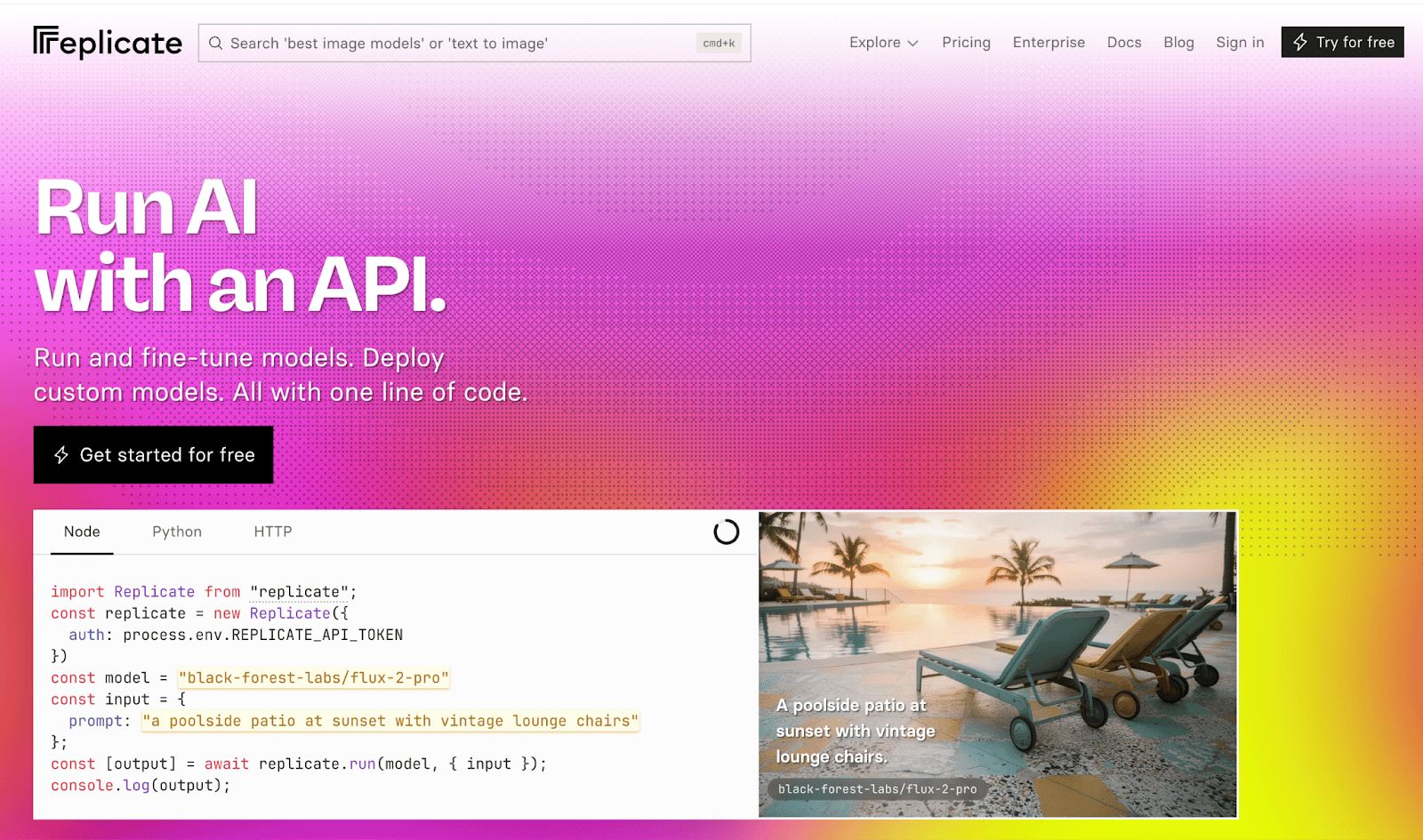
Replicate is an AI cloud provider for running your AI workloads through APIs and a CLI. Its model library provides access to a large number of models for use cases such as image generation, voice generation, LLM development, and more. Whether you choose an existing model or upload your own, you can then train your selected model with your own data to generate the results you want (such as a specific answer style or knowledge, image style, or voice type). Replicate also offers Cog, an open-source tool for packaging machine learning models that provisions an API server and hosts it on the cloud without manual setup. Plus, the company has recently joined Cloudflare to expand its network capabilities and AI support at scale.
Replicate key features:
-
Models are published with version identifiers, enabling developers to lock applications to a specific version and maintain consistent outputs as models evolve.
-
The platform supports long-running inference jobs with asynchronous execution and streaming outputs, enabling applications to handle large or compute-intensive model requests without blocking requests.
-
Replicate Playground enables AI model comparisons, prototyping, and development through a unified interface.
- Replicate uses a pay-as-you-go pricing model, and usage and hardware rates vary depending on the specific model you use. This applies to both public and private models from the library.
Understanding the differences between Hugging Face vs Replicate can help you choose the right platform for your AI workflow. While Hugging Face excels as a massive model hub and development ecosystem, Replicate focuses on running models via simple APIs—making it another option for deploying and serving models without managing infrastructure.
Neo-clouds for direct cloud GPU connectivity
If you’re in the market for just cloud GPU providers, neo-clouds might be a suitable option for you and your team, especially if you want the cheapest cloud GPU provider for AI. These providers give you access to GPU computing resources directly, with minimal platform or managed services. These options can be useful for getting workloads running, but might require a fair amount of technical expertise.
3. CoreWeave featuring direct, high-powered GPU access
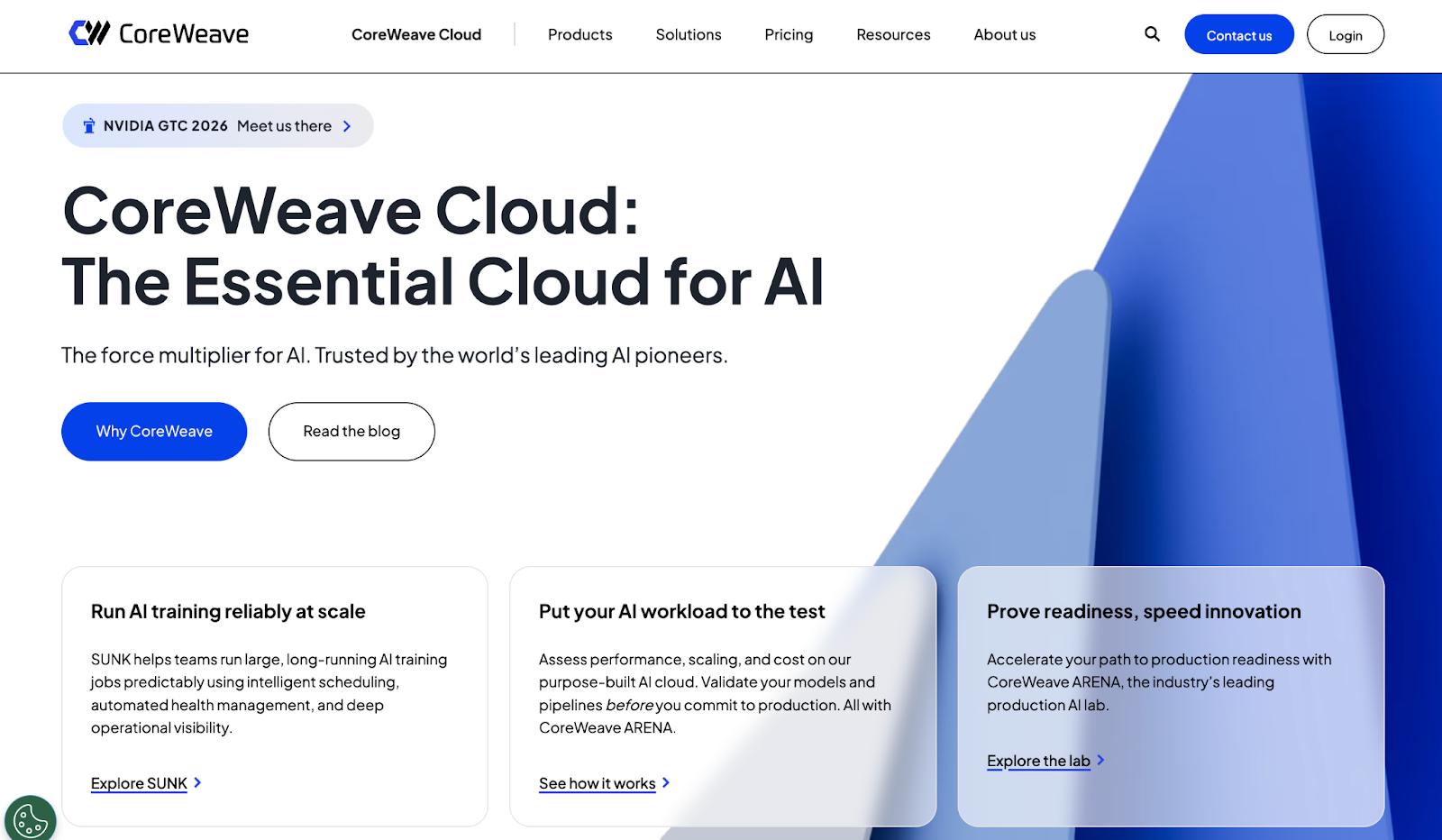
CoreWeave is a cloud purpose-built for AI workloads with high-speed infrastructure and monitoring tools to support optimized performance. Its ARENA platform is an end-to-end environment for workload evaluation, testing, validation, and deployment. Post-deployment, you can use CoreWeave Mission Control for observability on your workloads and receive feedback on bottlenecks, scheduling effects, and any potential runtime issues. Each deployment also integrates directly with Kubernetes, enabling containerized AI workloads to scale across GPU clusters using standard Kubernetes orchestration tools.
CoreWeave key features:
-
High-throughput storage systems that are designed to support large training datasets, checkpoints, and model artifacts used in machine learning pipelines.
-
Hardware isolation, real-time identity control, and continuous verification checkpoints for integrated security.
-
GPUs are available with NVIDIA Blackwell, Hopper, and Ada architectures. Configurations can be deployed as single-GPU servers up to 8x NVLink systems and InfiniBand clusters.
-
On-Demand GPUs - Starting at $6.50/hr for NVIDIA GH200 with 96 GB vRAM, 72 vCPUs, 480 GB system RAM, and 7.68 TB of local storage.
-
On-Demand CPUs - Starting at $3.36/hr for an Intel Ice Lake CPU with 96 vCPUs, 384 GB system RAM, and 19.2 TB of local storage.
AI teams evaluating GPU clouds often need to balance raw performance with the rest of their infrastructure stack. This CoreWeave alternatives guide compares platforms like DigitalOcean, RunPod, Lambda Labs, AWS, and Google Cloud—highlighting how some providers focus purely on GPU compute while others deliver a broader developer cloud with storage, databases, and orchestration tools for building full AI applications
4. RunPod with global availability and exposed APIs, SDKs
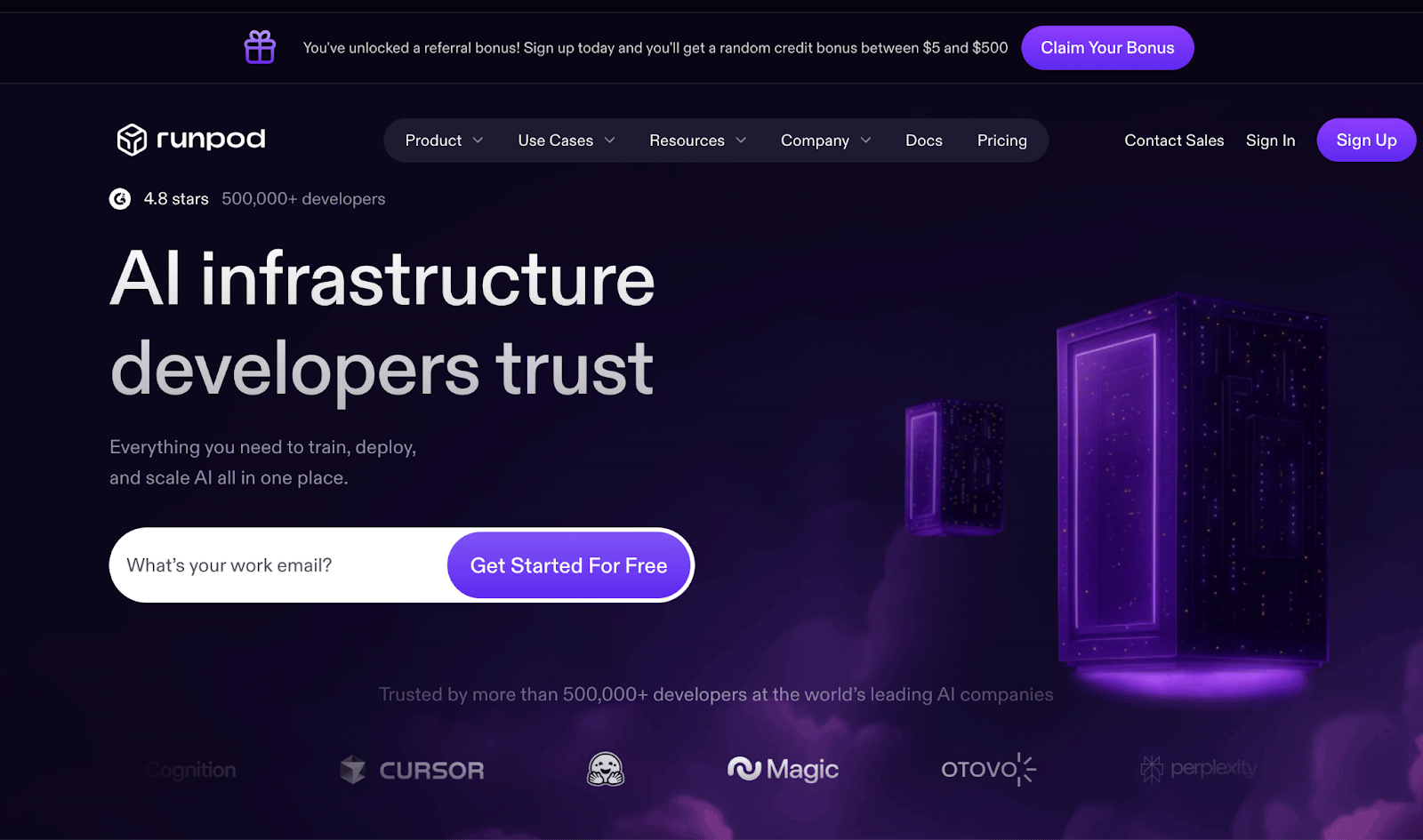
RunPod provides on-demand GPU infrastructure for AI workloads and projects, with global availability across more than 30 regions. Access is available to several configuration types: Pods (dedicated GPU environments on a community or secure cloud), serverless, reserved GPU instances, and instant GPU clusters. Its Hub—currently in beta—provides a library of preconfigured AI repositories you can quickly deploy on RunPod infrastructure for your own use, such as AI training or prototyping, and have immediate access to scalable endpoints.
RunPod key features:
-
Custom Docker image support that makes it easy to configure specific frameworks, dependencies, and runtime environments for machine learning pipelines.
-
Exposed APIs and SDKs that enable programmatic creation and management of GPU Pods, serverless endpoints, and other resources, supporting automated workflows and infrastructure-as-code patterns.
-
Support for PyTorch, CUDA, TensorFlow, JAX, and ONNX frameworks and additional compatibility for any Linux distribution that supports cloud GPU computing.
-
Pods - Starting at $0.16/hr. Includes NVIDIA RTX A5000 with 9 vCPUs, 24 GB of vRAM, and 25 GB of RAM.
-
Serverless - Starting at $0.00016/s for Flex deployments or $0.00011/s for Active deployments. Includes 16 GB A4000, A4500, RTX 4000, and RTX 2000 NVIDIA GPUs.
-
Instant Clusters - Starting at $1.79/hr for A100 SXM.
-
Reserved Clusters - Custom. Clusters can be reserved for 1-, 3-, 6-, or 12-month contracts.
Pricing will depend on the amount of vRAM and the type of GPU.
Different GPU clouds take very different approaches to performance, pricing, and infrastructure control. Our list of RunPod alternatives explores several platforms that offer on-demand GPUs, flexible pricing, and ML-ready environments—helping you compare options for training models, running inference, or scaling AI workloads beyond RunPod.
5. Lambda Labs with GPU-powered environments for AI training
Lambda Labs offers 1-Click Clusters, Superclusters, and instances for GPU computing access. These 1-Click Clusters provide production-ready access and connectivity to NVIDIA H100 and HGX B200 hardware for AI training, fine-tuning, and inference use cases at scale. For large-scale operations, superclusters provide liquid-cooled, high-density clusters to support single-tenant AI deployments. Lambda’s tech stack is built on Ubuntu Linux and can be accessed via a Python virtual environment after installation. It also includes the NVIDIA Container Toolkit and GPU-accelerated Docker containers.
Lambda Labs key features:
-
Hosted Jupyter notebook environments that integrate with GPU instances, enabling interactive experimentation, model training, and dataset exploration directly within the platform.
-
Preinstalled deep learning frameworks and drivers (such as CUDA, PyTorch, and TensorFlow), helping developers to launch GPU environments without manual configuration.
-
Multi-node GPU clusters connected with high-bandwidth networking, designed for the distributed training of large machine learning models.
-
1-Click Clusters - $4.62/hr for on-demand deployment.
-
Instances - Starting at $0.63/GPU/hr.
Hyperscaler offerings with managed AI development
Many teams that want to build out their AI applications and models might be within an organization that’s already using hyperscaler clouds and service portfolios. If your team is already running workloads on AWS, Azure, or Google Cloud, their AI services plug directly into your existing infrastructure, though that convenience can come with higher per-GPU costs and less flexibility than specialized providers.
6. AWS AI with end-to-end model development and deployment
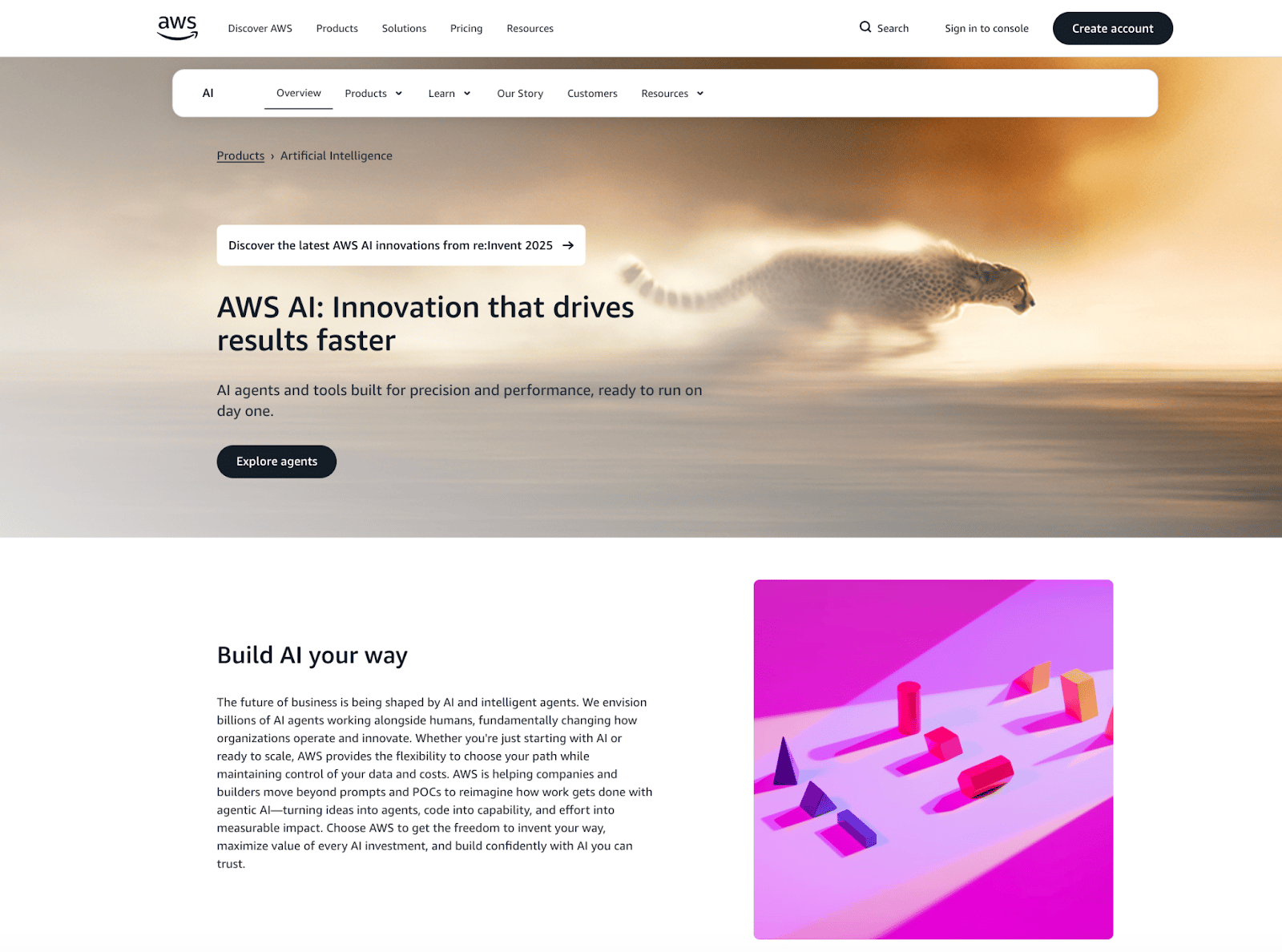
AWS supports AI workloads on its global cloud infrastructure (such as EC2 GPU-based instances and S3 Storage) and a large portfolio of AI-focused tooling. You can use AWS SageMaker’s features, including serverless model customization, checkpointless training, MLflow (designed for AI experimentation without infrastructure management), and pipeline orchestration. Beyond SageMaker, the AWS AI tool suite includes Amazon Bedrock AgentCore (for production-ready agents), Frontier Agents, and Amazon Quick Suite. You can also deploy Trainium chips designed for AI acceleration on dedicated EC2 or UltraServers as part of your AI infrastructure.
AWS AI key features:
-
Access AWS-developed Amazon Nova foundation models through Amazon Bedrock, supporting multimodal workloads such as text generation, image creation, and video understanding within Bedrock’s managed model API environment.
-
Amazon Kiro, an AI-assisted development tool designed to support programming workflows through automated code suggestions, debugging assistance, and documentation generation.
-
Pre-built AI services for common workloads, including computer vision, speech recognition, and natural language processing through services such as Amazon Rekognition, Amazon Transcribe, and Amazon Comprehend.
AWS AI pricing:
-
EC2 Capacity Blocks - Starting at $9.532/hr/instance for Trainium 1 and Trainium 2 instances with 16 accelerator chips.
-
On-Demand (SageMaker Studio) - Starting at $0.05/hr for ml.t3.medium instances with 2 vCPUs and 4 GB of RAM.
-
Bedrock - Custom. Pricing depends on the individual services used. Contact AWS for a quote.
7. Microsoft Azure featuring Windows support and data analytics use cases
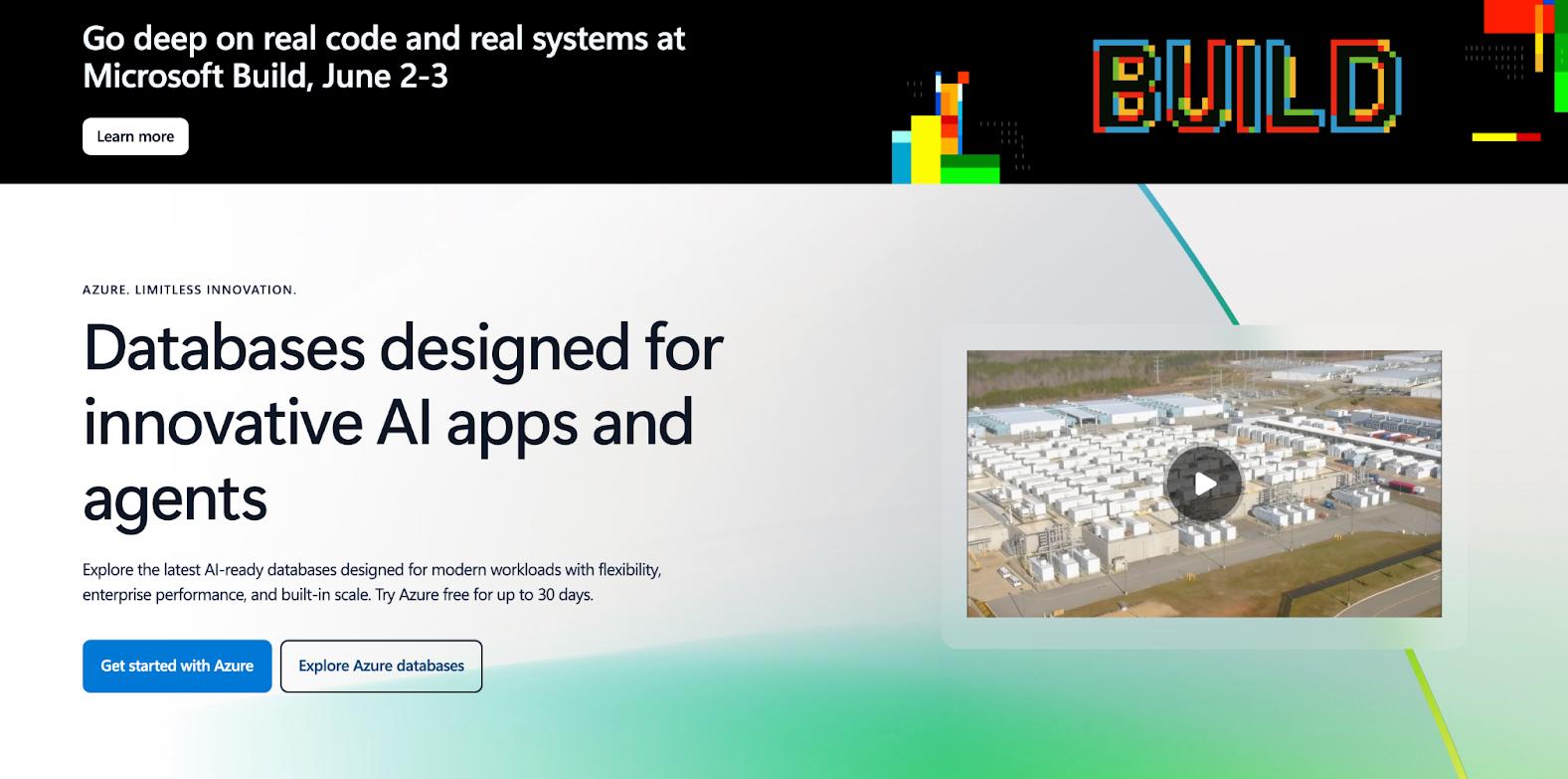
Microsoft’s AI-focused stack lives within the Microsoft Azure ecosystem, supporting the building, training, and deployment of machine learning and generative AI applications. The platform combines GPU-accelerated virtual machines, distributed storage services such as Azure Blob Storage, and container orchestration through Azure Kubernetes Service. It also includes managed AI and ML tooling, such as Azure Machine Learning, and model development environments in Azure AI Foundry. All of these components provide infrastructure for large-scale model training, experiment tracking, and deployment of AI inference endpoints.
Microsoft Azure key features:
-
Multi-node GPU clusters connected via low-latency networking technologies such as InfiniBand, which enable large-scale distributed AI model training.
-
Integrated capabilities for DevOps automation and feature building through multiple GitHub Copilot modes (Ask, Edit, and Agent).
-
Machine learning pipeline preparation with functions for data preparation, model training, evaluation, and deployment in repeatable pipelines.
- Azure Machine Learning is free to use, but you must pay for the compute that you consume.
8. Google Cloud Platform featuring Gemini access and Google ecosystem integration
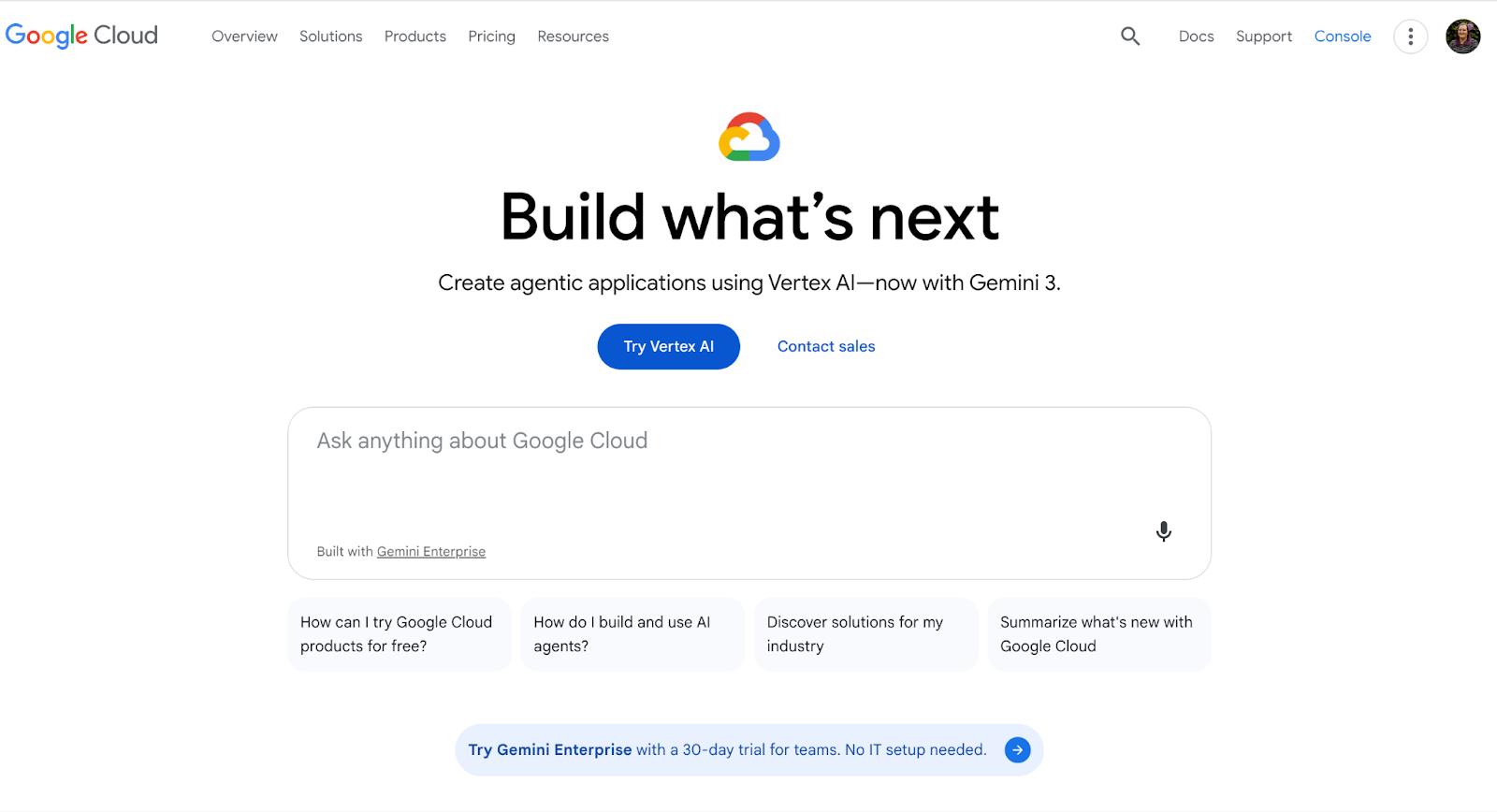
The Google Cloud Platform (GCP) AI ecosystem centers on Vertex AI, which offers tools for building, training, and deploying models in a managed environment, and on Gemini, a family of multimodal foundation models for text, image, and code generation. These capabilities run on Google’s global cloud infrastructure, which includes GPU-and TPU-accelerated compute, distributed storage, and Kubernetes container orchestration. Vertex AI integrates with data and analytics services across GCP to support model training pipelines and production deployment workflows. You’ll also gain access to multimodal foundation models from the Gemini family for tasks such as text generation, image understanding, and code assistance.
Google Cloud Platform key features:
-
A managed vector search service that enables applications to index embeddings and retrieve contextual information for grounding generative AI responses.
-
GCP’s Agent Garden includes ready-to-use samples and tools for agent development. They support data science, customer service, deep search, RAG, and marketing workflows.
-
Security features for AI models and data, including identity and access management, customer-managed encryption keys, private endpoints, and the Data Loss Prevention (DLP) API.
Google Cloud Platform pricing:
-
GPU instances - $88.49/hour on-demand for A3-highgpu-8g instance with 8 GPUs, 208 vCPUs, and 1872 GiB RAM
-
Vertex AI - Custom. Contact Google for an estimate.
AI clouds for enterprise-scale hybrid deployments
Not all AI deployments need to (or should) live entirely in the cloud. That’s where providers such as Oracle and IBM come in, with capabilities to support hybrid AI infrastructure at scale. This can be useful for regulated industries or organizations with specific data storage or sovereignty requirements.
9. Oracle Cloud Infrastructure featuring database automation and support
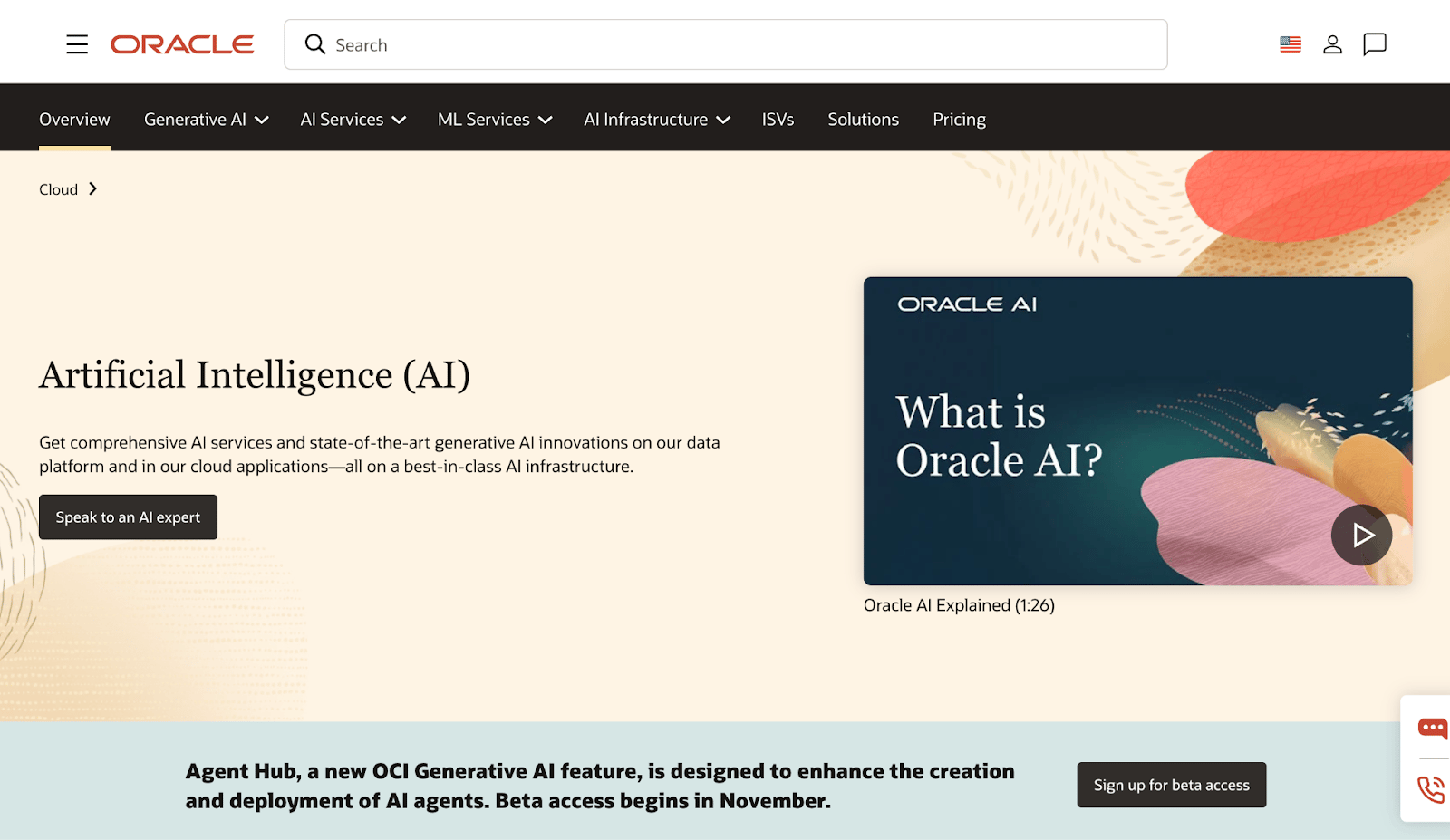
Oracle Cloud Infrastructure (OCI) is a cloud platform designed to support enterprise workloads, data platforms, and large-scale artificial intelligence applications. The platform provides GPU-accelerated compute clusters, high-performance networking, and distributed storage used for machine learning training and inference. OCI’s AI stack includes services such as Oracle Cloud Infrastructure Data Science for model development and experimentation, as well as infrastructure optimized for running large AI models on GPU clusters. The platform also integrates with Oracle’s data ecosystem, including the Oracle Autonomous Database, which is commonly used for storing and processing datasets in AI pipelines. Hybrid deployments are possible with OCI’s FastConnect (connecting your data center to an OCI region via public virtual circuit) and unified monitoring with Oracle Enterprise Manager.
Oracle Cloud Infrastructure key features:
-
Access to foundation models through OCI Generative AI, which supports building applications using large language models and generative AI capabilities within the Oracle Cloud environment.
-
OCI includes cluster networking with Remote Direct Memory Access (RDMA) over high-bandwidth interconnects, enabling low-latency communication between nodes during distributed model training.
-
Bare metal GPU instances are designed for large-scale machine learning training workloads, enabling direct access to GPU hardware for distributed AI model training.
Oracle Cloud Infrastructure pricing:
- GPU-accelerated compute: $1,897.20/month starting for 2x NVIDIA P100 Pascal Architecture, 32 GB of RAM, and an autonomous Linux OS. Block volumes storage is an additional cost of $8.50/month with this configuration.
Oracle Generative AI does not come at an additional cost, but you must pay for the compute resources that you use. Estimates taken from the Oracle Cloud cost estimator with the baseline of 744/hrs/month of use. Values will fluctuate depending on your hypothetical configuration.
10. IBM Cloud featuring hybrid deployments in regulated industries
IBM Cloud provides cloud infrastructure and enterprise AI services built around the IBM watsonx platform. Watsonx serves as the primary environment for building, training, and governing machine learning and generative AI models within IBM’s cloud ecosystem. The platform includes model development and deployment tools through IBM watsonx.ai, enterprise data management capabilities through IBM watsonx.data, and governance controls through IBM watsonx.governance. These services run on IBM Cloud infrastructure that provides GPU-enabled compute, container orchestration, and managed data services. With hybrid deployments, you can use IBM Virtual Power Server, IBM Fusion, and IBM Cloud Satellite to allocate your resources to both on-premise and in the cloud.
IBM Cloud key features:
-
IBM Cloud Confidential Computing uses hardware-based trusted execution environments to protect sensitive data while it is being processed, helping organizations run AI and analytics workloads with encrypted data in memory.
-
Access to curated foundation models—including IBM’s Granite model family—for tasks such as text generation, summarization, and conversational AI.
-
Watsonx Code Assistant supports over 116 programming languages for coding automation and workflow assistance.
- Watsonx.ai - Starting at $1,050/month for pay-as-you-go usage. Includes Playground UI, inferencing, open-source models, RAG, synthetic data generator, and custom foundation models.
AI cloud providers FAQ
Which cloud provider has the best GPU infrastructure for AI?
The most suitable provider depends on your specific hardware needs. For example, if quick and scalable access to serverless inference is your priority, then you may choose DigitalOcean, which offers rapid provisioning of NVIDIA and AMD GPUs in under a minute with access to a variety of powerful models, while you may choose Oracle Cloud Infrastructure to provide bare metal instances for large-scale distributed training. Or, you might choose another provider, such as RunPod and GCP, who offer global availability and specialized TPU-accelerated compute to support various high-performance AI workloads.
Can I use multiple cloud providers for AI workloads?
Yes, developers can use a multi-cloud approach to leverage the unique strengths of different platforms, such as using one provider for model training and another for serverless inference. Many AI cloud providers support this by offering managed Kubernetes, Docker containers, and open-source frameworks such as PyTorch and TensorFlow that can be moved across environments.
What should I look for in a cloud provider for inference vs training?
For AI training cloud providers, prioritize vendors that offer multi-node GPU clusters with high-bandwidth interconnects and high-throughput storage to handle large datasets. For inference, DigitalOcean’s Gradient AI Agentic Inference Cloud provides low-latency serverless endpoints and autoscaling to manage production traffic efficiently while maintaining cost transparency. GPU Droplets are also available with the latest NVIDIA and AMD hardware to support inference workloads at scale.
What are the best clouds for AI workloads and development?
The best clouds for AI workloads focus on providing high-power computing and automation for AI development and implementation. These platforms provide essential features such as multi-node GPU clusters, high-bandwidth interconnects, and high-throughput storage to efficiently handle massive datasets. DigitalOcean’s Gradient AI Inference Cloud provides both the hardware power and scalability for AI workloads, along with capabilities for orchestration and autoscaling.
What’s the most cost-effective way to train and deploy AI models?
Cost-effectiveness in training and deploying models is often achieved by choosing providers with transparent, per-second, or pay-as-you-go billing models to avoid paying for idle resources. Utilizing serverless inference and automated cost-optimization tools can further reduce expenses, especially for workloads with fluctuating demand. Comparing on-demand GPU rates across providers like DigitalOcean, RunPod, and Lambda Labs can help teams find the best performance-to-price ratio for their specific hardware requirements
Deploy on DigitalOcean’s Agentic Inference Cloud
DigitalOcean has spent over a decade building cloud infrastructure for developers, from virtual machines and managed Kubernetes to object storage, managed databases, and app hosting. DigitalOcean’s Agentic Inference Cloud extends that same simplicity to AI workloads, giving teams the tools to train, run inference, and deploy agents at scale without the operational overhead. We offer multiple paths to get your AI workloads into production:
Gradient™ AI Platform—build and deploy AI agents with no infrastructure to manage
-
Serverless inference with access to models from OpenAI, Anthropic, and Meta through a single API key
-
Built-in knowledge bases, evaluations, and traceability tools
-
Version, test, and monitor agents across the full development lifecycle
-
Usage-based pricing with streamlined billing and no hidden costs
GPU Droplets—on-demand GPU virtual machines starting at $0.76/GPU/hour
-
NVIDIA HGX™ H100, H200, RTX 6000 Ada Generation, RTX 4000 Ada Generation, L40S as well as AMD Instinct™ MI300X
-
Zero to GPU in under a minute with pre-installed deep learning frameworks
-
Up to 75% savings vs. hyperscalers for on-demand instances
-
Per-second billing with managed Kubernetes support
Bare Metal GPUs—dedicated, single-tenant GPU servers for large-scale training and high-performance inference
-
NVIDIA HGX H100, H200, and AMD Instinct MI300X with 8 GPUs per server
-
Root-level hardware control with no noisy neighbors
-
Up to 400 Gbps private VPC bandwidth and 3.2 Tbps GPU interconnect
-
Available in New York and Amsterdam with proactive, dedicated engineering support
→ Get started with DigitalOcean’s Agentic Inference Cloud
DISCLAIMER: Any references to third-party companies, trademarks, or logos in this document are for informational purposes only and do not imply any affiliation with, sponsorship by, or endorsement of those third parties.
About the author

Jess Lulka is a Content Marketing Manager at DigitalOcean. She has over 10 years of B2B technical content experience and has written about observability, data centers, IoT, server virtualization, and design engineering. Before DigitalOcean, she worked at Chronosphere, Informa TechTarget, and Digital Engineering. She is based in Seattle and enjoys pub trivia, travel, and reading.
Start building today
From GPU-powered inference and Kubernetes to managed databases and storage, get everything you need to build, scale, and deploy intelligent applications.
