
Businesses building AI products today all eventually find themselves asking the same question: which provider actually fits the workload in front of you? LLM cost is usually where the search for answers starts. DigitalOcean’s 2026 Currents report found that 49% of respondents identify the high cost of inference as the top blocker to scaling AI. Many providers’ pricing pages promise the cheapest rates and the widest model catalogs, but their claims don’t always hold up once you factor in real usage volume.
Choosing an LLM API provider can be a challenge because the “best” depends entirely on what you’re optimizing for. A team chasing low latency requires a different platform than another that’s trying to keep costs down at scale. Let’s explore how different LLM API providers compare on pricing, model access, and reliability to help you find the best fit.
Key takeaways:
-
LLM API providers give developers hosted access to large language models (LLMs), cutting out the weeks of work it takes to build and maintain that infrastructure in-house.
-
An LLM API platform brings faster time to production, lower operational overhead, access to a wider range of models, and built-in failover, without requiring a team to run its own inference stack.
-
The right provider depends on the workload: budget-constrained teams should compare real per-token rates at expected volume, and latency-focused teams should benchmark actual throughput.
-
The LLM API providers include: DigitalOcean, Nebius, OpenRouter, Fireworks AI, Together AI, SiliconFlow, Groq, Baseten, and Modal.
What is an LLM API provider?
An LLM API provider is a platform that gives developers access to large language models on its own infrastructure or through a hosted inference API. Some LLM providers train and serve their own proprietary model, like OpenAI or Anthropic. Other companies operate as LLM platforms that aggregate access to many open and proprietary models under a single LLM inference API. DigitalOcean Serverless Inference offers a version of this, giving developers access to 70+ models through one endpoint instead of a single company’s model lineup. Because these models run on the same cloud as DigitalOcean’s databases and networking, inference is already part of the application stack instead of something stitched together across vendors.
When does self-hosting stop being the “cheap” option and start becoming the expensive one? Our Serverless vs. Dedicated vs. Self-Hosted LLM Inference guide does the math so you don’t have to guess.
Benefits of an LLM API provider
Building and maintaining your own model infrastructure ties up significant engineering time that could be spent on your product, instead. A hosted cloud provider hands you that infrastructure already built, tested, and running at scale. Here’s what you can gain:
-
Faster time to production: Start sending real requests as soon as you have an API key. Building that infrastructure yourself takes time to get right.
-
Built-in compliance and security: Providers like DigitalOcean offer security and compliance certifications for certain services and configurations, including SOC 2 report, support for HIPAA-eligible workloads under a signed Business Associate Agreement (BAA), and ISO certifications and data isolation controls. Available features, certifications, and customer responsibilities vary by service, region, and configuration.
-
Access to a wider range of models: A single integration can grant access to dozens or even hundreds of open and proprietary models. As a result, you can test new model releases without writing separate integrations.
-
Predictable, usage-based costs: Most providers charge per token processed, so your spend scales directly with actual usage. This keeps costs affordable both while you’re running a small pilot and once you move to production traffic.
-
Built-in reliability features: Some providers offer configurable routing or failover to a backup endpoint if the primary degrades. The redundancy is challenging to build in a single self-hosted deployment.
Learn how Hippocratic AI reported 2x production throughput and a 99.9% safety score across 10 million patient calls.
These customer-reported results reflect Hippocratic AI’s methodology, workload, configuration, and measurement period and may not be representative of results in other environments. Results in customer environments may vary depending on configuration, implementation, and usage. Results and/or savings are not guaranteed.
How to choose an LLM API provider
Various LLM providers solve distinct problems. For example, a team chasing the lowest possible latency requires a very different provider than a team trying to keep costs down at high volume. The ideal solution depends on which situation matches your project:
-
If budget is the main constraint, compare the actual per-token rate at your expected volume, not headline pricing alone. The seemingly cheapest LLM API provider on paper isn’t always the actual cheapest once real usage volume is factored in. So, weigh any cheap LLM API claim against your own usage math before committing.
-
If latency is the priority, test actual throughput under load, since the fastest LLM API claim on a marketing page rarely holds up once real concurrency enters the picture. Benchmark the exact model and region planned for production, not a generic demo endpoint.
-
If long-term support matters, choose a provider that can assist you beyond the prototype stage. Look for migration guidance, production support, and ongoing technical assistance as your AI workloads evolve. Because a long-term partnership can matter more than the savings from a short-term free tier.
-
If you already have an integration built around a specific request format, prioritize a provider offering compatible LLM API access. Switching request formats costs more engineering time than most pricing differences save.
-
If usage is low and predictable, compare running a model locally via OpenAI-compatible options, such as Ollama, against a hosted LLM provider. A hosted LLM API might cost more per request than owning the hardware if volume drops below a certain threshold.
AI inference platforms handle the operational overhead—choosing the right one determines the cost of running your application, plus its performance and ability to scale. Explore the top AI inference platforms to determine the best choice for your production AI applications.
9 best LLM API providers
Pricing and feature information in this article are based on publicly available documentation as of August 2026 and may vary by provider, model, service, usage level, configuration region, and workload. Listed prices may exclude taxes, additional service charges, minimum commitments, and promotional terms. For the most current pricing and availability, please refer to each provider’s official documentation.
This “best for” information reflects DigitalOcean’s editorial opinion based on publicly available provider documentation, third-party commentary, and user experiences shared in public forums as of August 2026. DigitalOcean prepared this comparison and included its own services. It does not constitute verified facts, comprehensive data, or a definitive assessment of the service. Availability, default settings, and coverage may vary by model, service, and configuration.
The best LLM API providers offer distinct approaches to model access, inference performance, and deployment. The top options include providers suited to different workloads, from managed APIs to infrastructure-focused services.
| Provider | Best for* | Key feature | Pricing |
|---|---|---|---|
| DigitalOcean | AI-native enterprises building agentic workflows | Inference Router; Access to 70+ models; zero data retention and Virtual Private Cloud (VPC) isolation by default | Input tokens: ~$0.05-$10/1M; Output tokens: ~$0.05-$50/1M |
| Nebius | Compliance-certified inference with dedicated GPU capacity | Supports 60+ models; SOC 2, HIPAA, and ISO 27001 certifications | Input tokens: ~$0.06-$3.00/1M; Output tokens: ~$3.20-$15.00/1M |
| OpenRouter | Routing requests across a wide model marketplace | Unified API layer over 400+ models from 70+ providers; price-weighted load balancing | Free plan (25+ models, 50 req/day); Input tokens: ~$0-$5/1M; Output tokens: ~$0-$25/1M |
| Fireworks AI | Serving open-weight models | Multi-Low-Rank Adaptation (LoRA) deployment; full-parameter fine-tuning on models up to 1T parameters | Input tokens: ~$0.10-$1.74/1M; Output tokens: ~$0.20-$4.40/1M |
| Together AI | Mature fine-tuning tooling with a broad model catalog | LoRA, full fine-tuning, and DPO tuning; multi-node training above 100B parameters | Input tokens: ~$0.10-$9/1M; Output tokens: ~$0.10-$3.00/1M |
| SiliconFlow | Multimodal deployment across text, image, and video | 200+ model catalog; AI gateway for smart routing and cost controls | Input tokens: ~$0.04- $3/1M; Output tokens: ~$0.06-$15.0/1M |
| Groq | Low-latency inference on custom Language Processing Unit (LPU) hardware | Route up to 10 automatic tool calls; stores model parameters inside on-chip SRAM (Static Random-Access Memory) mesh. | Free; supported models at 30 requests per minute; Input tokens: ~$0.04-$0.79/1M; Output tokens: ~$0.08-$3.00/1M |
| Baseten | Custom models, with dedicated, autoscaling infrastructure | Compound-AI pipelines with per-step hardware allocation; dense text-generation models with automatic optimization | Input tokens: ~$0.20-$3.00/1M Output tokens: ~$1.20-$15.00/1M |
| Modal | Code-first model serving on serverless GPUs | Container runtime with memory snapshotting; Multi-node clusters with InfiniBand and private networking | Per-second GPU billing; NVIDIA T4 from $0.000164/sec with no standard per token input/output costs |
Cloud infrastructure providers
Cloud infrastructure providers combine model inference with the infrastructure needed to run AI workloads at scale, which includes deployment, scaling, and compute resources.
-
DigitalOcean for AI-native enterprises building agentic workflows
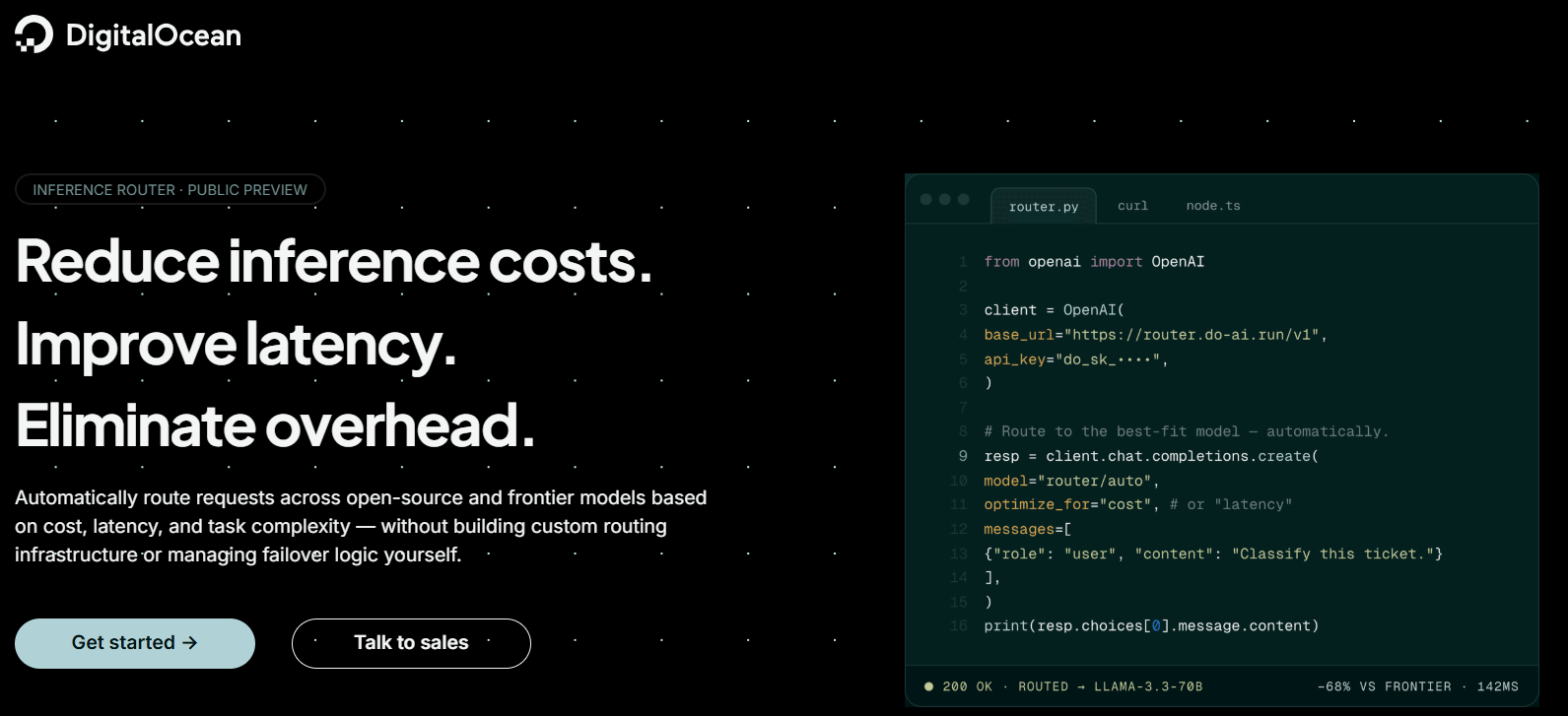
DigitalOcean’s cloud infrastructure provides Inference Engine, which gives developers a single OpenAI- and Anthropic-compatible endpoint for running production LLM workloads. The DigitalOcean Inference Engine spans serverless, dedicated, and batch inference on GPU capacity. Inference Router matches each request to a task-appropriate model from a developer-defined pool using a purpose-built routing model. Because Serverless Inference runs on the same cloud as DigitalOcean’s databases and networking, requests move between those layers without cross-vendor hops. The Model Catalog hosts 70+ curated open-weight and frontier models, served with zero data retention and VPC isolation by default. For teams that run their own models, DigitalOcean also supports bring-your-own-model (BYOM).
DigitalOcean key features:
-
The Inference Router’s routing model, Plano orchestrator, scores 87.84% average accuracy across general, coding, and long-context tasks in a DigitalOcean evaluation, compared with GPT-5.1 (86.93%) and Claude Sonnet 4.5 (86.11%) under the same evaluation methodology. Results may vary based on the dataset, prompts, model versions, configuration, scoring methodology, and evaluation date.
-
Content safety guardrails can apply policy-based “allow/flag/block decisions” to both the input and output of supported inference requests by default, rather than as an opt-in add-on layer.
-
Evaluations run LLM-as-a-judge tests across models and routers side by side to compare output quality before changing a production router’s model pool.
Usage-based pricing based on the model that processes the request:
-
Input tokens: ~$0.05-$10/1M
-
Output tokens: ~$0.05-$50/1M
Coding agent sessions tend to include both deep analysis and quick lookups, yet most teams pay frontier rates for all of it. Learn about how DigitalOcean Inference Router was built to stop that waste at the infrastructure layer.
API platforms and model marketplaces
API platforms and model marketplaces offer developers a unified way to access models from multiple providers through a single integration. An LLM aggregator like OpenRouter can simplify model switching and comparison, making it easier to evaluate options for the fastest and cheapest LLM APIs, while managing access and authentication.
-
OpenRouter for routing requests across a wide model marketplace
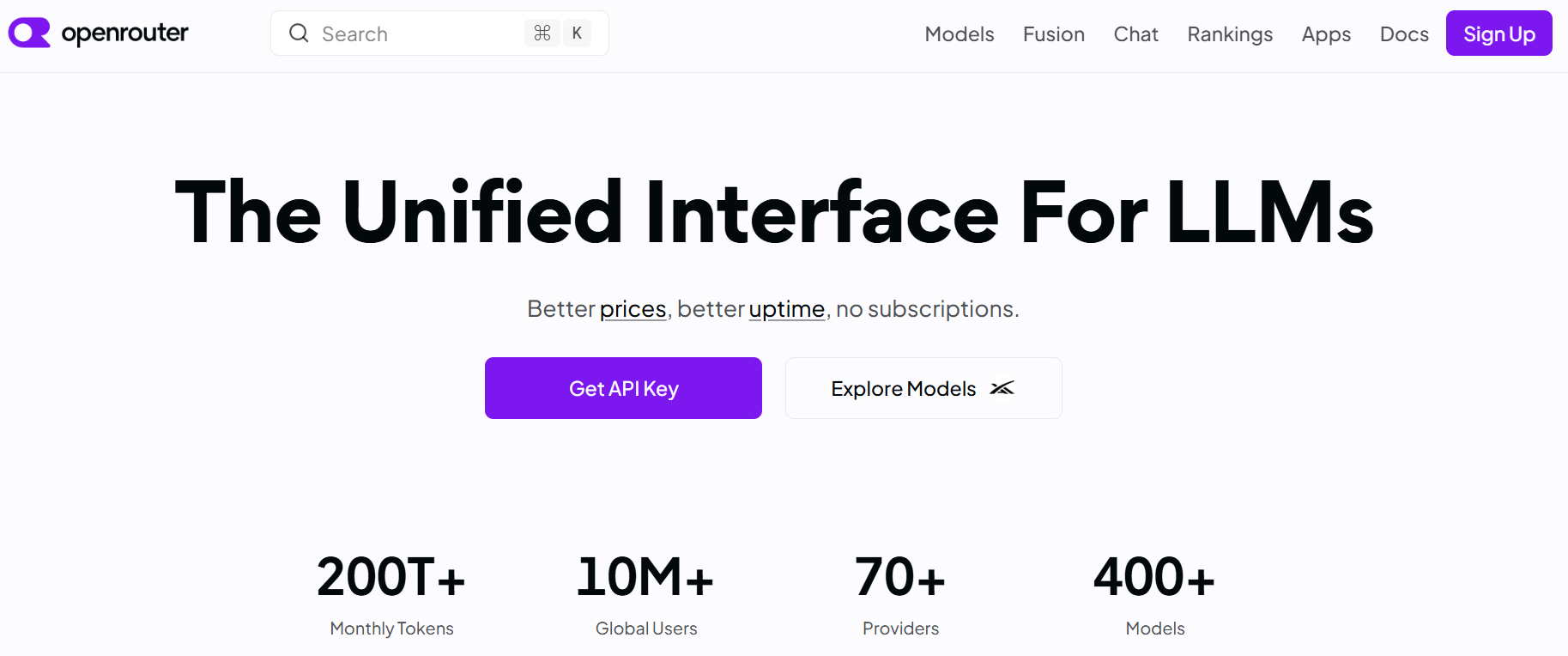
OpenRouter operates as a unified API layer over 400+ models from 70+ third-party providers, including DigitalOcean, rather than running its own inference infrastructure. It is perhaps the most comprehensive free LLM API offering because the same model can be served through different underlying implementations or configurations (depending on the provider handling the request). Developers can use provider preferences and quantization filters to constrain routing, but doing so adds another layer of configuration when consistent model serving is important. Provider selection and fallback settings may therefore require additional configuration for production workloads that need predictable serving behavior.
OpenRouter key features:
-
Quantization filter (int4 through fp32) restricts routing to providers serving a specific precision level of a mode.
-
Requests for a given model are load-balanced across available providers using a price-weighted algorithm. Stable providers are chosen with a probability proportional to the inverse square of their price, while any provider that has seen an outage in the last 30 seconds is deprioritized.
-
Retrieve model metadata through the API to identify models that support capabilities, like structured responses or extended reasoning.
-
Free plan - Access to 25+ free models, with a request limit of 50 per day.
-
Input tokens: ~$0-$5/1M
-
Output tokens: ~$0-$25/1M
-
Paying pass-through fees on top of vendor list rates, on top of building your own failover logic? Explore OpenRouter alternatives to compare available pricing, routing, and failover options.
-
Looking for a gateway to manage routing across multiple providers instead? Our guide to the best LLM routers compares LiteLLM alternatives and more.
-
Fireworks AI for serving open-weight models

Fireworks AI serves open-weight models through an OpenAI- and Anthropic-compatible endpoint, like DigitalOcean. They also offer GPU infrastructure for training and fine-tuning those same models. For teams running their own reinforcement-learning models, it offers dedicated rollout inference. Fireworks AI focuses primarily on model serving and inference, so application infrastructure outside the inference layer—such as databases and general-purpose storage needs to be managed separately.
Fireworks AI key features:
-
Full-parameter fine-tuning supported on models up to 1 trillion parameters.
-
Multi-LoRA deployment serves fine-tuned models with one-click deployment.
-
Fireworks Nexus routes requests between frontier and open-weight models based on the requirements of each workload.
-
Input tokens: ~$0.10-$1.74/1M
-
Output: ~$0.20-$4.40/1M
Fast token generation is now table stakes. Can your provider also handle storage, databases, and agent tooling? Compare the best Fireworks AI Alternatives for your AI workloads.
-
Together AI for a broad model catalog and mature fine-tuning tooling
Together AI runs inference for open-weight models and exposes them through an API built to match the OpenAI request format. The traffic distributes API requests across endpoints based on current load. It keeps a session pinned to the same endpoint when needed, along with regional availability. Note that Together AI only handles the inference layer. Teams still need somewhere to host their application logic and databases, which could add cross-cloud data transfer costs and extra integration work.
Together AI key features:
-
Model customization spans LoRA adapters, full fine-tuning, and Direct Preference Optimization (DPO) tuning, with multi-node training available for models above 100 billion parameters.
-
Async Batch API runs jobs of up to 30 billion tokens per model in one submission, a fit for offline work like labeling a dataset or summarizing content in bulk.
-
Code Sandbox sits at the core of the inference and training stack to execute agentic workloads.
-
Input tokens: ~$0.10-$9/1M
-
Output tokens: ~$0.10-$3.00/1M
Teams that require models not offered in Together AI’s catalog may need to use an additional provider, which might add vendor-management and billing complexity. Our guide to Together AI alternatives covers providers that consolidate the stack.
-
SiliconFlow for multimodal deployment across text, image, and video
SiliconFlow is an LLM API provider that provides developers with OpenAI-compatible endpoints for running multimodal models. Its catalog lists 200+ models from providers like DeepSeek and Meta. Model capabilities include a wide range of text generation, image generation, video generation, and audio models. The application logic, orchestration, and data storage live on separate infrastructure, which can add integration work and cross-cloud data transfer costs.
SiliconFlow key features:
-
Deployment options include serverless pay-per-use inference, a dedicated reserved GPUs tier, and BYOC (bring-your-own-cloud).
-
Tooling integration with standard development platforms like Dify Marketplace and Cursor.
-
Options to switch between guaranteed, always-on dedicated compute endpoints for mission-critical apps, or standard elastic Function-as-a-Service (FaaS) pooling.
-
Input tokens: ~$0.04-$3/1M
-
Output tokens: ~$0.06-$15.0/1M
Buying GPUs outright means paying for idle hardware between jobs. The top serverless GPU platforms charge only for the compute you actually use.
-
Groq for low-latency inference on custom LPU hardware

Groq is an LLM API provider that runs inference on its own custom LPU chip, now paired with NVIDIA GPUs. It gives developers a single API to use open models, its catalog including models such as Llama, Qwen, Kimi, and OpenAI’s GPT-OSS models. Token rate limits are tracked across eight distinct metrics, which include requests per minute, tokens per minute, and other request and token limits. Groq Compound currently doesn’t support HIPAA-covered workloads or regional and sovereign endpoints, which might restrict its use for regulated applications with strict data-residency requirements.
Groq key features:
-
Platform is organized into three layers: GroqMetal for dedicated bare-metal infrastructure, GroqCore for a tested inference stack, and GroqAssured for enterprise governance.
-
Compound and Compound Mini agentic systems route a request up to 10 automatic tool calls and a context window of 131,072 tokens.
-
Stores open-weight AI model parameters directly inside a high-speed, on-chip SRAM (Static Random-Access Memory) mesh, a network of memory blocks built into the processor to provide fast access to model data.
-
Free - All supported models, at 30 requests per minute
-
Input tokens: ~0.04-$0.79/1M
-
Output tokens: ~$0.08-$3.00/1M
Learn about Groq’s LPUs, AWS Inferentia2, and TPUs; each trade off on cost, latency, and flexibility for LLM serving layers.
-
Nebius for compliance-certified inference with dedicated GPU capacity
Nebius is an LLM API provider that runs Token Factory, its managed inference API for open-source models, with access to 60+ models. Requests run through two optimized serving modes: fast (for low latency with smaller batch sizes) or base ( for throughput with larger batching), depending on whether latency or throughput matters more. According to Nebius’s publicly available documentation as of August 2026, the platform holds a SOC 2 Type II examination, support for certain HIPAA workloads, applicable ISO/IEC certifications, and measures intended to support NIS2 requirements, with data residency options across EU and US data centers. The stack may require customers to use separate providers for application services not offered by Nebius, depending on their architecture and requirements.
Nebius key features:
-
Nebius Agents Blueprint integrates with LangChain, LangSmith for orchestration, and Pinecone Nexus for retrieval.
-
Provides an end-to-end sandbox integrating tools like NVIDIA Cosmos and OSMO for synthetic data creation, simulation training, and physical AI execution.
-
Token Factory inference layer supports built-in NVIDIA NIM integration.
-
Input tokens: ~$0.06-$3.00/1M
-
Output tokens: ~$3.20-$15.00/1M
Picking a model by benchmark score alone is how teams end up with a bill they didn’t expect and latency they can’t explain. Choosing the right model for your inference use case demonstrates how to match model to workload instead.
Custom model deployment platforms
Custom model deployment platforms provide greater control over how a model runs in a deployment environment. The tradeoff is more setup work, where developers handle deployment code and infrastructure decisions that would generally be offloaded when using a fully managed API provider like DigitalOcean.
-
Baseten with dedicated, autoscaling infrastructure for custom models
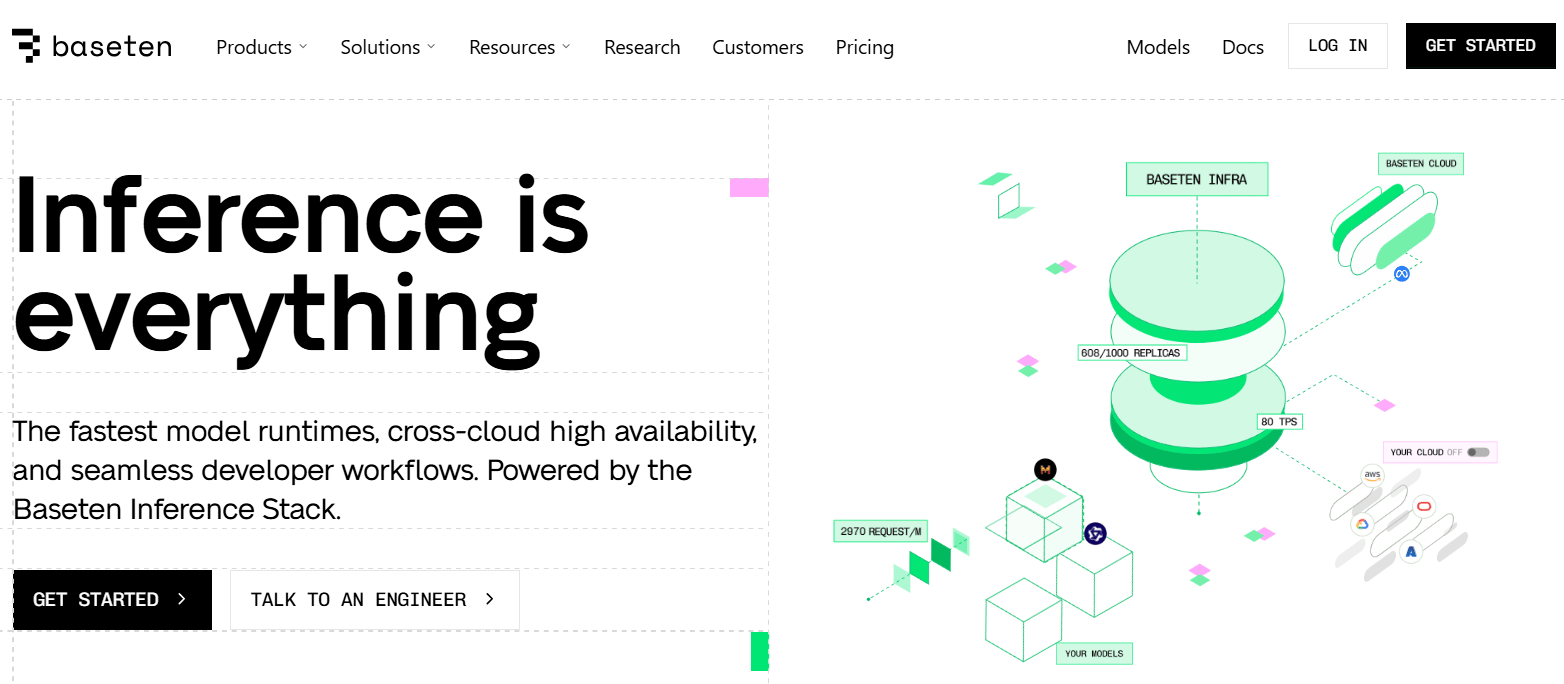
Baseten is an inference platform that serves open-source, custom, and fine-tuned models through pre-optimized Model APIs and dedicated deployments. Baseten Chains handles compound-AI pipelines with per-step hardware allocation and autoscaling. Deployment options include Baseten’s own cloud, a self-hosted customer VPC, and a hybrid mode. The platform’s orchestration layer(via Baseten Chains) includes the model pipeline itself, not the surrounding application. Databases, general storage, and app-level orchestration run on separate infrastructure. That split can add operational complexity, making teams responsible for managing integrations and cross-cloud costs.
Baseten key features:
-
Baseten Embeddings Inference (BEI) is a custom runtime engine that processes up to 1,400 client embeddings per second on an NVIDIA H100 GPU.
-
Baseten’s training SDK (Loops”) runs asynchronous reinforcement learning with 1 trillion parameters.
-
Automatically compiles and optimizes dense text-generation models using NVIDIA’s TensorRT-LLM framework to accelerate performance.
-
Input tokens: ~$0.20-$3.00/1M
-
Output tokens: ~$1.20-$15.00/1M
Slow time-to-first-token isn’t always a GPU problem. It can be a queuing, batching, or memory bottleneck hiding in plain sight. Learn about the hidden bottlenecks in LLM inference to understand where inference pipelines break.
-
Modal for code-first model serving on serverless GPUs
Modal is a serverless compute platform for running GPU workloads, with a dedicated inference product for deploying and serving LLMs. Teams can deploy an open-source or custom model with a single CLI command (modal endpoint create --model <name>) that exposes an OpenAI-compatible endpoint. Modal runs a hosted shared endpoint option, which is a ready-to-use API for select models like Kimi K3. Using the platform requires writing applications using Modal’s custom decorators and image builders. As a result, moving away from Modal may require changes to applications that use Modal-specific decorators or deployment workflows, potentially increasing migration time and engineering effort.
Modal key features:
-
Container runtime built on memory snapshotting that restores a paused container’s full state to cut cold starts.
-
Features ‘modal run’ command for quick scripting and ‘modal shell’ command to securely drop directly into a live, GPU-accelerated cloud container terminal for debugging.
-
Multi-node distributed training clusters with Infiniband and private networking.
Modal bills for infrastructure usage by the second, based on active compute time—not standard per-token input/output pricing.
- Per-second GPU billing: NVIDIA T4 starts at $0.000164.
Great for spinning up ML jobs fast, but is Modal still the right fit as your workloads scale and your infrastructure needs grow? Explore the top Modal alternatives for ML deployment.
LLM API providers FAQs
Which inference providers reliably serve Qwen 3 in production?
Several LLM API providers run broad open-weight catalogs. DigitalOcean’s Model Catalog includes Qwen 3. For supported services and configuration, DigitalOcean offers zero-data retention and VPC isolation controls that can help customers protect sensitive data for production workloads. Customers remain responsible for assessing their security, privacy, and regulatory requirements.
Which providers offer dedicated GPU endpoints for fine-tuned models without minimum commitments?
DigitalOcean Inference Engine provides dedicated GPU endpoints for custom fine-tuned models with pay-as-you-go flexibility, zero long-term commitments for eligible offerings, and configurable scaling controls, subject to applicable service terms, capacity, and availability. Platforms like Nebius, SiliconFlow, Baseten, and Modal also offer dedicated, autoscaling GPU infrastructure with usage-based billing.
Which inference providers offer OpenAI-compatible APIs for DeepSeek, Llama, and Qwen models?
The DigitalOcean Inference Engine offers OpenAI- and Anthropic-compatible endpoints for DeepSeek, Llama, and Qwen models. Switching an existing integration over means swapping the model name for a router name. SiliconFlow and Groq offer models from DeepSeek and Meta (Llama) through an OpenAI-compatible endpoint.
Which inference providers offer OpenAI-compatible APIs for open-source models?
The DigitalOcean Inference Engine, SiliconFlow, and Fireworks AI serve open-weight models through OpenAI and Anthropic endpoints. Together AI and Groq serve OpenAI-compatible APIs for open-source models. On DigitalOcean, requests run on the same cloud as databases, storage, and networking—no need to hop across vendors.
Which serverless inference providers handle cold starts well for open-source models?
Modal’s container runtime uses memory snapshotting to restore a paused container’s full state, which cuts cold starts for models served on its serverless GPUs. DigitalOcean and SiliconFlow offer serverless, pay-per-use inference for open-source models as part of their broader deployment options.
Are there the best free LLM API providers?
OpenRouter is a solid free LLM API option, offering a free plan with access to 25+ models—note that it’s capped at 50 requests per day. Groq offers a free tier for its supported models at 30 requests per minute. SiliconFlow gives new accounts $1 in free credits with no minimum spend, but that’s a one-time starter credit, not an ongoing free tier.
Ship AI workloads faster with DigitalOcean Inference Engine
DigitalOcean Inference Engine brings real-time, batch, and dedicated inference together under one platform. Teams can reduce the need to piece together routing tools and monitoring systems on their own. As an LLM API provider, it supports multimodal workloads and gives developers a single control plane for evaluating and running inference in production.
The platform brings together key controls for evaluating, routing, and monitoring inference into one workflow:
-
Use the inference mode that best fits the workload: Serverless inference for real-time agents and applications, batch inference for async jobs, or dedicated inference for sustained traffic and custom models.
-
Set routing policy per request: Select from a list of 70+ models by cost, latency, or intent, with fallback priorities.
-
Check quality and performance ahead of deployment: Run models and routing policies against your own datasets using reusable rubrics and side-by-side comparisons.
-
Monitor inference in production: Token usage, latency, and batch-job status are visible in the dashboard, which may reduce the need for a separate monitoring stack depending on the customer’s requirements.
-
Scale across workload patterns: Handle real-time requests, batch jobs targeted to deliver within 24 hours, subject to applicable service terms, capacity, workload, and availability, or dedicated GPU endpoints with custom scaling controls.
-
Multiple modalities through one setup: Text, image, and vision-language workloads run through a single API key and billing system.
Start deploying with DigitalOcean.
Any references to third-party companies, trademarks, or logos in this document are for informational purposes only and do not imply any affiliation with, sponsorship by, or endorsement of those third parties.
About the author

Sujatha R is a Technical Writer at DigitalOcean. She has over 10+ years of experience creating clear and engaging technical documentation, specializing in cloud computing, artificial intelligence, and machine learning. ✍️ She combines her technical expertise with a passion for technology that helps developers and tech enthusiasts uncover the cloud’s complexity.
Start building today
From GPU-powered inference and Kubernetes to managed databases and storage, get everything you need to build, scale, and deploy intelligent applications.
