The 11 Best Cloud Migration Tools for Businesses in 2026

By Maddy Osman
Senior Content Marketing Manager at DigitalOcean
- Updated:
- 19 min read
Not every cloud decision ages well. Maybe the provider you chose years ago was the cheapest option at the time, or it handled your workloads fine when you were small, but now you’ve outgrown it, and the scaling limitations are creating real problems. On the flip side, you might be on a major cloud platform that technically does everything you need—but the bill has gotten so out of hand that a more cost-effective alternative starts looking very appealing.
Whatever’s driving the move, cloud migration tools exist to take the pain out of the process, helping you assess your current environment, map dependencies, and actually execute the transition without losing your mind (or your data). These tools support a range of migration strategies, from straightforward lift-and-shift rehosting to more involved refactoring and replatforming approaches. Some come directly from the hyperscalers themselves—AWS, Azure, and Google Cloud all have their own migration suites—while others are cloud-agnostic and designed to work across any provider or destination. Read on for a look at some of the most popular cloud migration tools on the market and what users report each one does best.
Key takeaways:
-
Cloud migration tools support the planning, execution, and validation of moving workloads to the cloud by reducing risk across every stage of the migration process.
-
Implement a strategy that addresses common migration challenges—such as compatibility gaps and unplanned downtime—to maintain operational continuity while shifting between providers.
-
Look for tools that offer pre-migration assessments, real-time data replication, performance monitoring, application rehosting and replatforming support, and migration tracking — these features help you find a solution that fits your performance needs and budget.
-
Top cloud migration tools for 2026 include provider-specific options like Azure Migrate, AWS Application Migration Service, and Google Cloud Migration Tools, alongside specialized platforms such as AppDynamics, Datadog, Dynatrace, IBM Turbonomic, OpenText Migrate, VMware HCX, RiverMeadow, and CloudBolt.
Considering a cloud migration for your organization? DigitalOcean is the Inference Cloud—purpose-built to run AI applications in production with predictable performance, cost efficiency, and simpler operations than hyperscaler alternatives. DigitalOcean’s inference-optimized GPU Droplets, serverless and dedicated inference services, and full-stack cloud underneath are designed to give you everything you need to deploy, scale, and operate without stitching together a complex stack.
What are cloud migration tools?
Cloud migration tools are specialized software solutions designed to facilitate the transfer of data, applications, and workloads from on-premises infrastructure to the cloud, or between different cloud environments. These tools simplify the migration process by automating tasks, helping to ensure data integrity, maintaining security, and minimizing downtime. These tools automate the actual movement of workloads between environments, so your team isn’t manually recreating configurations and re-deploying applications from scratch.
Features to look for in cloud migration tools
When selecting a cloud migration tool, identify features that align with your cloud migration strategy and goals, such as:
-
Pre-migration assessment: A cloud migration assessment evaluates which applications and data can be moved to the cloud and identifies potential risks and compatibility issues. The best tools often go further by flagging dependencies between workloads, so you know what’s safe to move independently and what needs to migrate together.
-
Data replication: Helps to ensure data is accurately and securely copied to the cloud environment—vital for maintaining data integrity and minimizing downtime. Look for tools that offer real-time replication and support various data types and structures, as well as validation mechanisms to help ensure that the data in the cloud is an exact replica of the original.
-
Performance monitoring: This gives you real-time tracking of the cloud migration process so you can spot and address performance issues before they disrupt business operations. Look for tools with detailed analytics and reporting that help you optimize resource allocation and troubleshoot problems as they happen.
-
Application rehosting: This is your classic lift-and-shift—moving applications to the cloud without significant changes to the code itself. It’s generally the fastest and most cost-effective migration approach, so look for tools that automate the process and run compatibility checks across different application architectures.
-
Application replatforming: This goes a step beyond rehosting by making targeted modifications to your applications so they can leverage cloud-native features. Look for tools that guide you on what to change and support integration with cloud services and automated testing.
-
Migration process tracking: You need visibility into where things stand at every stage of the migration. Detailed progress reports, predictive analytics, and real-time dashboards with collaboration features help your team manage timelines, flag risks early, and keep stakeholders aligned without chasing down status updates.
Cloud migration best practices
A successful migration requires more than just moving data; it demands a structured approach to ensure your new environment is secure, performant, and cost-effective. By following this cloud migration checklist, you can simplify the transition and reduce the burden on your engineering team:
-
Audit your existing environment first: Before moving a single byte, create a comprehensive inventory of your applications, dependencies, and data volumes. This allows you to identify which workloads are ready for the cloud and which may require significant updates before they can function efficiently in a new environment.
-
Choose the right migration strategy: Don’t assume every application needs a total rewrite; evaluate whether to retire, retain, rehost, replatform, refactor, or repurchase each component. You should align your choice with your business goals, prioritizing rehosting for speed or refactoring for long-term scalability and performance.
-
Establish a robust backup and rollback plan: Always maintain a complete, up-to-date backup of your data and configurations before starting the migration process. This helps ensure that if you encounter a critical failure during cutover, you can quickly revert to your original state without losing data or experiencing extended downtime.
-
Implement a security-first mindset: Integrate security protocols like end-to-end encryption, multi-factor authentication, and firewalls into your plan from day one. You should follow the principle of least privilege when setting up identity and access management (IAM) to help ensure only authorized users can access sensitive cloud resources.
-
Prioritize a phased migration approach: Avoid the risks of a “big bang” migration by moving non-critical workloads first to test connectivity and performance. This allows your team to gain familiarity with the new cloud platform and refine your processes before transitioning mission-critical systems or large databases.
Common cloud migration challenges and mistakes
While the right tools are essential, they are not a substitute for a sound migration strategy. Organizations encounter avoidable setbacks by rushing the transition or overlooking architectural nuances that impact long-term performance. Avoid these cloud migration risks to ensure your transition stays on track and within budget:
-
Treating lift-and-shift migration as the only strategy: Moving your entire infrastructure exactly as-is might be the fastest method, but it often carries over legacy inefficiencies and technical debt. Evaluate which applications require refactor migration to truly benefit from cloud-native features like auto-scaling and managed databases.
-
Neglecting the shared responsibility model: Many teams mistakenly assume the cloud provider handles every aspect of security, yet you remain responsible for securing your data and application access. Failing to properly configure cloud firewalls or identity management can leave your startup vulnerable to breaches during and after the move.
-
Overlooking data transfer costs: Migrating without accounting for data egress fees or the costs of running parallel environments can lead to significant bill shock. Implement cost monitoring early to track resource consumption and prevent unanticipated spending as you scale your infrastructure.
-
Skipping comprehensive post-migration testing: Assuming your application works perfectly just because the data transfer finished is a frequent cause of unplanned downtime. Perform rigorous validation of application dependencies and performance benchmarks to ensure the user experience remains consistent in the new environment.
-
Underestimating the learning curve: Cloud environments require a different skill set than traditional on-premises setups, and a lack of specific platform knowledge can lead to critical configuration errors. Invest in upskilling your team or partnering with migration experts to navigate the technical complexities of your chosen platform.
-
Failing to plan for a rollback: Even with perfect testing, things break. Launching without a verified backup strategy or a kill switch to revert traffic to the legacy system can turn a minor glitch into a catastrophic data loss event.
11 best cloud migration tools
Choosing the right cloud migration tool can make all the difference. Some tools are tailored for migrating specifically to major cloud providers like AWS, Azure, or Google Cloud, while others provide more general capabilities, enabling migration to a range of cloud platforms, including options like DigitalOcean.
Whether you’re steering a scaling AI startup or a digital-native enterprise, there’s an option built for your needs.
Pricing and feature information in this article are based on publicly available documentation as of February 2026 and may vary by region and workload. For the most current pricing and availability, please refer to each provider’s official documentation.
*This “best for” information reflects an opinion based solely on publicly available third-party commentary and user experiences shared in public forums. It does not constitute verified facts, comprehensive data, or a definitive assessment of the service.
| Solution | Best for* (use cases) | Key features | Pricing |
|---|---|---|---|
| Azure Migrate | Mid-to-large enterprises committed to the Microsoft ecosystem | Agentless discovery, automated business cases, and application containerization | Free for first 180 days per machine |
| AWS Application Migration Service | Rapid lift-and-shift rehosting | Continuous replication, automated modernization scripts, and non-disruptive testing | Free for 2,160 hours (90 days) per server |
| Google Cloud Migration Tools | Businesses focused on AI and high-volume data transitions | BigQuery migrations, SQL code conversion, and rightsizing recommendations | Free for the first 90 days |
| VMware HCX | Large organizations with VMware-centric infrastructure stacks | Network extension (Layer 2), WAN optimization, and automated scheduling | Included with VCF/VVF subscription packages |
| AppDynamics | Enterprises needing deep forensic monitoring of complex apps | Performance baselining, dependency mapping, and business KPI validation | Infrastructure Monitoring from $6/month per CPU core |
| Datadog | Startups and mid-market teams with multi-cloud setups | Service dependency mapping, 15-month metric retention, and resource optimization | Pro plan at $15/host/month |
| Dynatrace | Large-scale DevOps teams requiring AI-powered automation | AI root-cause analysis, microservices inventory, and carbon footprint tracking | Full-Stack Monitoring at $0.08 per host-hour |
| IBM Turbonomic | Large enterprises in regulated industries needing hybrid cloud | AI resource management, workload-specific strategies, and financial impact calculation | Custom quote required for enterprise solution |
| OpenText Migrate | Any-to-any replication with diverse hardware environments | Byte-level replication, AES 256-bit encryption, and non-disruptive testing | Custom quote based on per-server licensing |
| RiverMeadow | Enterprises seeking automated operating system modernization | Automated OS upgrades, block-level replication, and pre-migration checks | Custom quote based on workload volume |
| CloudBolt | Large infrastructure stacks requiring multi-cloud governance | Resource provisioning blueprints, FinOps budget tracking, and security monitoring | Custom quote based on managed resources |
Provider-specific and proprietary migration tools
These tools are engineered by the hyperscalers and major platform providers to move workloads specifically into their own ecosystems. They are often cost-effective (sometimes free for a limited time) but are designed for a one-way trip. Choose these if your organization has already committed to a single cloud provider.
1. Azure Migrate with support for mid-to-large enterprises committed to the Microsoft ecosystem
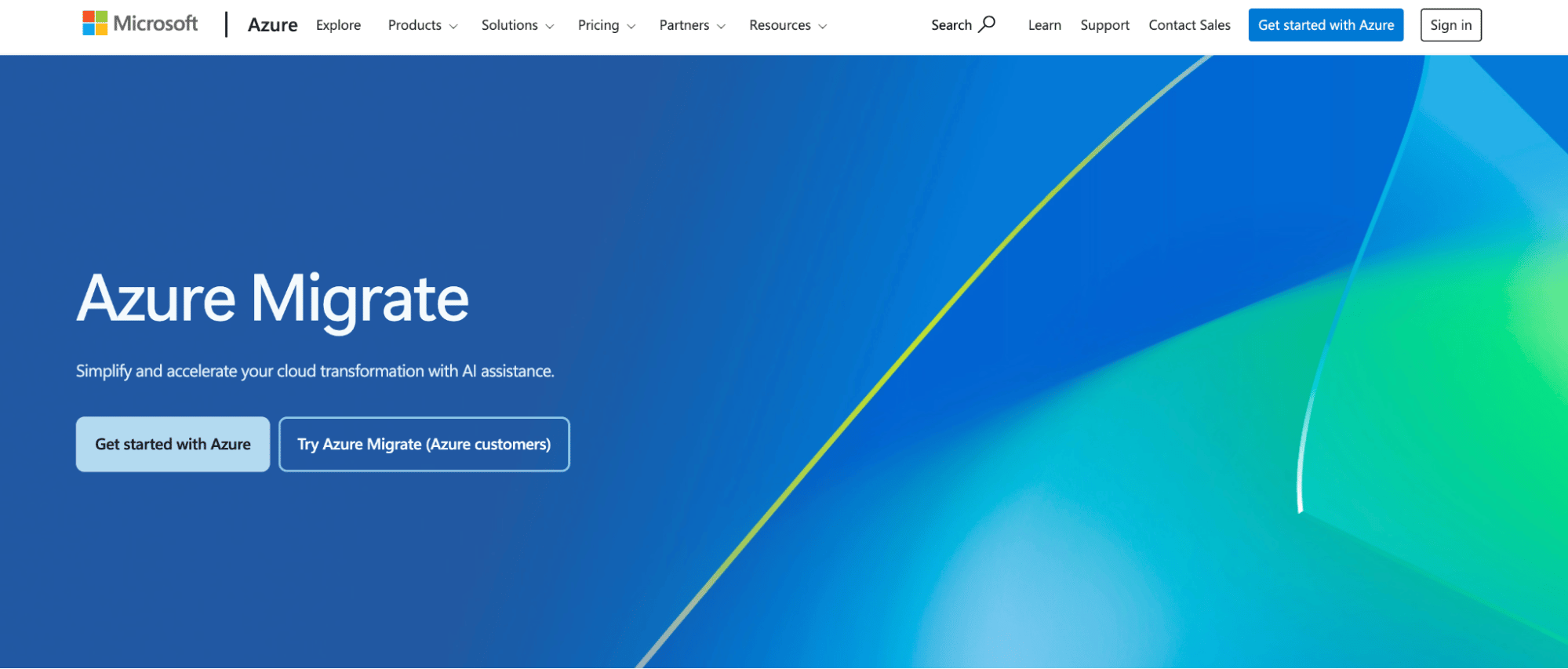
Azure Migrate provides a centralized platform for the discovery, assessment, and migration of on-premises workloads to Microsoft Azure. The platform currently prioritizes the generation of automated business cases, which provide stakeholders with total cost of ownership (TCO) comparisons and sustainability metrics. It uses agentless discovery to inventory existing infrastructure across VMware, Hyper-V, and physical servers without requiring software installation on individual guest systems. The tool tracks the transition of different cloud assets, including databases and web applications, while providing real-time progress monitoring through a unified dashboard. The tool is a standard for Microsoft-centric environments with extensive configuration options and integration with the broader Cloud Adoption Framework.
Azure Migrate key features:
-
Identifies critical server groupings to ensure all related components move together and maintain application performance throughout the transition.
-
Transitions legacy applications directly into managed container services to reduce long-term server management tasks and overhead.
-
Handles the simultaneous move of hundreds of servers to meet tight data center exit deadlines without manual per-machine intervention.
Azure Migrate pricing:
- Free. Use of the migration tool itself is free for the first 180 days per machine, though users are billed for the storage and compute resources consumed during the replication process.
Azure Migrate is built for organizations committed to Azure. If you’re comparing migration options with cost clarity and operational simplicity in mind, see how DigitalOcean approaches cloud infrastructure differently in our guide to DigitalOcean vs. Azure.
2. AWS Application Migration Service with rapid lift-and-shift rehosting
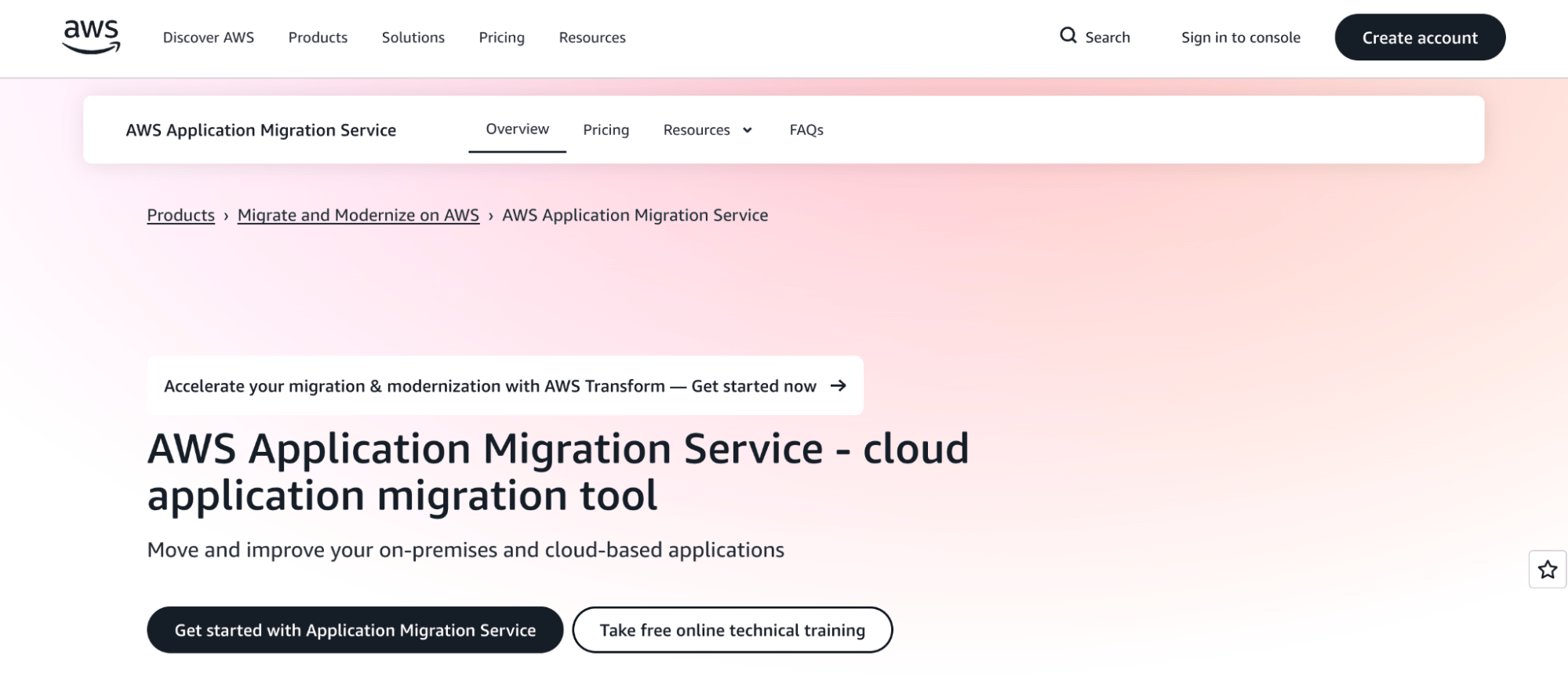
AWS Application Migration Service (MGN) serves as the primary technical tool for rehosting on-premises and cloud-based applications on Amazon EC2. It automates the conversion of source servers from physical, virtual, or other cloud infrastructures to run natively on AWS. The service maintains source server availability during the replication process to minimize operational downtime before the final cutover. Users configure the platform to execute post-migration scripts that automate routine tasks like software updates or security agent installations.
AWS Application Migration Service key features:
-
Consolidates infrastructure across different AWS Regions or accounts to fulfill specific disaster recovery and compliance requirements.
-
Automates modernization steps like security agent installation and instance rightsizing during the move to eliminate manual configuration time.
-
Verifies application stability in an isolated environment before the production cutover to prevent unexpected downtime or data loss.
AWS Application Migration Service pricing:
-
Free. Use of the service is free for 2,160 hours (90 days) per server, though users remain responsible for the costs of the underlying AWS infrastructure consumed during replication and testing.
-
$0.042 per server cost per hour and ~$30 per server cost per month after the free period.
Migrating to the cloud shouldn’t mean inheriting unnecessary complexity. Teams evaluating providers often balance powerful capabilities against operational overhead and cost predictability. If that trade-off matters to you, this AWS vs. DigitalOcean cloud platform guide explores a simple path forward.
3. Google Cloud Migration Tools with support for AI and high-volume data transitions

VMware HCX provides an application mobility platform to migrate virtual machines across hybrid and multi-cloud environments. The software performs large-scale migrations by extending on-premises networks into the cloud to prevent the need for IP address changes. It maintains application connectivity during the transfer to eliminate downtime for complex, multi-tier workloads. Technical teams manage the movement of thousands of virtual machines through automated migration schedules and integrated WAN optimization to reduce bandwidth requirements.
VMware HCX key features:
-
Extends on-premises Layer 2 networks to the cloud to ensure applications keep their original IP addresses and maintain communication with dependent services.
-
Compresses and deduplicates data traffic to speed up transfers across low-bandwidth connections and reduce the time required for data center evacuations.
-
Moves large batches of virtual machines simultaneously using automated scheduling to meet strict project deadlines without manual intervention.
VMware HCX pricing:
- Contact for pricing. Included with VMware Cloud Foundation and VMware vSphere Foundation subscription packages, with costs calculated on a per-core basis.
Cloud-agnostic and multi-cloud migration platforms
These independent solutions offer the flexibility to migrate workloads between various source and target environments, including transferring from one public cloud to another. This category includes tools for executing transfers, as well as observability and governance platforms that monitor performance and cost during the move. These are typically ideal for organizations pursuing a hybrid or multi-cloud strategy to avoid vendor lock-in.
5. AppDynamics with deep forensic monitoring of complex apps for enterprises
AppDynamics (now part of Cisco) provides observability tools to monitor application health before, during, and after a transition to cloud infrastructure. Following the integration with Splunk, the platform provides deeper log analysis and security monitoring to protect data integrity throughout the migration lifecycle. AppDynamics establishes performance baselines to identify the technical requirements of legacy systems before the move. Engineers use the integrated dashboard to compare pre- and post-migration KPIs to verify that the cloud environment meets business objectives.
AppDynamics key features:
-
Establishes clear performance benchmarks of existing on-premises systems to ensure the cloud target is sized correctly for production workloads.
-
Identifies application dependencies and hidden bottlenecks to prevent unexpected outages during the data transfer phase.
-
Validates the financial and technical success of the migration by comparing real-time business KPIs against historical data.
AppDynamics pricing:
- Infrastructure Monitoring - $6/month per CPU core. The entry-tier plan provides basic visibility into servers and containers, though full application and business performance monitoring through the Splunk-integrated suite requires higher-priced enterprise agreements.
6. Datadog with support for startups and mid-market teams using multi-cloud setups
Datadog provides a unified observability and security platform to monitor application performance across hybrid and multi-cloud environments during a transition. The platform maps existing on-premises infrastructure and service dependencies to establish baseline metrics before the move. Teams use real-time dashboards to track the health of migrated workloads against these benchmarks to detect performance regressions immediately and integrated security monitoring identifies vulnerabilities in the new cloud configuration during the deployment phase.
Datadog key features:
-
Visualizes data flow and service interdependencies to ensure critical components remain connected during the transition to a new provider.
-
Retains performance metrics for 15 months to provide long-term historical comparisons that validate the success of the cloud migration strategy.
-
Identifies resource overprovisioning in the new environment to help teams reduce infrastructure costs without sacrificing application uptime.
Datadog pricing:
-
Free. Offers core collection and visualization features, with 1-day metric retention and up to 5 hosts.
-
Pro - $15/host/month. Includes core infrastructure monitoring and over 600 integrations to track server health during a migration.
7. Dynatrace with AI-powered automation for large-scale DevOps teams
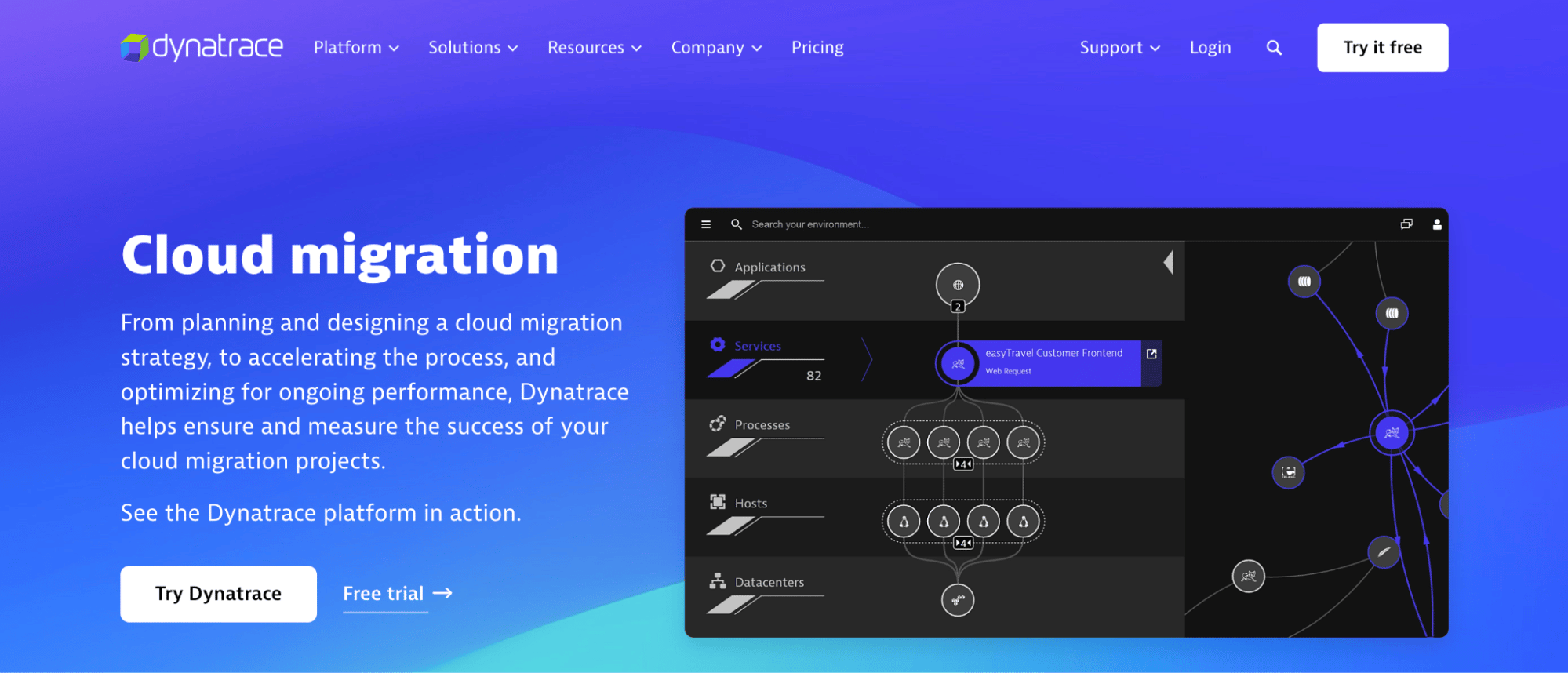
Dynatrace provides a self-service AI-powered observability platform to monitor application performance across hybrid and multi-cloud ecosystems. The platform creates real-time maps of all application components and their relationships to identify the technical requirements of the source environment before a move. Internal DevOps teams use automated root-cause analysis to pinpoint performance bottlenecks before they impact users during the transition phase. Integrated carbon footprint monitoring calculates the environmental impact of shifting workloads to new data centers to meet corporate sustainability goals.
Dynatrace key features:
-
Generates dynamic visualizations of the entire application topology to ensure no hidden dependencies will disrupt the migration sequence.
-
Detects and inventories all microservices automatically to provide immediate visibility into cloud-native architectures without manual configuration.
-
Compares pre- and post-migration response times and error rates to verify that the new infrastructure meets established service level objectives.
- Full-Stack Monitoring - $0.08 per host-hour. Provides end-to-end visibility into applications, infrastructure, and user experience for a standard 8 GiB host.
8. IBM Turbonomic with hybrid cloud capabilities for large enterprises in regulated industries
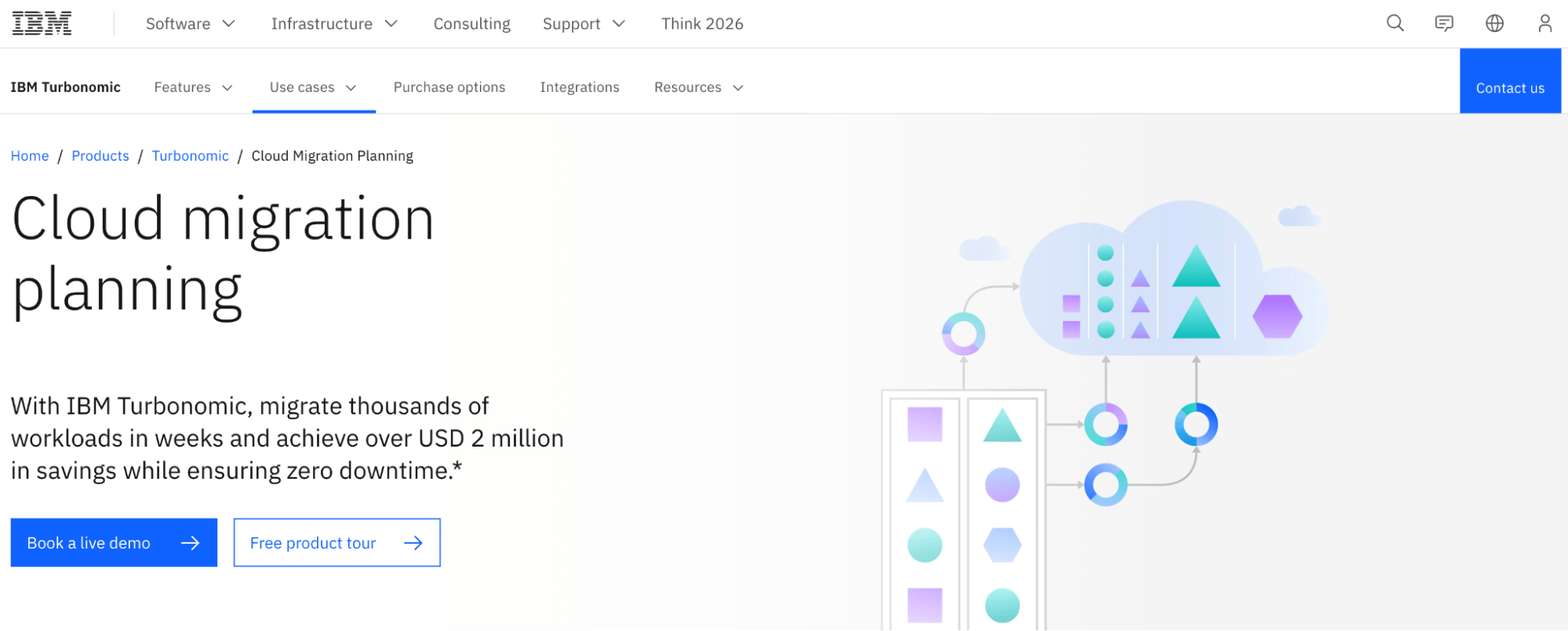
IBM Turbonomic provides an AI-powered resource management platform to automate the planning and optimization of cloud migrations. The platform performs real-time analysis of application resource demands to generate migration plans for hybrid and multi-cloud environments. Organizations also access IBM Cloud Migration Services for hands-on architectural support and managed execution of these technical plans. It identifies cost-saving opportunities by comparing current utilization against cloud provider pricing models and reserved instance discounts.
IBM Turbonomic key features:
-
Generates workload-specific migration strategies that prioritize either cost reduction or performance stability based on specific application requirements.
-
Calculates the financial impact of cloud transitions by factoring in negotiated provider discounts and billing adjustments automatically.
-
Guides technical teams through automated cloud migration workflows to configure different migration scenarios without manual data entry.
IBM Turbonomic pricing:
-
Free trial. Free for 30 days, includes a 30-day evaluation with unlimited optimization of your application resources and cloud costs.
-
Contact for pricing. This enterprise solution requires a custom quote based on the number of managed workloads and the specific level of automation required.
9. OpenText Migrate with any-to-any replication for diverse hardware environments
OpenText Migrate provides a technical platform for replicating physical, virtual, and cloud workloads between disparate infrastructures. The software performs byte-level replication to create an exact copy of the source server on the target environment in real-time. This continuous synchronization keeps data current until the final cutover to prevent operational gaps and data loss. Technical teams execute non-disruptive testing on the target system to verify application readiness while production traffic remains on the original server. The tool supports a wide range of legacy operating systems and any-to-any migration paths.
OpenText Migrate key features:
-
Encrypts data with AES 256-bit protocols during transmission to protect sensitive information while moving across public networks.
-
Synchronizes changes at the byte level to ensure the target environment mirrors the source system exactly before the final switch.
-
Supports migration across diverse hardware and hypervisors including VMware, Hyper-V, and major public clouds to eliminate platform-specific lock-in.
OpenText Migrate pricing:
10. RiverMeadow with automated operating system modernization for enterprises
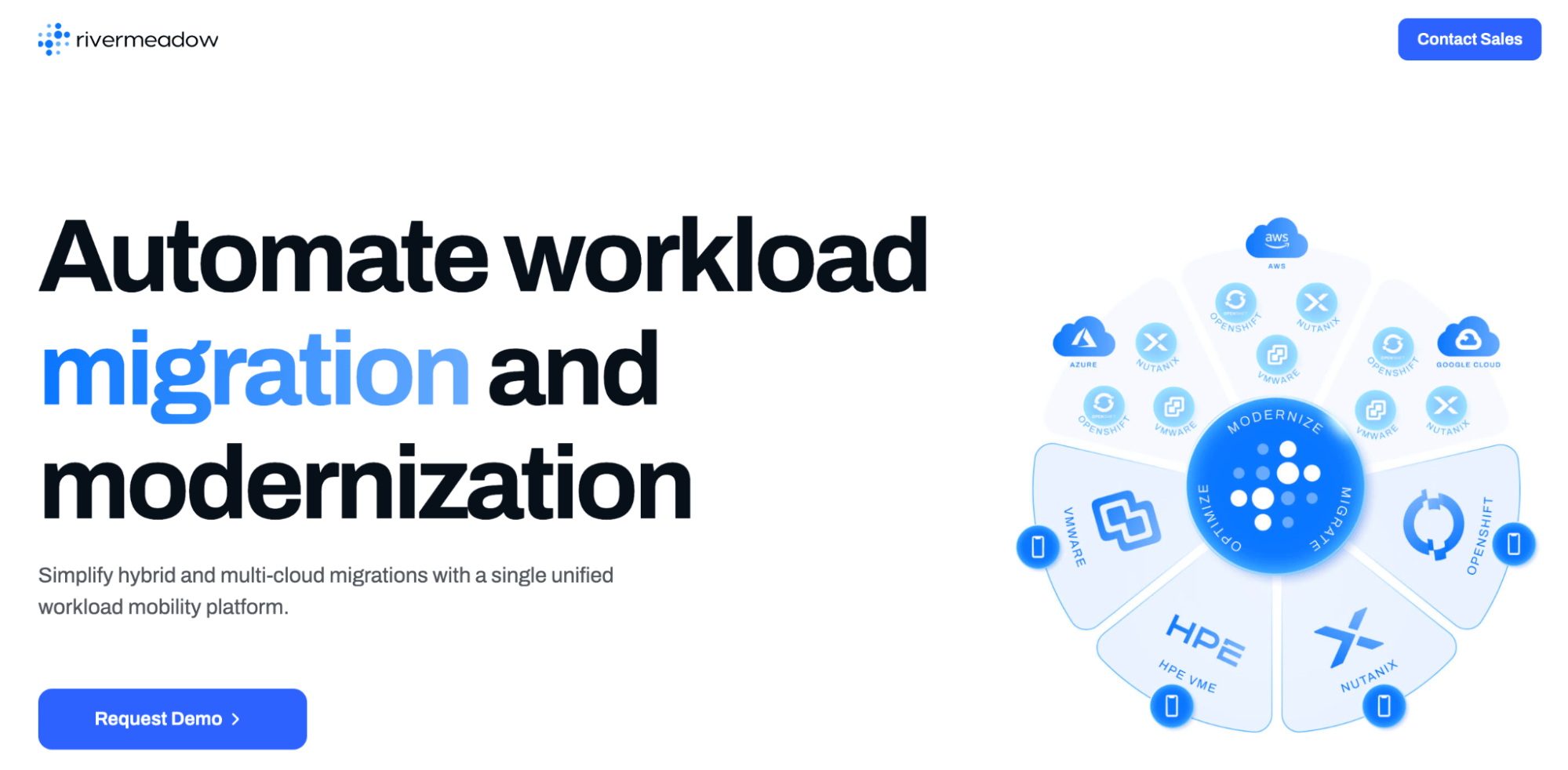
RiverMeadow provides an automated migration platform to move workloads between physical, virtual, and cloud-based environments. The software performs automated operating system upgrades during the migration stream to modernize legacy servers without requiring manual rebuilds. This “In-Place” upgrade capability provides a path for technical teams to address end-of-life Windows or Linux versions during the transition to a new cloud provider. The platform conducts pre-migration checks to verify that source servers meet the technical requirements for the target environment.
RiverMeadow key features:
-
Upgrades outdated operating systems to current versions automatically during the migration process to eliminate the need for separate modernization projects.
-
Conducts non-disruptive testing of the target environment while production systems remain active to verify application stability before the final cutover.
-
Replicates data at the block level to ensure the target environment mirrors the source system exactly and prevents configuration errors.
RiverMeadow pricing:
- Contact for pricing. Potential customers request a custom quote from the sales team based on the specific number of workloads and the required depth of modernization services.
11. CloudBolt with multi-cloud governance for large infrastructure stacks
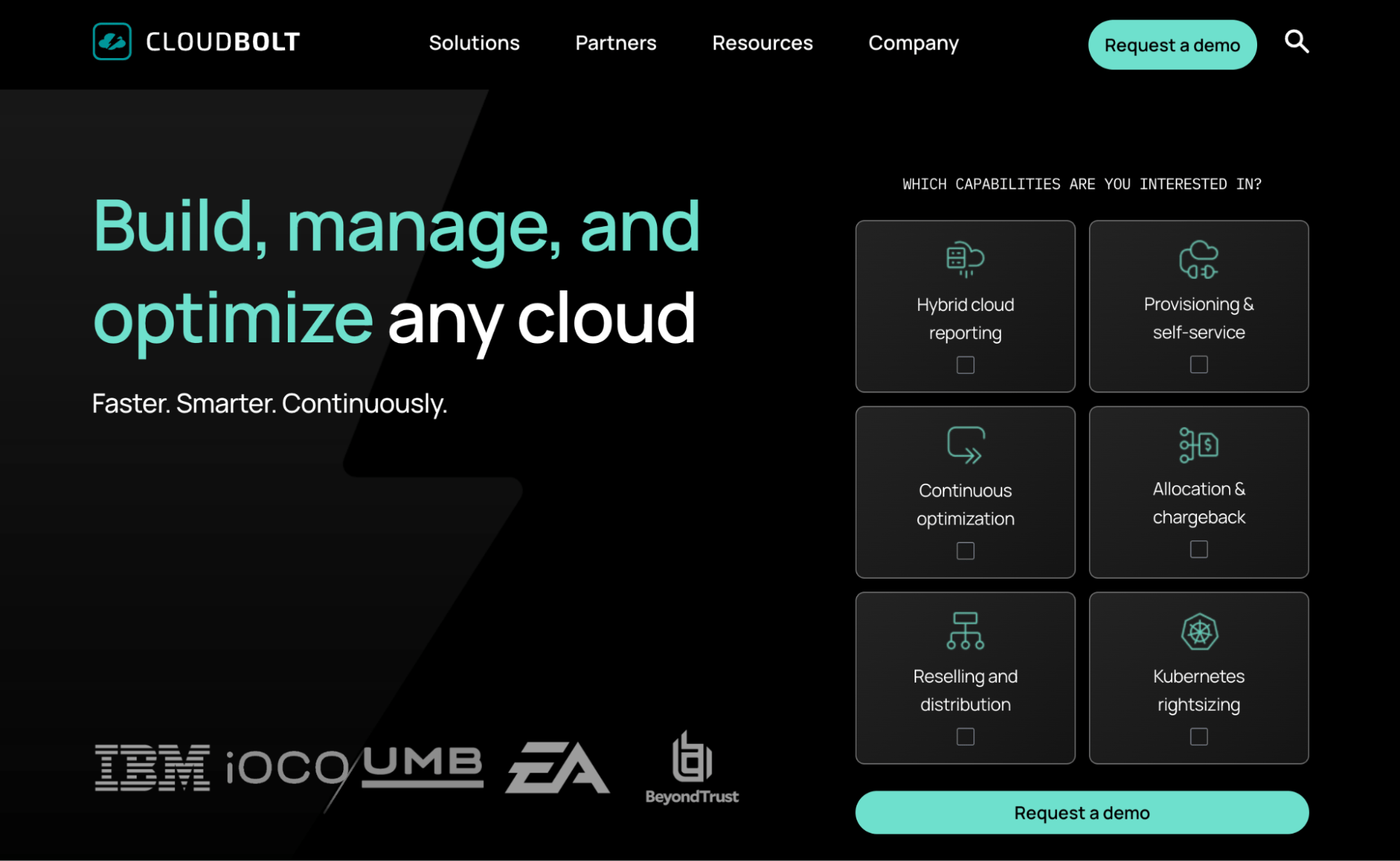
CloudBolt provides a hybrid cloud management platform to oversee resource provisioning and governance across multi-cloud environments. The platform integrates with various hypervisors and public cloud providers to provide a single interface for managing technical assets. It includes FinOps capabilities to track cloud spend and identify budget leaks during the transition between providers. Teams use the integrated orchestration engine to automate the deployment of new infrastructure according to corporate security standards.
CloudBolt key features:
-
Automates the provisioning of cloud resources through pre-defined blueprints to ensure configuration consistency across hybrid environments.
-
Identifies unallocated or overprovisioned resources to provide actionable recommendations for reducing monthly infrastructure costs.
-
Monitors cloud accounts against industry security standards to maintain compliance during and after the migration process.
CloudBolt pricing:
Cloud Migration Tools FAQ
What are the best cloud migration tools for businesses?
The best tools depend on your specific strategy and destination, but leading options include Azure Migrate, AWS Application Migration Service, and Google Cloud Migration Tools for provider-specific moves. For general-purpose observability and data transfer across various platforms, tools like Datadog can be effective.
Which cloud migration tool is best for enterprises?
Enterprises often require high-level automation and deep forensic insights, making platforms like AppDynamics, Dynatrace, and IBM Turbonomic ideal for complex infrastructures. For large-scale virtual machine moves, VMware HCX is generally a standard choice as it extends on-premises networks to the cloud to avoid changing IP addresses. OpenText Migrate is also notable for its ability to perform byte-level replication across diverse hardware and hypervisors.
What is the safest way to migrate to the cloud?
The safest approach combines a phased strategy—moving non-critical systems first—with rigorous pre-migration assessments and non-disruptive dry runs to verify stability. To further assist, providers like DigitalOcean offer white-glove migration support, giving you access to experts who manage the architectural complexity and help ensure a seamless transition.
Are cloud migration tools expensive?
Pricing varies significantly; many major providers like AWS and Azure offer their standard migration tools free for a limited time, though you still pay for the underlying resources consumed. Enterprise-grade observability or automation tools can be more costly, often requiring custom quotes or per-host-hour licensing fees.
Can businesses migrate without downtime?
Yes, many tools facilitate near-zero downtime by using real-time data replication or continuous byte-level synchronization to keep the target system current until the final cutover—the moment you flip traffic from the old environment to the new one. By that point, everything has already been synced and validated, so the switch itself typically takes seconds or minutes with little to no disruption for end users.
Migrate to DigitalOcean for your cloud infrastructure needs
Join the many digital native enterprises and AI startups who rely on DigitalOcean’s dynamic and cost-effective cloud infrastructure. Whether you’re looking for cost savings, improved scalability, or greater efficiency, migrating to DigitalOcean could be the right move for your business. Here’s why:
-
Flexible and scalable infrastructure. DigitalOcean provides a range of services that can grow with your business, including Droplets, Kubernetes, and various storage and networking options.
-
AI/ML offerings. Accelerate your AI workloads with DigitalOcean Gradient™ AI Inference Cloud. Leverage cost-effective GPU Droplets powered by NVIDIA and AMD for training, or use the Gradient Platform to build fully managed AI agents with serverless inference.
-
Transparent pricing and cost-efficient offerings. DigitalOcean offers a simplified pricing structure, helping you predict your expenses and manage your budget more effectively.
-
User-friendly interface. Navigating through your cloud infrastructure has never been easier with DigitalOcean’s intuitive interface. Manage your resources without a steep learning curve.
-
Robust security. DigitalOcean implements advanced security features and protocols that can help protect your business from potential threats.
-
24/7 support and comprehensive documentation. DigitalOcean provides round-the-clock customer support to address your technical queries and concerns. For further learning and understanding, you can delve into our extensive library of documentation, tutorials, and community resources.
-
Cloud migration services. DigitalOcean works with cloud migration experts like CTO.ai, Slower.ai, Crafty Penguins, Stack, Webbar, and GlobalDots to support startups who are considering cloud migration. They can provide you with the tools and expertise necessary to migrate your cloud infrastructure successfully.
With over 280 million users, Tango migrated from Google Cloud to DigitalOcean to optimize costs while maintaining high stability.
Take the leap to DigitalOcean for your cloud infrastructure needs. With our robust services and dedicated support, let us help your organization achieve its technical and business goals. Learn more about migration and speak to a migration expert today.
Any references to third-party companies, trademarks, or logos in this document are for informational purposes only and do not imply any affiliation with, sponsorship by, or endorsement of those third parties.
About the author

Maddy Osman is a Senior Content Marketing Manager at DigitalOcean.
Start building today
From GPU-powered inference and Kubernetes to managed databases and storage, get everything you need to build, scale, and deploy intelligent applications.
