
Deploying an AI model means choosing among three distinct setups: raw GPUs you manage yourself, a managed cloud provider, or a hyperscaler platform. The catch is that none of the tradeoffs show up clearly until the workload is already in production. GPU access that looked available during a demo can end up queued once real traffic hits, and scaling to zero might reintroduce cold starts when latency matters most.
The right cloud for your AI model deployment depends on a decision framework that considers how pricing scales, whether your preferred model formats are supported, and how well the provider’s security and compliance posture aligns with your industry’s requirements. Let’s see how the best AI model deployment tools compare on GPU pricing and key features, so you can pick the one that fits your workload.
Key takeaways:
-
Clouds for AI model deployment range from managed cloud providers with broad compliance coverage to GPU specialists built for raw compute.
-
The right platform reduces setup time and helps pricing scale with actual usage rather than fixed infrastructure spend.
-
Before choosing a cloud provider for model deployment, weigh GPU access and costs, availability of serverless versus dedicated inference, model framework, support, and regional compliance requirements.
-
The best clouds for AI model deployment include DigitalOcean, AWS SageMaker, Google Vertex AI, Azure Machine Learning, Runpod, Modal, Baseten, OVHcloud AI Deploy, Together AI, Fireworks AI, and Hugging Face Inference Endpoints.
Benefits of cloud for AI model deployment
A cloud deployment platform takes care of the heavy lifting behind AI model hosting, from GPU procurement to scaling logic:
-
Faster time to production: Quickly spin up an instance to run a model behind a live endpoint. DigitalOcean Marketplace skips the setup hassle entirely because you can deploy an AI model without touching infrastructure.
-
Access to specialized GPU hardware: GPU cloud providers give on-demand access to high-performance chips like H100s without the need for a separate capital purchase. This GPU access helps teams that require high-end hardware to set up AI workflows.
-
Cost control at scale: Serverless and pay-per-token pricing scale your bill according to actual usage, instead of locking you into a fixed GPU-hour rate. DigitalOcean batch inference offers up to 50% off for workloads that don’t require real-time results.
-
Built-in scaling for serving ML models: Cloud platforms handle traffic spikes, autoscaling, and failover automatically, so your team doesn’t have to build and maintain the infrastructure layer.
-
Compliance and security by default: Providers support SOC 2, popular ISO certifications, and Virtual Private Cloud (VPC) isolation. When certifications and network controls are built in, you can meet regulatory requirements from day one, versus building the controls yourself.
Confused about which inference platform to choose? Compare leading AI inference platforms across model availability, deployment options, performance, and cost.
How to choose the right cloud for your AI model deployment
Picking a cloud for AI model deployment comes down to matching your workload to the right deployment platform. Before you compare GPU cloud providers or lock in an AI deployment framework, consider these factors:
-
If your workload requires guaranteed GPU access at scale, on-demand availability matters more than list price. Queued or rationed GPU access quietly breaks model deployment strategies once you’re running at volume.
-
If you need to move fast without managing infrastructure, serverless cuts operational work but caps your control over hardware and scaling rules; managed inference hands off day-to-day operations while still giving you a say over instance types and configuration. If you want full control, self-managed works, but then you have to own patching, scaling, and uptime.
-
If your app has latency-sensitive or bursty traffic, look closely at how the platform handles spikes and cold starts. Throughput bottlenecks only show up under real production load, which is why this factor gets missed until it’s too late.
-
If your workloads go beyond simple inference, confirm the platform supports the frameworks and model formats you already use, retrieval-augmented generation (RAG) pipelines, agent-serving workloads, and fine-tuning or custom models—so you’re not rebuilding your hosting setup later.
-
If you’re in a regulated industry or handle sensitive data, filter first on data residency and SOC 2, HIPAA, or ISO certifications, and confirm the platform offers VPC or data-isolation controls.
Deploying a model is just the start. Learn how MLOps platforms add monitoring and the ability to roll back changes when needed.
How to deploy your first AI model
Deploying machine learning models for the first time takes a few steps, with options for fast versus more controlled paths, depending on your traffic and requirements:
-
Pick a model: Choose an open-weight model from a catalog, like Llama, Qwen, or DeepSeek. Or bring your own fine-tuned or bring-your-own-model (BYOM) if you need something built for your specific use case.
-
Choose a deployment mode: Serverless works well for quick testing and variable traffic, since you only pay for what you use. Dedicated Inference fits sustained or predictable workloads, where steady performance matters more than flexibility.
-
Get an endpoint running: A one-click deploy, like DigitalOcean 1-Click Models, gets you running fastest with minimal setup. A CLI or API-based deploy takes more steps but gives you more control over configuration.
-
Test the endpoint: Send a first request through an OpenAI- or Anthropic-compatible API call. Confirm the output looks right and check the latency before moving forward.
-
Move to production: Add monitoring for token usage and latency so you can catch problems early. Set up autoscaling or a fallback plan, and know when to graduate from serverless to dedicated capacity as traffic grows.
Once you’re running more than one model, the next bottleneck isn’t compute, it’s picking which model handles which request. Explore the best LLM routers to choose the right option for your AI workload.
Best clouds for AI model deployment
The best clouds for AI model deployment take different approaches to GPU access, AI model hosting, and deployment platform design. Some lean into managed inference APIs, while others offer raw GPU cloud for AI infrastructure.
Pricing and feature information in this article are based on publicly available documentation as of August 2026 and may vary by region and workload. For the most current pricing and availability, please refer to each provider’s official documentation.
This article, including comparisons, characterizations (such as regional footprint, ease of use, or competitive positioning), and “best for” information, reflects an opinion based solely on publicly available third-party commentary and user experiences shared in public forums. It does not constitute verified facts, comprehensive data, or a definitive assessment of the service.
| Provider | Best for* | Key features | Pricing |
|---|---|---|---|
| DigitalOcean | AI-native enterprises running inference and agentic workloads in production | 70+ models behind one OpenAI-compatible key; BYOM support for fine-tuned weights; zero data retention by default | Serverless: ~$0.05-$10/1M input tokens; ~$0.05-$50/1M output tokens; GPU: Starts at $4.41/GPU hour for H100 |
| Runpod | Scaling GPU capacity across the community and serverless tiers | Three capacity tiers under one account; multi-node clusters up to 64 H100s; shared network volumes | GPU: Starts at $2.69/GPU-hour for H100 (bills by worker execution time, not per token) |
| Modal | Running Python-native serverless GPU workloads | Scale-to-zero with 1,000+ GPU bursts; sub-second cold starts; parallel batch processing via .map() | GPU: Starts at ~$3.95/GPU-hour for H100 (bills per second, not per token) |
| Baseten | Serving compliance-focused open-weight models | Chains SDK for multi-model pipelines; multi-node fine-tuning; self-hosted and hybrid (BYOC/VPC) deployment | Serverless: ~$0.20-$3.00/1M input tokens; ~$1.20-$15.00/1M output tokens; GPU: Starts at $3.75/GPU hour for H100 |
| OVHcloud AI Deploy | Hosting containerized models on European sovereign infrastructure | Rolling upgrades, restricted access endpoints; remote storage bucket mounting | GPU: Starts at ~$2.99/GPU hour for H100 (billed by GPU-hour and vCPU-hour, not per token) |
| Together AI | Fine-tuning and serving open-source models at scale | Async Batch API for 30B tokens per job; LoRA, full fine-tuning, and DPO tuning; Code Sandbox for agentic workloads | Serverless: ~$0.10-$9/1M input tokens; ~$0.10-$3.00/1M output tokens; GPU: Starts at $6.49/GPU hour for H100 |
| Fireworks AI | Fast serving of open-weight models without a surrounding cloud | Fireworks Nexus routes coding-agent traffic; managed reinforcement fine-tuning; Eval Protocol for agent scoring | Serverless: ~$0.10-$1.74/1M input tokens; ~$0.20-$4.40/1M output tokens; GPU: Starts at $7.00/GPU hour for H100 |
| Hugging Face Inference Endpoints | Deploying a Hugging Face Hub model directly to a production endpoint | Three built-in endpoint security profiles; CPU-to-H200 hardware range; automatic vLLM/SGLang serving engine pairing | Serverless: $9/month, 20× included inference allowance; GPU: Starts at $4.50/GPU hour for H100 |
| AWS SageMaker | Running enterprise ML pipelines inside the AWS environment | Shadow deployments for safe traffic validation; multi-model and multi-container endpoints; automated batch transform | Serverless: ~$0.0000200-$0.0001200/second, scaling based on RAM tier; GPU: Starts at $2.58/GPU hour for ml.p5.4xlarge (1x H100) |
| Google Vertex AI | Building on Gemini and open models across a full ML lifecycle platform | Traffic-splitting canary rollouts; native NVIDIA GPU and TPU support; automated drift monitoring | Serverless: ~$0.075-$2.00/1M input tokens; ~$0.30-$12.00/1M output tokens; GPU: Starts at $3.69/GPU hour for H100 |
| Azure Machine Learning | Deploying models inside a Microsoft-centric enterprise stack | Blue/green deployment; Prompt Flow visual workflow builder; native Azure OpenAI and Entra ID integration | Serverless: ~$0.075-$15.00/1M input tokens; ~$0.30-$60.00/1M output tokens; GPU: Starts at $1.40/GPU hour for H100 |
-
DigitalOcean for AI-native enterprises running inference and agentic workloads in production

DigitalOcean AI-Native Cloud combines infrastructure, core cloud services, and the Inference Engine into a single integrated stack. Inference Router uses a purpose-built routing model to send each incoming request to the right model from a pool you define, based on the task’s needs. Inference Router is cache-aware, meaning it preserves context across agentic sessions via X-Model-Affinity. DigitalOcean provides access to 70+ open and multimodal models with a single OpenAI-compatible key. It also supports importing fine-tuned weights from Hugging Face via bring-your-own-model (BYOM), and integrates AI inference with Managed Databases and multi-agent workflows.
DigitalOcean key features:
-
The Inference Router’s routing model resolves task intent in ~200 milliseconds. In benchmarks published by Katanemo (acquired by DigitalOcean), it beat both GPT-5.1 and Claude Sonnet 4.5 on routing accuracy. That speed and accuracy mean requests reach the right model automatically, with minimal added latency. Results may vary based on the dataset, prompts, model versions, configuration, scoring methodology, and evaluation date.
-
Built-in performance boosters like speculative decoding, custom vLLM forks, and a tuned KV-cache to help reduce response times.
-
Zero data retention by default for DigitalOcean-hosted serverless models and VPC-restricted model access keys.
-
Serverless: ~$0.05-$10/1M input tokens;~$0.05-$50/1M output tokens
-
GPU: Starts at $4.41/GPU hour for H100
The 200-millisecond routing benchmark is not a one-off. Explore the latest additions in what’s new on Inference Engine.
GPU cloud and serverless compute platforms
Raw or dedicated GPU infrastructure suits teams handling their own machine learning deployment who want GPU cloud for AI without complete managed services. You pick the hardware, package the model, and control the runtime. The tradeoff for that control is that self-hosted AI model deployment means owning more of the stack than you would with a managed provider.
-
Runpod for scaling GPU capacity across the community and serverless tiers
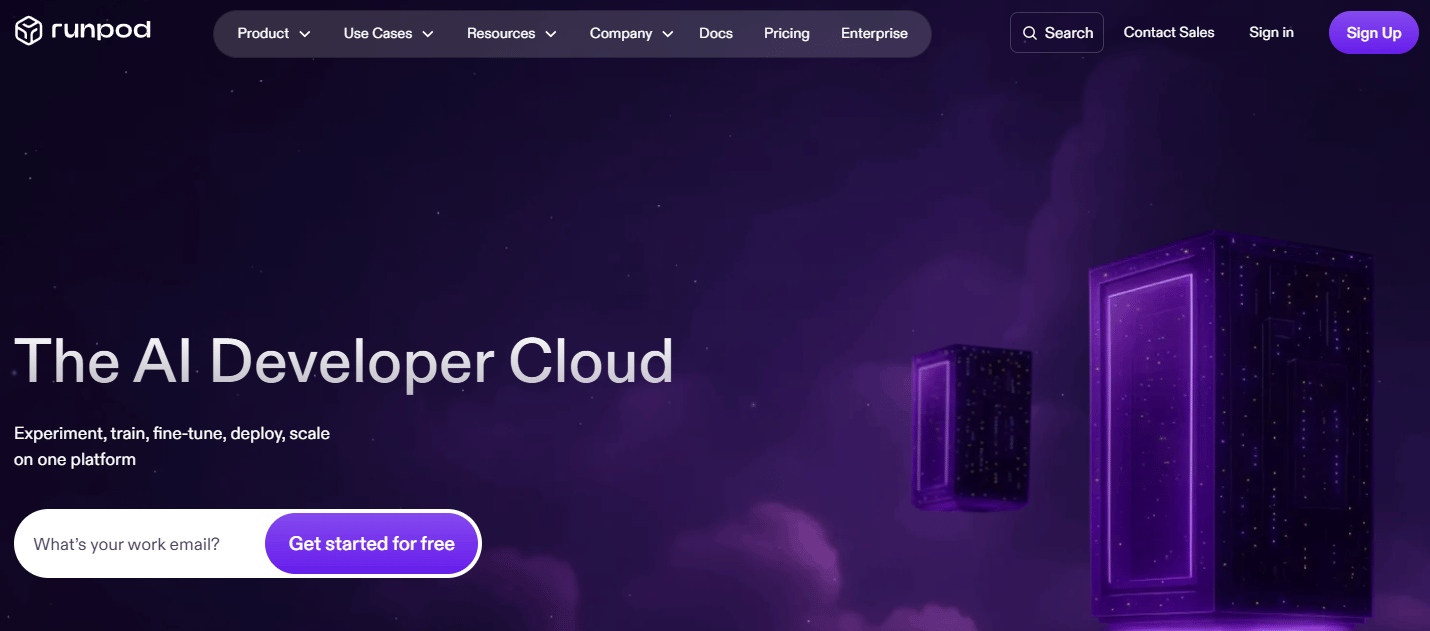
Runpod is a GPU cloud built for AI inference and training. It splits GPU capacity into three tiers under one account: peer-hosted Community Cloud for the lowest cost without SLA backing, Runpod-operated Secure Cloud for SLA-backed capacity, and a Serverless tier built to auto-scale with cold starts for latency-sensitive traffic. Network volumes are shared across Pods, Serverless endpoints, and Instant Clusters, helping models load faster regardless of which compute option runs them. The tradeoff is that provisioned capacity keeps billing whether or not it’s actively serving traffic, which might inflate costs.
Runpod key features:
-
Custom architecture to minimize cold-start overhead for containerized workloads to boot from a dead stop to active serving in sub-200ms.
-
Load-balanced serverless endpoints expose custom HTTP APIs for real-time inference, with built-in retries.
-
Private container registry support (e.g., AWS ECR) for custom Docker image deployment.
Runpod does not bill per token. The Serverless charges are based on worker execution time (GPU/CPU/RAM time per second).
- GPU: Starts at $2.69/GPU-hour for H100
Provisioned capacity billing, whether it’s serving traffic or not, is the kind of leak that adds up fast on Runpod. If utilization monitoring is not something your team wants to own, weigh it against Runpod alternatives.
-
Modal for running Python-native serverless GPU workloads
Modal is a Python-native serverless GPU platform. Developers write a Python function, decorate it with the desired GPU type, then Modal handles the container build and scheduling behind it. Modal offers secured sandboxes to run untrusted code with distributed multi-GPU support. Note that Modal lacks out-of-the-box support for complex custom VPCs, private enterprise networks, and advanced hardware-level isolation.
Modal key features:
-
“Scale-to-Zero" autoscaling with instant bursts from 0 to over 1,000+ GPUs to handle a sudden traffic spike, then immediately drops back down to zero when work is completed.
-
Sub-second cold starts for both GPU workloads and model initialization.
-
Supports parallel batch processing through .map() declarations to distribute heavy data using Python commands.
Modal bills for infrastructure usage by the second, based on active compute time—not standard per-token input/output pricing.
- GPU: Starts at ~$3.95/GPU-hour for H100
Sub-second cold starts are fine until you need a custom VPC or enterprise-grade network isolation, which Modal doesn’t support. Explore Modal alternatives to find the best fit for your AI model deployment.
-
Baseten for serving compliance-focused open-weight models

Baseten is built around Truss, an open-source framework for packaging model code and hardware configuration into a deployable inference server. It holds SOC 2 Type II, HIPAA, GDPR, PCI DSS, and SOC 3 certifications. Baseten’s model catalog sticks to open-weight options only, with no access to frontier models. As a result, teams that need both open and closed frontier models end up managing separate vendors—and separate invoices.
Baseten key features:
-
Deployment options span Baseten’s own cloud, self-hosted infrastructure, and hybrid setups.
-
Chains SDK orchestrates multi-model pipelines (such as voice AI, agents, and RAG) with independent per-step scaling.
-
Baseten Training supports multi-node fine-tuning that promotes directly to production endpoints.
-
Serverless: ~$0.20-$3.00/1M input tokens; ~$1.20-$15.00/1M output tokens
-
GPU: Starts at $3.75/GPU hour for H100
Baseten’s catalog is open-weight only, so you can’t run GPT or Claude models through it when a project requires using a closed frontier model. Compare that tradeoff against other top Baseten alternatives.
-
OVHcloud AI Deploy for hosting containerized models on European sovereign infrastructure

OVHcloud AI Deploy is a Container-as-a-Service (CaaS) platform for hosting and serving machine learning models. Workloads stay on infrastructure governed by GDPR, ISO 27001, and HDS (healthcare data hosting) rules with a strong European presence. But it also means teams deploying closer to regions outside Europe may find OVHcloud’s regional footprint thinner than competitors with a more global presence.
OVHcloud AI Deploy key features:
-
Containers mount remote object storage buckets for datasets or model weights, and pull code from a designated Git repository at initialization.
-
Restricted access endpoints require a custom-generated security token, which means only authorized clients can query a deployed model.
-
Rolling upgrades swap a live application’s container image for a newer version.
OVHcloud AI Deploy is container-based, so you package a model into a container, and OVHcloud runs it. Pricing is billed by GPU-hour and vCPU-hour and not by token.
- GPU: Starts at ~$2.99/GPU hour for H100
European data sovereignty is a real strength, but bring-your-own-container-only means no hosted model catalog and no one-click deploy. Explore platforms that solve both in our guide to OVHcloud alternatives.
-
Together AI for fine-tuning and serving open-source models at scale

Together AI is a GPU cloud built around open-source and custom models, founded in 2022 by a team of Stanford ML and systems researchers. Together Inference Engine uses FlashAttention-3 kernels and speculative decoding for AI model workflows. Note that the Together AI catalog is open-weight only, and it doesn’t ship a task-aware router that picks a model per request, so that logic has to live in the application code.
Together AI key features:
-
Offers Low-Rank Adaptation (LoRA) and fine-tuning, with support for multi-node model training above 100B parameters.
-
Async batch API processes up to 30 billion tokens per model.
-
Code sandbox interpreter for running isolated agentic workloads.
-
Serverless: ~$0.10-$9/1M input tokens; ~$0.10-$3.00/1M output tokens
-
GPU: Starts at $6.49/GPU hour for H100
Tired of Together AI limitations? Our guide to Together AI alternatives covers providers built as a single, integrated stack—no stitching required.
-
Fireworks AI for fast serving of open-weight models without a surrounding cloud

Fireworks AI was built by Meta’s PyTorch group and serves 400+ open-source and multimodal models. FireAttention technology features hand-written CUDA kernels and quantization schemes to maximize speed without degrading model quality. FireOptimizer ties training decisions to application-level KPIs. Fireworks AI model catalog is open-weight only, with no frontier closed models. Fireworks AI focuses on the model layer, leaving databases, storage, and the rest of your application infrastructure to a separate provider.
Fireworks AI key features:
-
Fireworks Nexus routes coding-agent traffic across AI coding tools like Claude Code.
-
Fireworks RFT offers managed reinforcement fine-tuning for models like DeepSeek and Kimi.
-
Eval Protocol scores agents from production traces with prebuilt integrations for AWS AgentCore.
-
Serverless: ~$0.10-$1.74/1M input tokens; ~$0.20-$4.40/1M output tokens
-
GPU: Starts at $7.00/GPU hour for H100
Can your provider handle storage, databases, and agent tooling? Compare the best Fireworks AI Alternatives for your next AI workflow.
-
Hugging Face Inference Endpoints for deploying a Hugging Face Hub model directly to a production endpoint

Hugging Face Inference Endpoints is a managed platform that turns any public, gated, or private model on the Hugging Face Hub into a production REST API. You can call the API directly, without setting up your own serving infrastructure. Hugging Face provisions the endpoint inside a developer-chosen provider like DigitalOcean. Dynamic autoscaling adds replicas under load, with the option to substitute a fully custom Docker container for model pre-processing. Hugging Face runs endpoints on top of other cloud providers, which might add a layer of operational overhead.
Hugging Face Inference Endpoints key features:
-
Endpoints ship with three built-in security profiles: Public (open to any internet request, no authentication needed), Protected (a Hugging Face access token required in request headers), and Private (routes traffic through intra-cloud networking).
-
Injects a custom ‘handler.py’ Python script to customize request payloads and combine multiple models into a single endpoint pipeline.
-
Deployments automatically pair a model with an optimized serving engine, either Text Generation Inference or vLLM, and SGLang for high-throughput multi-user serving.
Hugging Face Inference Endpoints pricing:
Hugging Face does not charge per-million input/output token ranges. They offer a unified, subscription-backed flat token fee:
-
Serverless: $9/month; Credits your account with a 20× included serverless inference allowance
-
GPU: Starts at $4.50/GPU hour for H100
Always-on endpoints bill by the hour, so the same GPU tier can cost a premium depending on where it’s hosted. Learn more about how the economics compare in the Hugging Face vs.Replicate article.
Hyperscaler cloud deployment platforms
AWS, Google Cloud, and Microsoft Azure are the three providers commonly referred to as “hyperscalers” in AI cloud hosting. Like DigitalOcean, each folds artificial intelligence deployment into a much larger stack of compute and networking services. Scale is the draw—companies already running workloads on one of these GPU cloud providers can deploy models without contracting with a new vendor. But picking a cloud for AI model deployment this way also means inheriting that provider’s broader pricing structure and learning curve.
-
AWS SageMaker for running enterprise ML pipelines inside the AWS environment

Amazon SageMaker is a managed machine learning model deployment platform within the AWS ecosystem. SageMaker JumpStart offers one-click deployment for 250+ foundation models. Multi-model and multi-container endpoints host distinct models on a single compute instance. Billing is spread across many separate meters, including the deployment region, data transfer, computer instance-hours, and storage. Reviewers describe “zombie resources” (an endpoint gets deleted, but its attached volumes or elastic inference accelerators keep billing) as a recurring source of unexpected AWS bill shock.
AWS SageMaker key features:
-
Real-time Inference endpoints support shadow deployments—routing a slice of live traffic to a new model version is validated before a full rollout.
-
Centralized Model Registry tracks which model version is deployed to which endpoint and simplifies rollback if a new version misbehaves.
-
Batch transform reads input data, runs it through the model, writes the results to Amazon S3, and automatically shuts down compute once the job completes.
Serverless inference does not directly meter token counts. It bills per millisecond based on the amount of memory allocated to your compute slot. SageMaker deploys dedicated NVIDIA H100 GPUs using the P5 instance line.
-
Serverless: ~$0.0000200-$0.0001200/second, scaling based on RAM tier selections
-
GPU: Starts at $2.58/GPU hour for ml.p5.4xlarge (1x H100)
If per-meter pricing across compute, storage, and data transfer is giving you budget anxiety, explore AWS alternatives.
-
Google Vertex AI for building on Gemini and open models across a full ML lifecycle platform
Google Vertex AI is managed by Google Cloud Platform (GCP), covering the full machine learning lifecycle. Predictions run through three paths: Online Prediction serves real-time web or mobile requests, Batch Prediction handles high-volume workloads by processing huge datasets in bulk, and Model Garden serves as the launching pad for the enterprise workflow. Vertex AI Model Registry tracks rollback if a new deployment misbehaves. GCP pricing for long-running training jobs can be complex and, as a result, hard to estimate in advance.
Google Vertex AI key features:
-
Vertex AI Search and Conversation connects enterprise data directly into Gemini for RAG without a separately built retrieval pipeline.
-
Security runs through GCP Identity and Access Management (IAM) with customer-managed encryption keys.
-
Online Prediction endpoints support traffic splits for canary rollouts and connect natively to both NVIDIA TPUs and GPUs.
-
Serverless: ~$0.075-$2.00/1M input tokens; ~$0.30-$12.00/1M output tokens
-
GPU: Starts at $3.69/GPU hour for H100
Vertex AI pricing can be hard to estimate. Learn more about how costs and complexity stack up in our guide comparing DigitalOcean vs.Google Cloud Platform.
-
Azure Machine Learning for deploying models inside a Microsoft-centric enterprise stack

Azure Machine Learning is a managed platform for machine learning model deployment across the MLOps lifecycle. AI models are deployed in two endpoint types: Managed Online Endpoints (HTTP webhooks backed by managed virtual machines), and Batch Endpoints (fires on demand and process data in parallel). Managed Online Endpoints support blue-green deployment, splitting a small percentage of traffic to a new model version to test stability before a full rollout. Azure Machine Learning splits usage across separate meters and regions. As a result, costs might be hard to track and can grow unpredictably.
Azure Machine Learning key features:
-
Native integration with Azure OpenAI Service, Microsoft Entra ID, and Power BI.
-
Prompt Flow adds a visual workflow tool for evaluating and deploying generative AI and LLM-based application graphs as a single production endpoint.
-
Model Registry records which model version is deployed to which endpoint, and which training dataset is used.
Azure Machine Learning pricing:
Azure provides NVIDIA H100 GPUs through two VM tracks: NCads v5 series and NDv5 series.
-
Serverless: ~$0.075-$15.00/1M input tokens; ~$0.30-$60.00/1M output tokens
-
GPU: Starts at $1.40/GPU hour for NCads H100 v5 Series
Between separately metered Azure bills and the Foundry rename forcing SDK migrations, Azure ML’s true cost goes well past the sticker price. Break down where that spending goes in our guide to why Azure gets expensive.
Best cloud for AI model deployment FAQs
What is AI model deployment?
AI model deployment is the process of making a trained model available to handle real requests. The process involves selecting infrastructure, choosing between serverless and dedicated capacity, and setting up monitoring so that the model holds up under real traffic. DigitalOcean handles most of the operational overhead, pairing GPU compute and inference with Managed Databases for production applications.
Where can I deploy an AI model?
You can deploy an AI model on any cloud provider, depending on your application needs: from hyperscalers like AWS and Google Cloud, to GPU specialists like Runpod or Modal, to managed inference APIs like Together AI or Fireworks. DigitalOcean is free of hyperscaler complexity, combining GPU compute and storage under a single account, so you don’t have to stitch those pieces together.
What is the best inference provider for AI startups?
Because early-stage teams rarely have dedicated infrastructure engineers on staff, startups benefit from working with a provider that combines serverless pricing, a broad model catalog, and low setup overhead. DigitalOcean helps with 1-Click Models and serverless inference, along with the databases and storage an app needs to run in production.
Which inference platform is HIPAA-eligible and SOC 2 compliant out of the box?
DigitalOcean GPU Droplets are SOC 2 compliant and HIPAA-eligible under a signed Business Associate Agreement (BAA), with enterprise-grade SLAs built in. Baseten also holds SOC 2 Type II and HIPAA certifications, but its catalog is open-weight only. As a result, if you need access to closed-frontier models, you must manage a second vendor and a second bill.
Which cloud provider offers AI inference plus compute, storage, networking, and databases in one platform?
DigitalOcean pairs Serverless, Dedicated, and Batch Inference with GPU compute, Managed Databases, storage, and networking under one bill. That helps avoid the cross-vendor egress and integration work that comes standard with using separate inference and infrastructure providers.
Where can I deploy a Hugging Face model to a production GPU endpoint quickly?
With Hugging Face Inference Endpoints, you get to deploy any model from the Hub directly, provisioning the endpoint on a cloud provider of your choice. DigitalOcean BYOM supports importing fine-tuned Hugging Face weights into GPU Droplets or Dedicated Inference without going through the Hugging Face endpoint layer.
Deploy and scale AI models with DigitalOcean
DigitalOcean AI infrastructure brings compute and networking for your applications into a single account. Instead of stitching together a separate inference API and storage from different vendors, deploy on a single platform with a single bill and a single support team.
Workato and Character.ai deploy and scale their AI models on DigitalOcean, which includes:
-
70+ open and multimodal models behind a single OpenAI-compatible key, with frontier models like GPT and Claude proxied through the same endpoint
-
Serverless, Dedicated Inference, and Batch Inference paired with Managed Databases in one account
-
Managed Agents Runtime Services (M.A.R.S.), now in Private Preview, for running coding agents and long-running agentic workflows without building the execution and tool-access layer yourself
-
BYOM support for importing your own fine-tuned weights from Hugging Face
-
Zero data retention by default on hosted serverless models, VPC-restricted access keys, and private Dedicated Inference endpoints
About the author

Sujatha R is a Technical Writer at DigitalOcean. She has over 10+ years of experience creating clear and engaging technical documentation, specializing in cloud computing, artificial intelligence, and machine learning. ✍️ She combines her technical expertise with a passion for technology that helps developers and tech enthusiasts uncover the cloud’s complexity.
Start building today
From GPU-powered inference and Kubernetes to managed databases and storage, get everything you need to build, scale, and deploy intelligent applications.
